





shopper spends twenty minutes on your product page. They zoom into every photo. They read your shipping policy twice. Then they close the tab.
Nothing was wrong with the product. The price was a bigger decision than they were ready to make that day. Merchants read that as a pricing problem. It is usually a timing problem.
The gap is wide. Baymard Institute puts the average documented cart abandonment rate at 70.22%, across 50 studies. The same research found that 42% of US shoppers abandon a cart because they are not ready to buy yet.
Shopify partial payment apps work on that moment. A customer commits with a deposit now and pays the rest later. Below are five apps merchants use, drawn from their review histories.
Key Takeaways
- A deposit shrinks the first decision, unlocking high-ticket orders.
- Choose by how the balance arrives: auto-charge, invoice, or cash on delivery.
- Lead times, made-to-order goods, and bookings are the strongest fits.
- In COD markets, a small advance is mainly a return-to-origin control.
- Pricing differs: flat tiers, order-value caps, and processing fees.
Shopify Partial Payment Apps Compared
Listings tell you what each tool claims. The table below comes from the full review histories, showing how merchants use these apps and how long they stay.
| App (by company) | Merchant clusters | Strongest observed use case | How the balance arrives |
| Downpay: Partial Pay & Deposit by Downpay | US, UK, Canada, Australia, Japan | Made-to-order goods, long lead times | Auto-charge, invoice or manual |
| DP: Deposit & Partial Payment by TAG Apps | Saudi Arabia, UK, Poland | First-time deposit sellers | Auto-charge on a set due date |
| SPD Split Payment & Deposit by FINLOOP SOLUTIONS LLC | US, UK, EU, Japan, Latin America | High-ticket 50/50 splits, course tuition | Auto-collection or final invoice |
| Partialy: Partial COD Payment by NxtSphere Tech | India, UAE, Pakistan, Bangladesh | COD advance to cut return-to-origin | Cash on delivery at the door |
| Deposit & Partial Payment Depo by Sidepanda Services LLP | US, India, UK, Australia | Online, POS and draft orders | Balance request or branded invoice |
Tenure reflects the longest continuous use visible in each review history.
Top 5 Shopify Partial Payment Apps
1. Downpay: Partial Pay & Deposit
By Downpay | Built for Shopify
Downpay: Partial Pay & Deposit by Downpay is built for orders where the product is not ready yet: custom furniture, made-to-order bicycles, event bookings. The customer pays a deposit through Shopify’s native checkout, and the card stays on file.
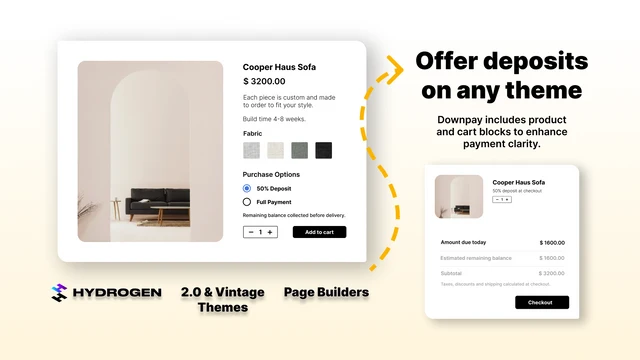
The balance can be auto-charged, invoiced, or collected manually. Due dates can follow a real event date instead of the order date, which matters for weddings and travel. It is Built for Shopify.
Key Features
- Percentage or fixed deposits, including 50/50 and 20/80 splits
- Due dates tied to a real event date, not the purchase date
- Card kept on file, so balances clear without chasing customers
- Fits older themes, custom builds, page builders and headless setups
- Deposits switched on for selected products, not the whole catalogue
- Pre-authorisation holds, with several deposit groups running at once
- Changelog published regularly since its 2023 launch
Ratings and reviews: 5.0 stars from 98+ reviews, 99% of them five stars.
Best for: Custom, made-to-order, or high-value items with real lead times.
Pricing: Essentials $29, Standard $49, Pro $99, and Scale $249 per month, tiered by order value from $5,000 to $100,000. 7-day free trial.
Use it wisely: Plans are capped by order value, so map your deposit volume first. Keep deposits on products with a genuine lead time. On an in-stock item, a second payment step costs more than it saves.
2. DP: Deposit & Partial Payment
By TAG Apps | Also branded Depositly
DP: Deposit & Partial Payment by TAG Apps lets a customer pay a percentage or a fixed deposit at checkout. Orders can be split into instalments or shared between people, each of whom pays by emailed invoice.
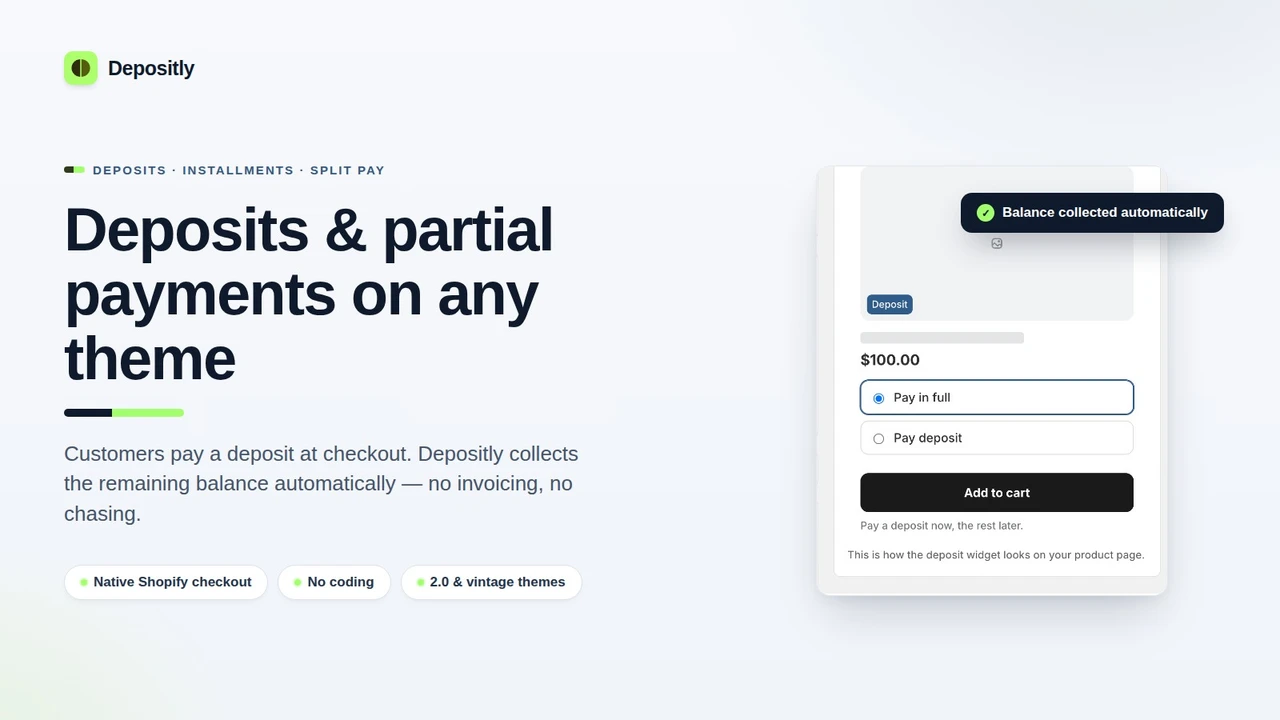
The balance is charged automatically to the saved card when due. Due dates can be a set date, days after checkout, or the moment you fulfil. Reminders, pay-in-full discounts and quantity caps are available.
Key Features
- Done-for-you configuration once access is granted, often live within hours
- New functionality built on request, including a cash-on-delivery flow
- Existing features reshaped to match how a business operates
- Step-by-step guided onboarding through each stage of setup
- Settings screen readable without opening documentation first
- Runs alongside existing store setups without reported conflicts
- Help centre documentation detailed enough to self-serve
Ratings and reviews: 5.0 stars from 26+ reviews, all five stars. The listing launched in July 2026, so the review base is young.
Best for: First-time deposit sellers who want setup handled for them.
Pricing: Free plan covering deposits, split payments, group pay, balance collection, reminders, and a customer portal. Pro is $15/month plus $3 per $1,000 of deposit value above $5,000, capped at $299/month. 14-day trial.
Use it wisely: Group pay suits shared gifts and team purchases, but only works when every payer acts. If one stalls, the order sits unfulfilled. Set a firm due date and reminders.
3. SPD Split Payment & Deposit
By FINLOOP SOLUTIONS LLC | Built for Shopify
SPD Split Payment & Deposit by FINLOOP SOLUTIONS LLC bundles four payment behaviours into one app. Take a deposit with the balance due later, pay one order with two methods, share a payment, or divide a total into instalments.
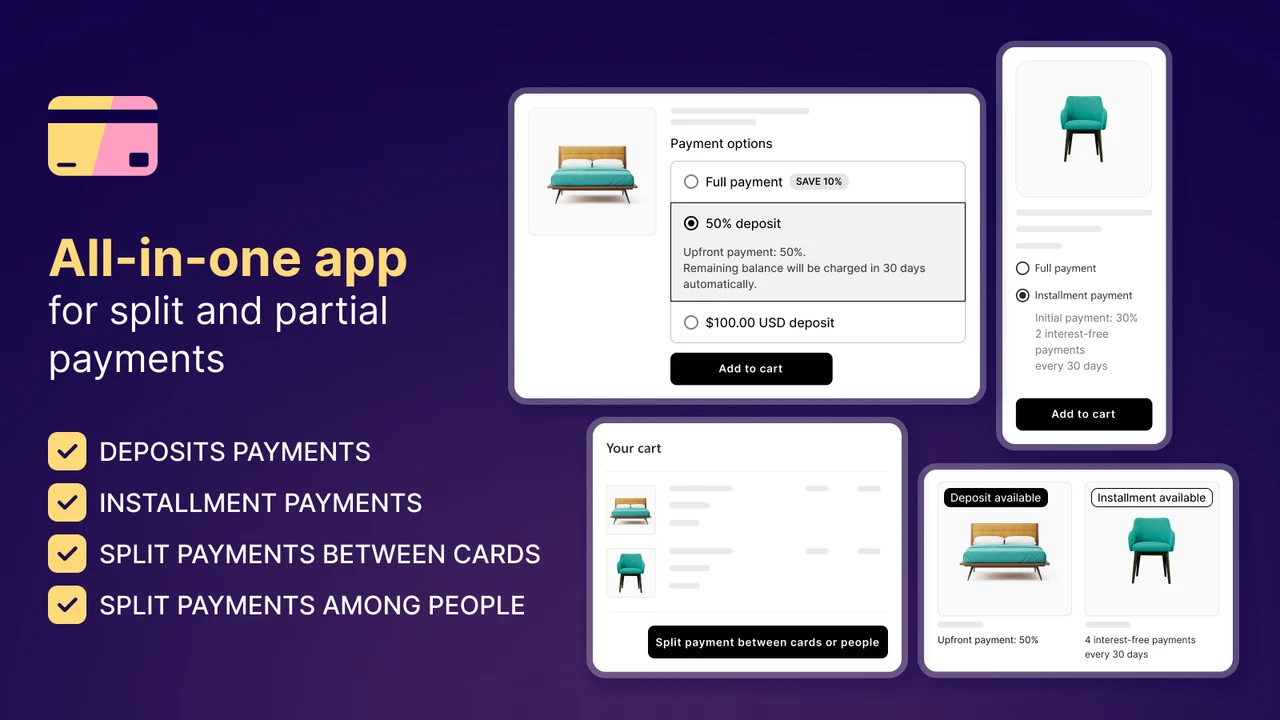
Live since 2017, it has the longest track record here and publishes release notes through a Changelog. Merchants use it for high-ticket goods and course tuition. It is Built for Shopify.
Key Features
- Deposit-now, balance-later on high-ticket orders, often a 50/50 split
- Merchant controls how many instalments an order is divided into
- Later payments collected automatically on the schedule you set
- Draft orders and quoted sales split into two payments before shipping
- One order paid from two separate cards or payment sources
- Live onboarding by video call, plus remote-session troubleshooting
- Fixed monthly pricing with no commission per sale, plus a Changelog
Ratings and reviews: 4.8 stars from 144+ reviews, 86% at five stars, including merchants at over four years of continuous use.
Best for: High-ticket stores and course businesses collecting tuition over months.
Pricing: Starter $19, Basic $29, Growth $49, and Scale $99 per month, tiered by monthly order value from $1,000 to $50,000. All features on every plan, 7-day free trial.
Use it wisely: Running all four modes at once gives shoppers too many ways to pay, which slows the decision. Switch on the mode matching your order type, then add another if customers ask.
4. Partialy: Partial COD Payment
By NxtSphere Tech | Built for Shopify
Partialy: Partial COD Payment by NxtSphere Tech is built around cash on delivery rather than card-on-file deposits. The customer pays a share upfront at checkout, commonly 20% to 50%, and settles the rest in cash on arrival.
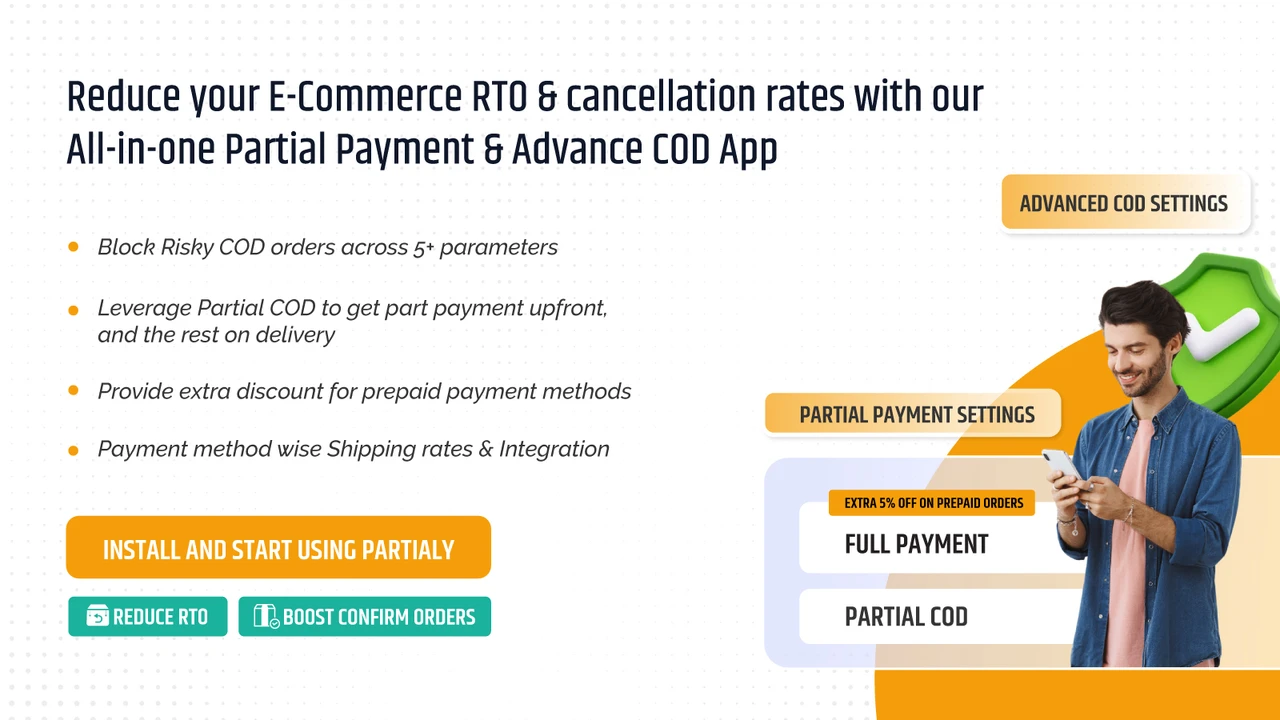
Alongside partial COD, it carries advanced COD rules based on order amount, location, customer, or product. You can rename or hide payment methods, add COD fees, set shipping rates per payment type, and discount prepaid orders. It is Built for Shopify.
Key Features
- A set advance on COD orders, with merchants reporting around 30% upfront
- Lower return-to-origin rates once an advance is required before dispatch
- Fewer last-minute COD cancellations and non-serious orders at dispatch
- Shipping costs recovered on parcels that would otherwise be refused
- Runs inside Shopify checkout with no third-party redirect
- Flexible part-payments covering bookings and preorders
- Cash arriving at order time rather than waiting until delivery
Ratings and reviews: 4.7 stars from 76+ reviews, 90% at five stars. Reviewers cluster in India, the UAE, Pakistan, and Europe.
Best for: Stores in COD markets losing margin to refused or undelivered parcels.
Pricing: Free Forever covers 25 orders/month with 2.5% commission. Growth $10/month or $102/year (300 orders). Premium $24/month or $230/year (600 orders, adds COD fees). Enterprise $49/month or $441/year (unlimited, no branding).
Use it wisely: Set the advance high enough to cover shipping exposure, but not so high that COD stops feeling like COD. Push it toward half and shoppers treat it as prepaid. Start modest, then adjust.
5. Deposit & Partial Payment Depo
By Sidepanda Services LLP | Built for Shopify
Deposit & Partial Payment Depo by Sidepanda Services LLP covers deposits in three places: your online store, Shopify POS, and draft orders in the admin. That last one matters for quoted and build-to-order work.
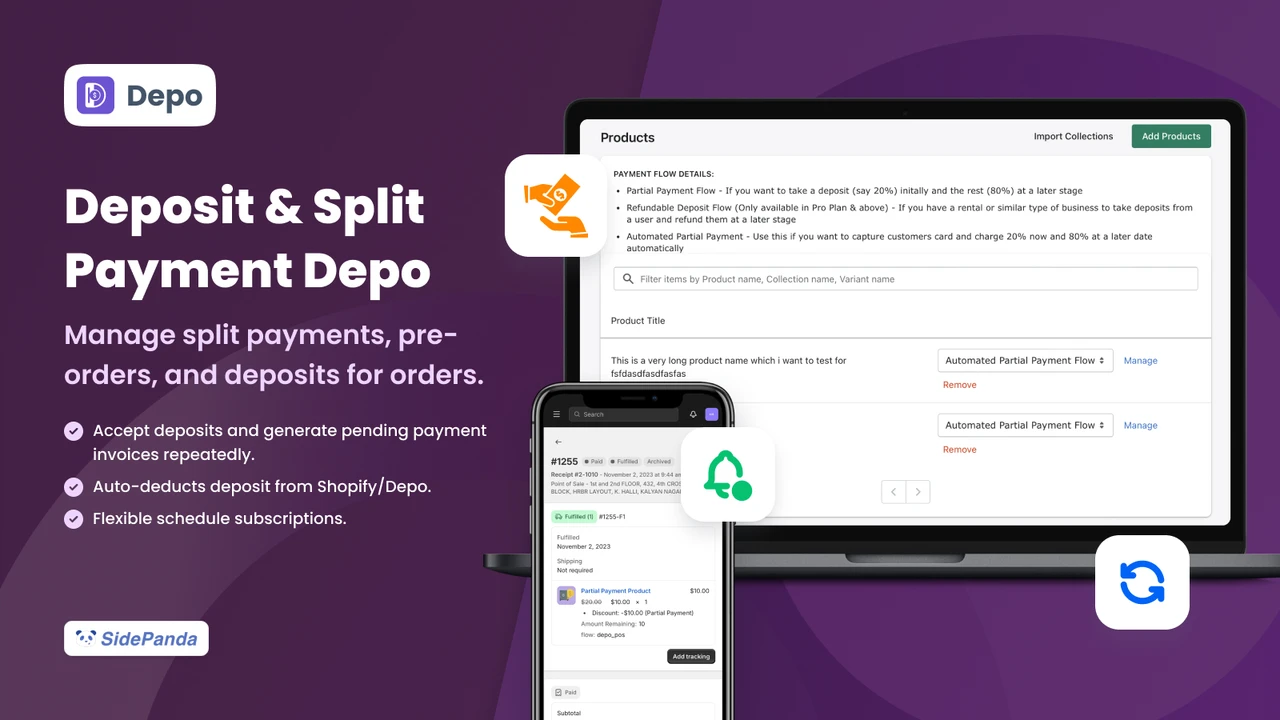
Cards can be vaulted so the balance is charged automatically on a set date, and pending invoices can be sent with your own branding. Pre-orders and COD orders are supported. It is Built for Shopify.
Key Features
- Deposit taken to reserve a specific unit of high-ticket inventory
- Balance requested later, on the schedule that suits dispatch
- Branded invoice and reminder emails for the outstanding amount
- Draft orders for build-to-order work sent to individual customers
- Available on Shopify POS, so staff can take deposits in person
- Partial prepayment on COD orders to cut return-to-origin losses
- Changelog with improvements published over time
Ratings and reviews: 4.5 stars from 98+ reviews, 86% at five stars, including merchants at over four years of use.
Best for: Stores selling online, in person, and by quote needing one deposit system.
Pricing: Starter $9/month with a 1% + $0.20 processing fee and unlimited orders. Lite $49/month drops it to 0.75% + $0.15. Pro $149/month to 0.5% + $0.10 with priority support. 14-day trial.
Use it wisely: The processing fee applies to value moving through the app, so the cheapest plan is not always the cheapest outcome. Compare the fee against the plan price at your volume.
What Is a Partial Payment on Shopify?
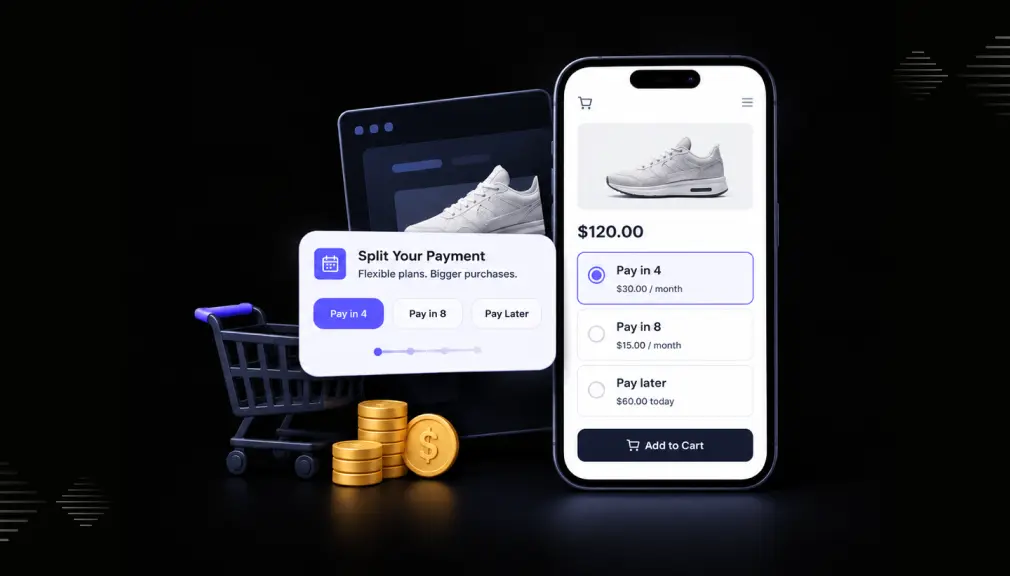
A partial payment splits one order into two or more charges. The customer pays an agreed amount at checkout, and the rest arrives later by card, invoice, or cash on delivery.
This differs from buy now, pay later, where a lender pays you in full and collects from the customer. Here the arrangement stays between you and the buyer, with no credit check.
Why Deposits Move High-Ticket Orders
A large single payment is not only a cost. It is a decision that feels irreversible, and people weigh the risk of getting it wrong more heavily than the benefit of getting it right.
A $2,400 sofa asks the buyer to accept that at once. A $400 deposit asks for less. The buyer still commits, but the first step matches their confidence.
Flexible payment is also what shoppers now expect. The Global Payments Report 2026 forecasts buy now, pay later will account for $500 billion of global ecommerce value by 2030. Partial payments meet that on your own terms.
When and Where to Offer Partial Payments
Deposits earn their place when there is a real gap between order and delivery. If the item ships tomorrow, a second payment is friction with no upside.
- Made-to-order and custom goods with production lead times
- Pre-orders and seasonal launches ahead of stock arriving
- Bookings, workshops, courses and travel with a fixed event date
- High-value items where the full price stalls the decision
- Cash-on-delivery orders needing a commitment signal before dispatch
Placement decides whether it gets used. Put it on the product page beside the price, and state both the deposit and the balance in plain numbers.
Setting It Up in Your Workflow
Implementation is the small part. Start with one product category.
- Pick products with real lead times and set a deposit covering your costs.
- Set the balance due date to a real milestone, and choose how it is collected.
- Place the widget on the product page and check that it renders on mobile.
- Switch on reminders, then review your paid-balance rate after 30 days.
Conclusion
Partial payments do not change what you sell or what it costs. They change the size of the first decision, which is where high-ticket orders are lost.
The five apps above solve that differently. Some focus on card-on-file deposits for made-to-order goods. One is built around COD advances. Another covers online, POS, and draft orders.
Choose based on how the balance needs to reach you, not the feature list. Set a deposit that covers your real costs, give it a visible place on the product page, and let your paid-balance rate guide you.
Frequently Asked Questions
Do partial payment apps work with Shopify native checkout?
Most run the first payment through Shopify’s own checkout, so customers are not redirected. Behaviour varies by theme, so test a live order first.
What happens if a customer never pays the balance?
You keep the deposit, and the order stays unfulfilled until it clears. A clear deposit policy and automated reminders reduce how often this happens.
Will offering deposits lower my average order value?
Usually the opposite, because shoppers who could not clear the full price now complete the order. The risk to manage is unpaid balances.
Can I take deposits on draft orders and in-person sales?
Some apps support draft orders and Shopify POS alongside the online store. Check this if you quote custom work, as support is not universal.
Do these apps help with cash-on-delivery returns?
A small upfront advance gives the buyer a real stake, which several merchants report lowers their return-to-origin rate.