





Imagine a shopper, just hearing about your product. They’re convinced. They add it to the cart, then, just before checking out, they stop and scroll to find one crucial piece of info: When’s it coming?
If your store cannot answer that question quickly, you have just given that shopper a reason to pass along to the next one. They’ll open a new tab, peek at a competitor, ask a buddy in a group chat, or just shut the tab and move on. That quiet little moment of stalling with the age-old question about when it will arrive is one of the most popular, and most easily corrected, reasons that Shopify stores lose sales they should have captured.
You’re wondering how to show estimated delivery time on Shopify? You’re already thinking like a store owner who wishes to retain, not acquire, customers. Read on as we explain how to set estimated delivery time on Shopify, why it matters more than ever in 2026, and how to implement it in a way that works for your customers and not just your conversions.
Key Takeaways
- A visible estimated delivery date directly affects whether shoppers complete a purchase, with research showing roughly 70% of shoppers say it influences their decision and about 40% will not buy without one.
- Shopify does not display estimated delivery dates on product pages by default, leaving a gap exactly where shoppers make their buying decision.
- Option 1, a Shopify app-based solution, automatically calculates and displays accurate delivery dates using rules for lead time, cutoff, weekoffs, and holidays, with no ongoing manual updates.
- Option 2, custom code, can work for a single static message but becomes difficult to maintain for anything dynamic, location-based, or product-specific.
- ZIP code-based and product-specific delivery dates make estimates feel personal and accurate, which builds more trust than a one-size-fits-all message.
- Stores that replace vague shipping ranges with specific delivery dates have reported conversion increases of roughly 12% to 25% in real-world tests.
- Accurate delivery dates reduce “where is my order?” support tickets, freeing up time for your team during busy sales periods.
Why “When Will It Arrive?” Decides Whether Shoppers Buy
Shopping today isn’t just about comparing prices; it’s about comparing certainty. When two stores sell the same thing at the same price, and only one displays an estimated delivery date you trust it more, think it’s better organized, believe it’s worth the risk.
Recent post-purchase studies confirm this on a much larger scale. Recent ecommerce research shows that delivery-date visibility significantly influences purchasing decisions. Forrester found that 64% of online shoppers want to see delivery dates on product pages, while 67% are more likely to complete a purchase when an estimated delivery date is displayed during checkout. Additionally, more than 40% of shoppers have abandoned carts due to delivery-date concerns. That is not a tiny edge case. That is a significant percentage of potential transactions walking out the door over a single line of text.
Similarly high are cart abandonment rates. With ecommerce cart abandonment averaging 70.22%, providing accurate shipping costs and estimated delivery dates early in the buying journey is critical, as unexpected shipping charges and slow delivery expectations remain among the leading reasons shoppers abandon checkout. If a shopper cannot answer “will this arrive before I need it?” it is wise not to.
There is also a less audible, but often-missed cost: support tickets. Messages such as “Where’s my order?” and “When will this arrive?” are some of the most common inquiries that Shopify store support teams deal with, particularly during sales or holidays. Each of those messages is just one more customer that couldn’t find it on their own and a few minutes of your team’s time spent on a question that could have been handled by your product page.
The Real Problem: Shopify Does Not Show This Information by Default
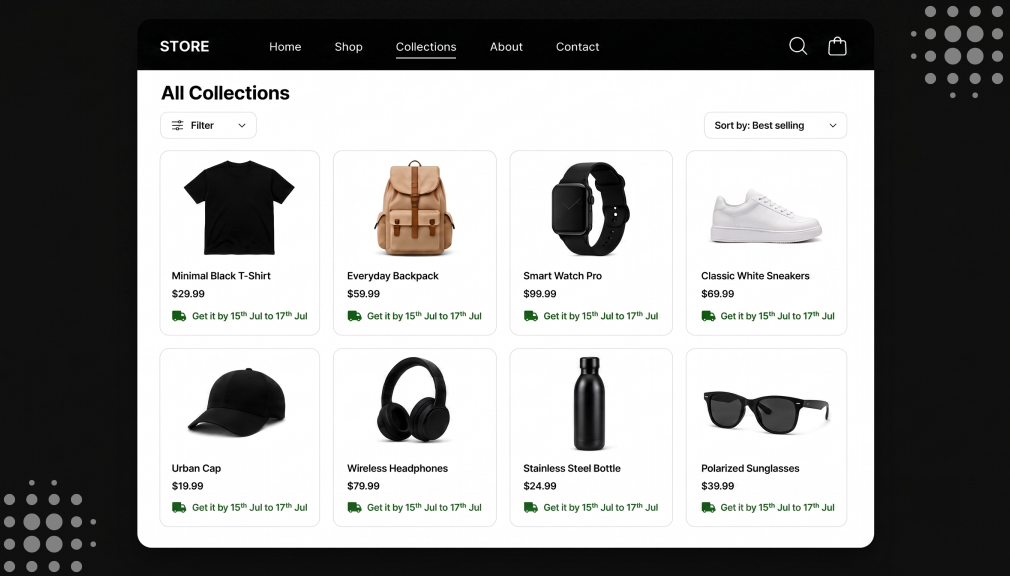
This is where most store owners are shocked. You will see that although the shipping cost on a standard Shopify store appears on checkout, it normally does not disclose an actual estimated delivery date on the product page.
What most merchants do to fill in this void is to insert a standard line somewhere in their shipping policy page, such as ‘orders ship within 3 to 5 business days.’ The issue with this approach is that hardly anyone ever checks the shipping policy page before they click on the ‘add to cart’ button. So by the time the consumer clicks on the ‘check it out’ button, they are already uncertain, and providing a vague timeframe isn’t very helpful.
This creates three pain points that show up again and again for Shopify merchants:
- Delivery information is missing exactly where shoppers need it most: the product page and cart.
- Generic ranges like “5 to 7 business days” do not account for processing time, weekends, holidays, or the customer’s actual location.
- Support teams end up answering the same delivery timing questions over and over, which adds up to real hours every week.
Thankfully, you can resolve all three issues without starting from scratch, though the challenge lies in figuring out how to estimate delivery time on Shopify so that it’s accurate, manageable, and truly visible for customers.
How to Set Estimated Delivery Time on Shopify: Two Paths
You can show an estimated delivery date on Shopify either with a dedicated Shopify delivery date app or by adding custom code to your theme. Both methods could work technically, but they are not equal in terms of ease and certainly not equal in terms of dependability.
Option 1: Shopify App-Based Solution (Recommended)
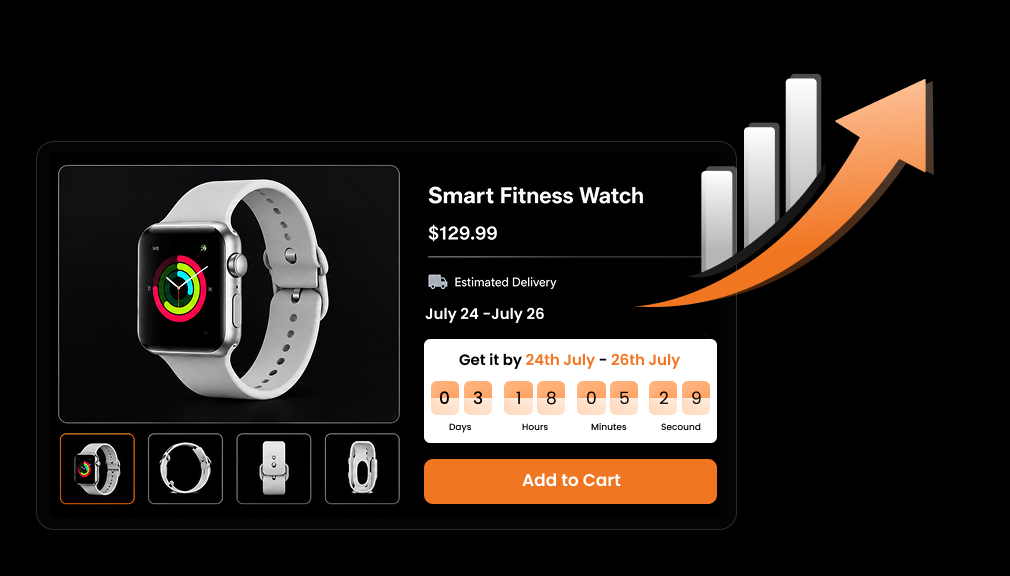
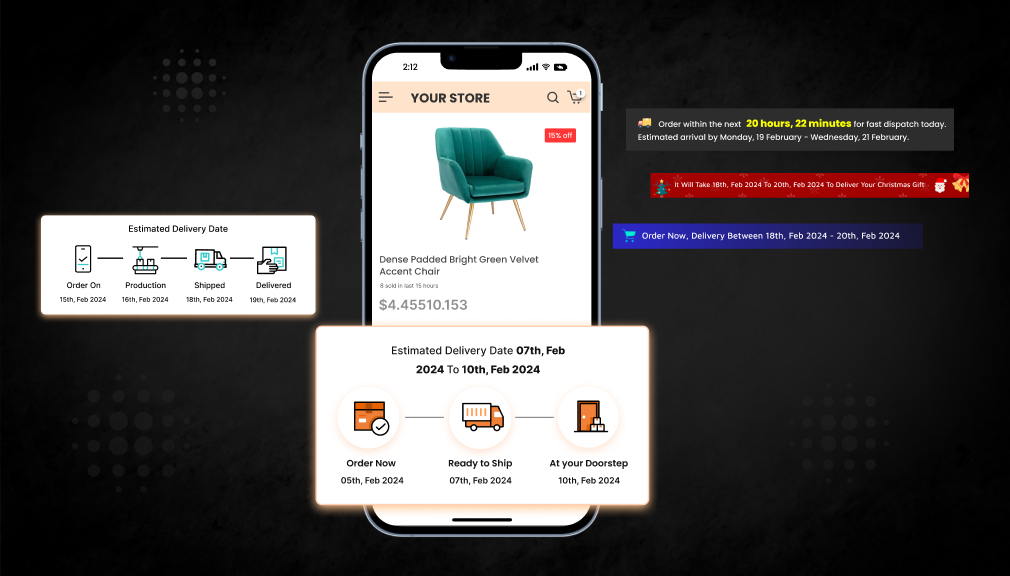
A Shopify estimated delivery date app overlays your site and automatically calculates a delivery or delivery window for each product with default delivery time rules you set once. Instead of hardcoding a sentence, your estimated date is updated through calculations every time your page gets refreshed: today’s date, plus your processing time, plus shipping time, minus the non-working days.
Ultimately, this is the solution that most store owners reach because it hits two obstacles- the accuracy problem and maintenance problem at the same time. Once you establish the rules, the messaging renews itself automatically regardless of who visits your site.
A well-configured Shopify estimated delivery date app typically lets you control:
- A custom delivery message template, written in your own words and tone.
- Minimum and maximum lead days, so the displayed window reflects your real processing and shipping times.
- Order cutoff times, so orders placed after a certain hour automatically roll over to the next shipping day.
- Weekly off days and holidays, so weekends and store closures are automatically excluded from the calculation.
- Where the message appears on the page, and how it looks, so it matches your store’s branding.
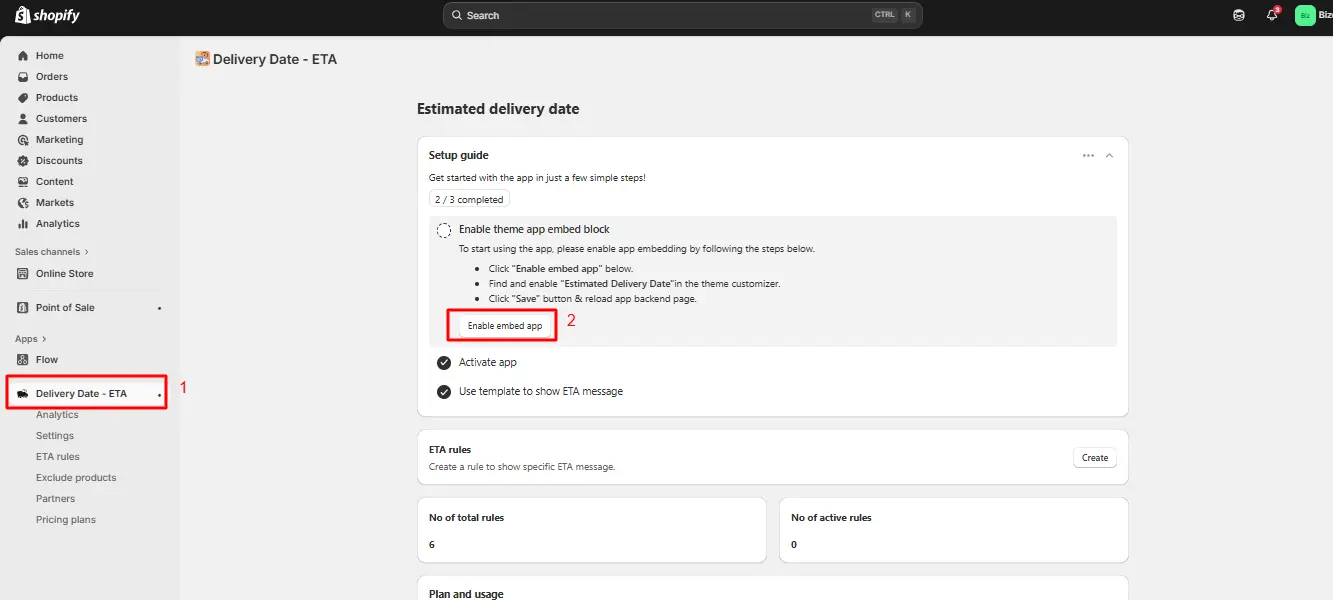
For Shopify store owners using the Estimated Delivery Date & Time app to set this up, the configuration generally follows this flow:
1 – Go to Shopify Admin, open Apps, find your Delivery Date app, and enable the app embed.
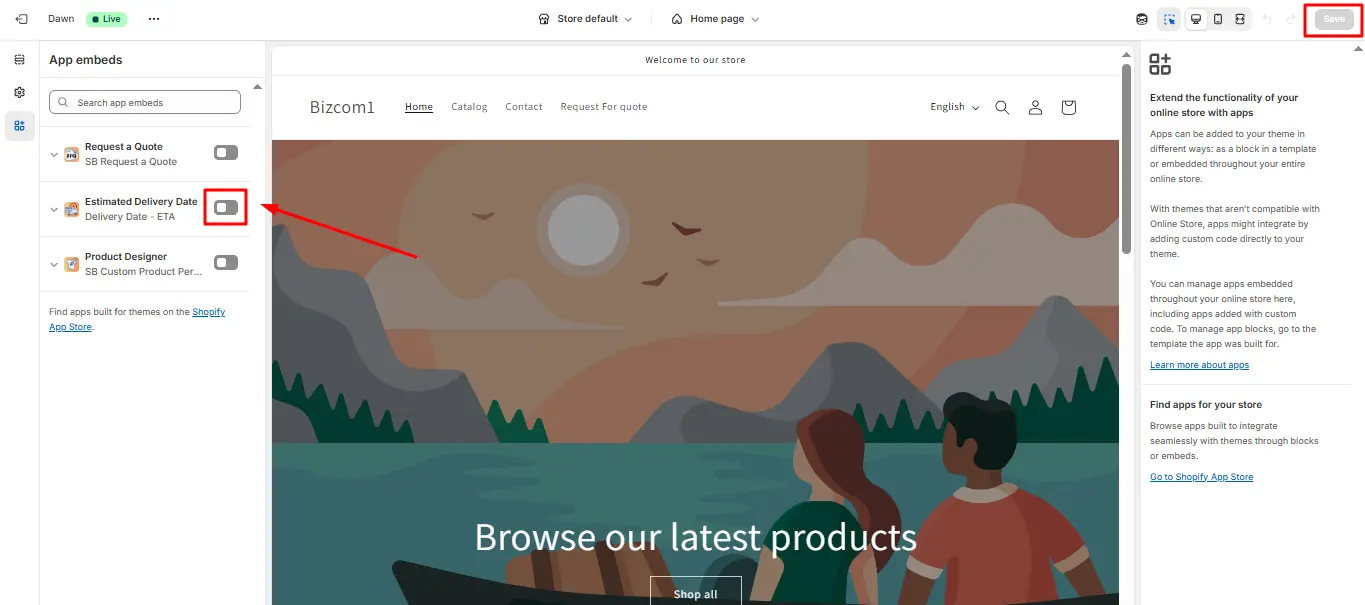
2 – Open your theme editor, find the “Estimated Delivery Date” section or block, and toggle it on, then save.
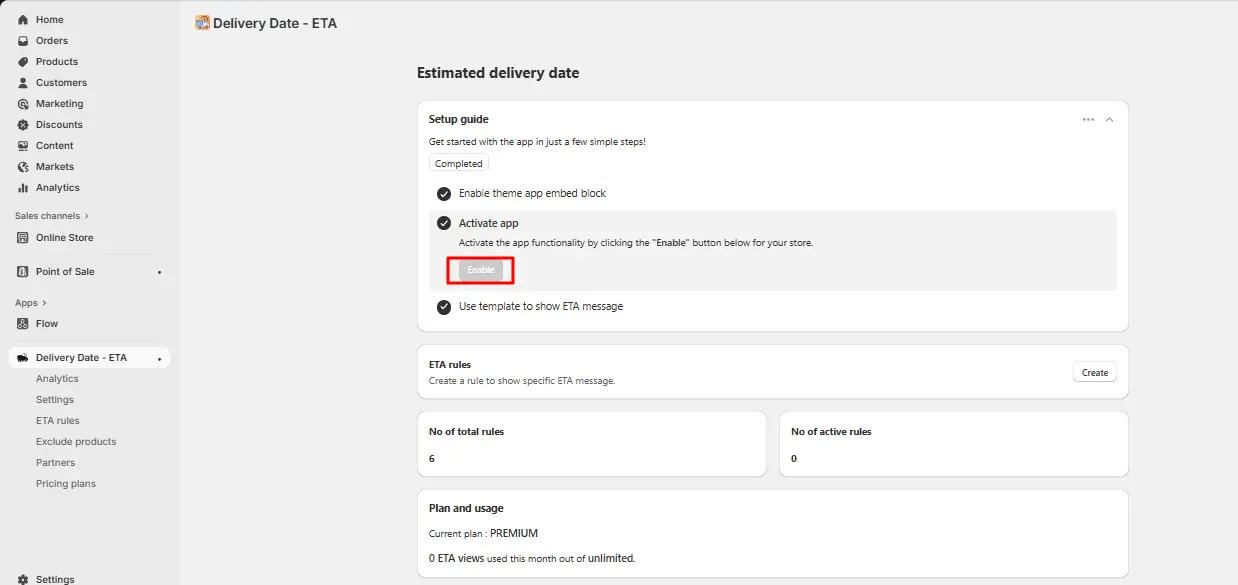
3 – Go back to the app’s backend and make sure the app itself is enabled.
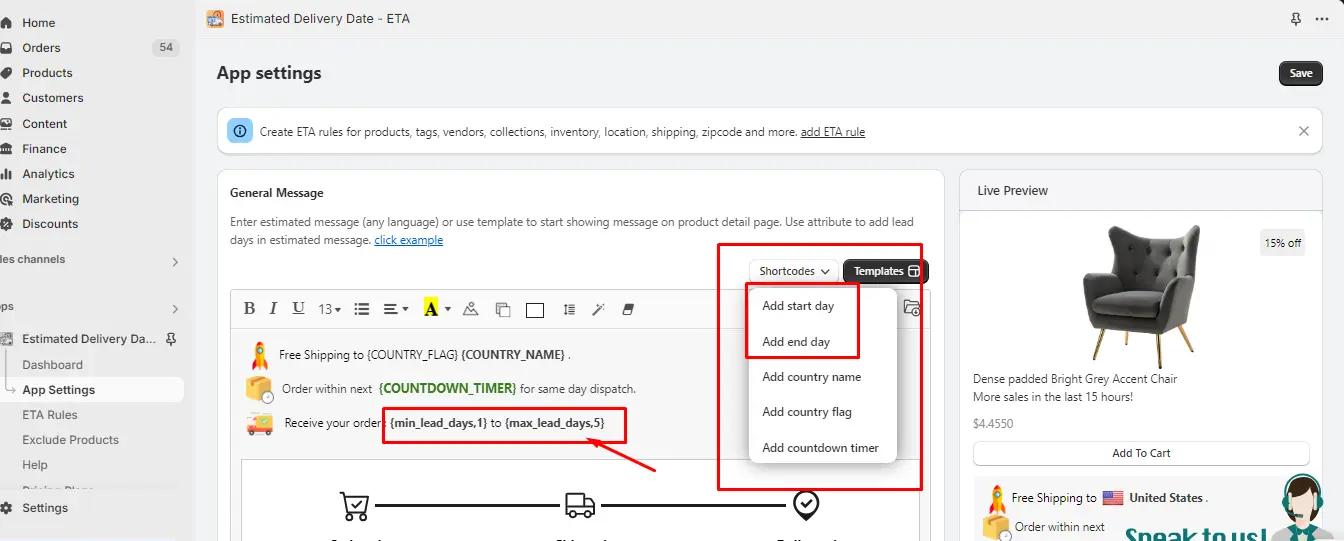
4 – Open the app settings and either write your own delivery message or choose from a ready-made template.
5 – Set the minimum and maximum lead days inside that message, so the date range matches your real fulfillment speed.
6 – Set your order cutoff time, plus any weekly off days or holidays, so the date calculation reflects how your business actually operates.
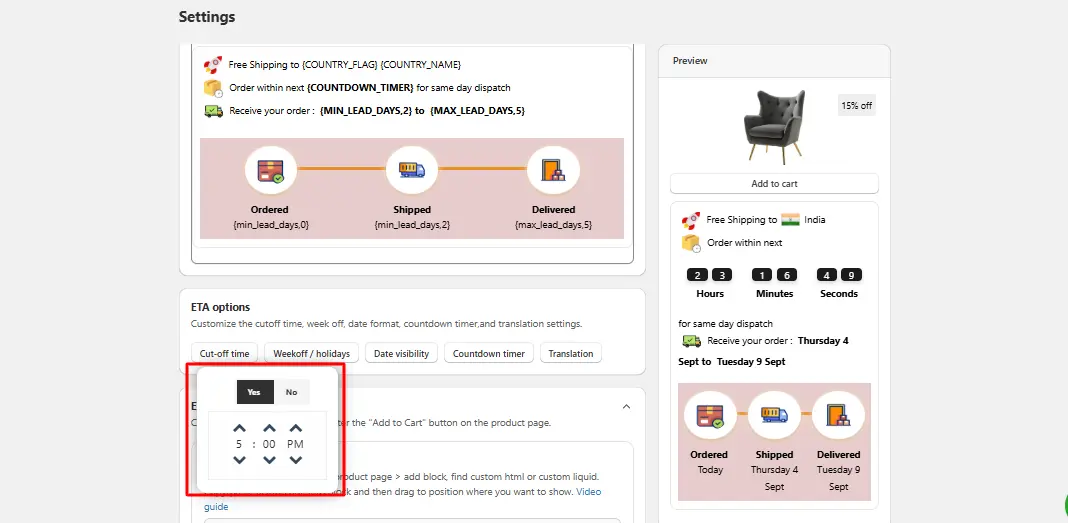
7 – Adjust the styling of the message widget so it fits naturally into your product page, then save your settings.
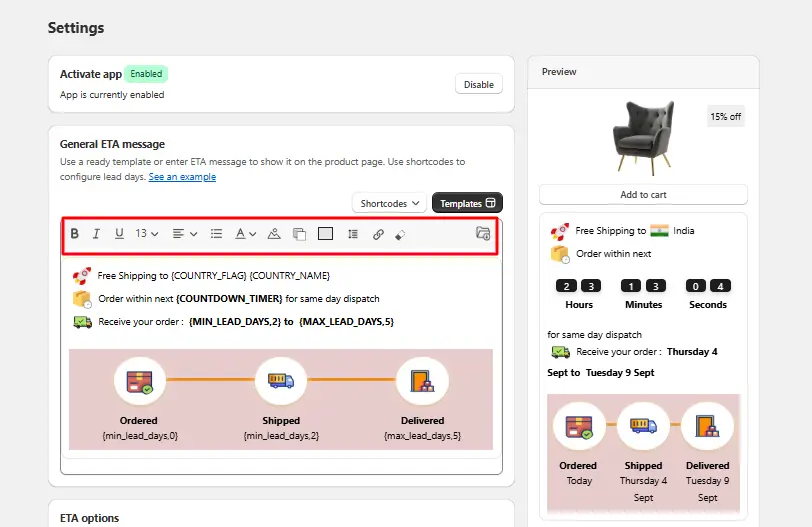
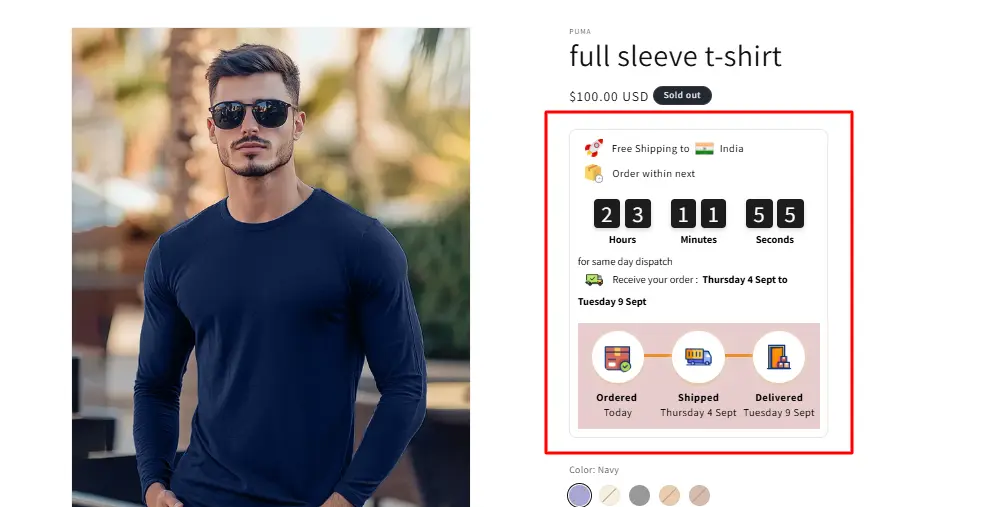
Right after the save, the estimated delivery message is automatically put into your product pages, updating your shop with the current date/time of when your site is being seen. No daily updating, no time to put it manually, no stale message sitting around your shop for days.
Option 2: Custom Shopify Code Solution
Furthermore, it is possible to insert a calculated delivery date through custom Liquid content and a little bit of JavaScript inside your theme files. Essentially, it is possible to write a script that gets today’s date, adds a certain number of days, and outputs a message such as “Estimated delivery: [date]”.
In reality, this way of doing things is very awkward and limited, and it’s good to understand why before you travel this road:
- It usually requires editing core theme files directly, which means a developer needs to be involved for any future change.
- Theme updates can overwrite or break your custom code, so the delivery message can quietly stop working after an unrelated update.
- Accounting for weekends, holidays, and cutoff times means writing and maintaining your own date logic from scratch.
- Showing different delivery estimates for different products, locations, or shipping methods means duplicating and managing multiple versions of that logic.
If you had a single static message, for example, your “ships within 3 to 5 business days” and wanted this printed on your products, then custom-coded instructions would work. However, if you require accuracy, location-based rules, or that something be dynamically updated, you will find that code-based implementations become costly to develop and even more costly to maintain. This is exactly why most rapidly expanding Shopify stores will opt for an application-based approach.
Beyond a Static Message: Smarter Ways to Show Delivery Dates
Now that the estimated delivery date is showing up somewhere on all your product pages, the next question is reliability. An estimated delivery date is only valuable if consumers believe in it, and they will believe in it if it’s as close to the truth as possible. These changes are most impactful.
ZIP Code and Location-Based Delivery Dates
Shipping time is not the same for all customers. A customer right next to your warehouse may get their order in 2 days, whereas someone on the other side of the country might take 5. Showing a single range for everyone either undersells for nearby customers or oversells for distant ones.
And a single handy feature can solve one of the most-asked questions by Shopify merchants: Can I show delivery dates by ZIP/postal code in Shopify? Yes, and a Shopify delivery date app can have customers enter their ZIP code or postal code, or detect the user’s location and change the expected delivery date based on the shipping zones you set.
Product-Specific and Variant-Level Delivery Estimates
Not all of your products ship at the same rate. An in-stock, best-selling product may arrive the same day, while a custom or low-inventory SKU might take an extra week. Displaying the same delivery date for both sets an incorrect expectation for at least one.
Using rule-based delivery date apps, you can also configure a separate estimated delivery date at the product level, collection level, or variant level. That comes back to another common question: can I display different delivery dates for different products in Shopify? The answer is yes, with the right configuration, each product/variant will display its own lead time and the message will always be accurate for the specific product the customer wants to buy.
Cutoff Times for Same-Day and Next-Day Messaging
Same-day and next-day shipping is just as important in the time of day as it is in the day of the week. A 9 a.m. order to ship the same day only ships that day. The same order with a 9 p.m. cutoff ships the next day. Setting the cutoff time ensures your delivery message always makes sense regardless of whether the customer sees it at 10 a.m. or 10 p.m.
Weekends and Holidays
There are few faster ways to erode your delivery date confidence than one that silently assumes your warehouse is open all 365 days of the year. By setting your weekly days off and holiday calendar in your delivery date software, then Saturday and Sunday (or whatever) are excluded on the back end when the date works its way forward. Easy to do and quite helpful around long weekends and holiday periods when delays are already expected.
How Estimated Delivery Dates Improve Shopify Conversions
Not only the customer experience, but having a forecasted delivery date is one of the more measurable kicks a Shopify store can give. A handful of brands that moved away from vague language about shipping expectations to concrete, calculated delivery dates experienced a checkout conversion uplift of between 12 and 13% in A/B tests, and a resultant order profit uplift. According to Shopify, stores that display delivery promises and expected delivery dates through Shop Promise have seen conversion increases of up to 25%, demonstrating how transparent delivery information can directly influence purchase decisions.
There is an opportunity here because of the fact that most stores have not yet adopted this practice. Independent checkout research has observed that a significant portion of top online checkouts, roughly 4 in 10, continue to just offer a shipping speed range, rather than a date. That is precisely the space where a precise, visible estimated delivery date can distinguish a Shopify store from status quo laggards.
What’s so brilliant here is that the improvement is not just ‘people tell us the number has gone up’. All of these results are ultimately traced back to one factor: the shopper demanding a guarantee before they give us their card details, and a precise date of delivery provides that guarantee at the point that the consumer is deciding to buy.
- Higher product page conversion, because shoppers no longer need to guess or search for shipping information.
- Fewer abandoned carts at checkout, because delivery timing is no longer a last-minute surprise.
- Lower support volume, because “when will my order arrive?” is answered automatically on the page.
- More repeat purchases, because customers who receive orders when expected are more likely to trust your store again.
Final Thoughts
Learning how to show an estimated delivery date on Shopify is not about enabling a new feature, but closing a trust gap you already have in your store: before they order, shoppers want to see when a product will get to them, not after. The best choice for most growing stores is an app, which takes into account actual processing time, cutoff hours, weekoffs, and even ZIP code to automatically update delivery estimates, but whether you choose code to give a static message, or an app to generate accurate, dynamic times, the goal remains the same.
But when you correctly set estimated delivery time on Shopify, you are doing more than including a line of text to the product page. You are also removing one of the silent, rarely-noticed factors that helped decide potential buyers to pause, and turn them to yes.
Frequently Asked Questions
1. How do I add an estimated delivery date on Shopify?
The easiest way is to install a Shopify delivery date app, enable its app embed in your theme, and configure your processing time, cutoff time, and weekoffs so the date is calculated and displayed automatically on your product pages.
2. Can Shopify show estimated delivery dates automatically?
Shopify itself does not calculate this by default, but a delivery date app adds this functionality, recalculating the estimated date in real time based on the rules you set, with no manual updates needed.
3. What is the best Shopify app for estimated delivery dates?
The best app is one that lets you set lead times, cutoff times, weekoffs and holidays, and location-based rules, then display the result on your product page without needing a developer for every change.
4. Can I show different delivery dates for different products in Shopify?
Yes, rule-based delivery date apps let you set separate lead times for individual products, collections, or variants, so faster-moving items and slower or made-to-order items each show an accurate estimate.
5. Can I display delivery dates by ZIP code in Shopify?
Yes, many delivery date apps support ZIP or postal code-based rules, either through automatic location detection or manual entry, so the displayed date reflects shipping time to that specific area.
6. How do estimated delivery dates improve Shopify conversions?
Showing a clear delivery date removes a major source of checkout hesitation, and real-world tests have shown conversion increases of roughly 12% to 25% after stores replaced vague shipping ranges with specific dates.

Shopify Expert
Dipen Panchal, Shopify Tech Lead at Setubridge Technolabs, brings over a decade of expertise as a Shopify Expert. Passionate about e-commerce growth, he specializes in UI/UX design, crafting intuitive, engaging solutions tailored for merchants and B2B clients to enhance user experiences.