





Suppose you walk into a shop with a thousand sweet varieties. First, you feel excited. Then you start being confused. Which one is good? Which one should you pick?
It’s how consumers behave when they buy glasses online.
Key Takeaways
- Selling glasses online is hard. Customers get confused by all the lens choices.
- A Prescription Lens Advisor is a simple tool. It helps customers pick the right lenses step-by-step.
- This tool can increase your sales by 40%. It also stops people from sending glasses back.
- It helps people trust your store. This is important because the eyewear market is growing fast.
- It lets you grow your business without hiring more staff. The tool works all day and all night.
Buying glasses online should be easy. You can look at many frames from your couch. But when you need to add the lenses, it gets hard. Lenses are the most important part.
Selling lenses is not like selling a shirt. It has many hard parts, like:
- Numbers like SPH, CYL, and Axis.
- Choosing between single vision and progressive lenses.
- Picking coatings like anti-glare or blue light.
- Choosing thin lenses or standard ones.
Most people do not know these words. In a real store, a person helps them. This person is called an optician. They guide the customer through every step.
When there is no guide online, bad things happen:
- People Get Confused: They do not know what to pick.
- People Make Mistakes: They guess and pick the wrong thing.
- People Leave: They get mad and leave your site without buying.
This is a big problem. The eyewear market is huge. It was worth over $183 billion in 2023. It is still growing. Online stores need a way to help people. The global eyewear market was valued at about USD 200–202 billion in 2024.
Expected CAGR through the late 2020s/2030 generally ranges around 6.7%–8.6%, depending on the source and segments included.
A Prescription Lens Advisor is the answer. It is a simple tool. It brings the help of a real store to your website. It helps your customers buy the right thing. It makes them feel good about their choice.
| Metric | Latest Figures / Forecast |
| 2024 Global Market | $200–202 billion (some estimates lower) |
| 2025 Global Market | $151 billion (Statista projection) |
| 2030 Forecast | $323–336 billion |
| 2032–2034 Forecast | $295–368 billion range |
| CAGR | 6.7%–8.6% (varies by report) |
What Is a Prescription Lens Advisor?
A Prescription Lens Advisor is a tool on your website. It acts like a virtual helper. Its job is to make picking lenses easy.
Think of it as a friend. It walks your customer through the steps.
How It Works
The tool does not show all the choices at once. It breaks them into small parts:
- Asks Easy Questions: It asks things like “Do you need glasses for reading?”
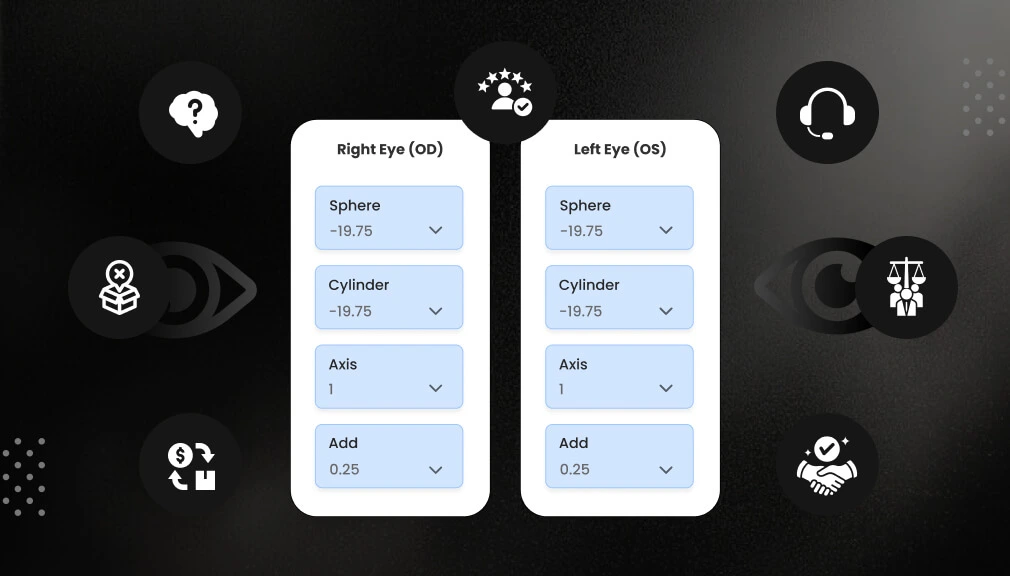
- Helps with Numbers: It helps the customer put in their prescription numbers. It uses pictures to show where the numbers go.
- Suggests Lenses: It tells the customer which lens is best for them.
- Explains Extras: It tells the customer what things like “anti-glare” do. It uses very simple words.
Old Forms vs. New Advisors
There is a big difference between an old form and a new advisor:
| Feature | Old Form | New Advisor |
|---|---|---|
| Feel | Asks for everything at once. | Goes step-by-step. |
| Help | No help for hard words. | Gives simple help and pictures. |
| Smart | Just takes data. | Uses logic to give advice. |
| Result | Confusing and scary. | Easy and clear. |
This tool is very important for glasses. Glasses are made just for one person. You cannot sell them to someone else if they are wrong.
The advisor stops these mistakes.
Reason #1: Customers Get Confused Without Expert Guidance
The most common reason for people leaving an online store is that they feel confused.
If a customer can read words such as polycarbonate or photochromic, then they have stopped. They know they require glasses, but they do not know which ones to choose.
Too Many Choices
Think about one pair of glasses. There are many choices:
- Material: Plastic, strong plastic, or thin material.
- Type: For one distance or for all distances.
- Coatings: To stop scratches, UV rays, or glare.
There are hundreds of ways to mix these. In a real store, the helper picks the best three for the customer.
Online, the customer has to do it all. This is hard.
What Happens When Customers Are Confused?
Another big problem is the Pupillary Distance (PD). This is the distance between your eyes. It is very important. It makes sure you can see clearly. Many people do not know how to find this number. A simple box on a site is not enough. A good advisor tool shows the customer how to find it. This stops mistakes.
- They Wait: The customer says, “I’ll do this later.” Then they never come back.
- They Guess: They pick the cheapest thing because they are not sure. This is often the wrong choice.
- They ask for Help: They send many emails to your team. This takes up your time.
An advisor tool is like a filter. It uses simple logic. It matches what the customer needs to the right lens. This turns a hard choice into an easy one.
Reason #2: Fewer Wrong Orders and Costly Returns
Returns are a big headache for any store. For glasses stores, they are a disaster.
The average return rate for online stores is about 16.9% in 2025. But for glasses, it can be as high as 25%.
Why do returns cost so much?
Returns are very expensive for an eyewear shop. When a customer sends back glasses with the wrong lenses in it it costs the shop money in 3 main ways:
- Wasted Product: Once a lens has been cut for an individual, it cannot be repurposed, so the shop has a waste item; in addition, they lose the cost of the work involved to produce it.
- Shipping Costs: If you have to ship the glasses to the customer and receive the pair back to adjust them again for free, this costs money.
- Unhappy Customers: If a customer is not happy with the product, they are unlikely to purchase again from the shop.
The cost of fixing one return can be more than the profit from many good sales. In the eyewear world, up to 25% of orders are sent back. This is a huge problem for any business.
Why Mistakes Happen
Many stores blame the customer. But the mistake often starts with a bad website.
If your site has a hard form, people will make mistakes. This is true for people with hard prescriptions.
How an Advisor Fixes This:
- Checks for Errors: A good tool checks the numbers. It can tell if a number looks wrong.
- Shows Pictures: It can show a picture of a prescription. It asks, “Does yours look like this?”
- Gives the Right Type: It helps the customer pick the right lens type. This stops them from ordering the wrong thing.
By stopping wrong orders, the tool saves you money. It turns a loss into a win.
Reason #3: Higher Conversion Rates on Product Pages
In online sales, the conversion rate is key. It is the number of people who buy something. In 2024, this was about 1.65%. Even a small change can mean a lot of money.
An advisor tool is great for this. It stops friction.
Friction is anything that makes a customer stop. In glasses stores, friction happens when picking lenses.
No More Guessing
When a customer is sure, they buy. When they are not sure, they leave.
- No Advisor: The customer has to guess. They think, “Is this $50 lens okay? Or do I need the $150 one?” They do not know. So they leave.
- With an Advisor: The tool gives a clear choice. It might say, “We suggest this thin lens for you.” This makes the customer feel sure.
Tools like this have a big impact:
| Metric | Change with a Tool |
|---|---|
| Sales | Up to 40% more |
| Order Value | 15% to 30% higher |
| Time to Buy | 50% faster |
Which implies that for every 100 people, four of them will be buying more. They will also be spending more money, which is because they already feel good about the lenses that they now have.
The tool also makes this process fast. The fast selection can buy fast. The customer will not divert as the selection is fast.
The tool takes away the “I don’t know.” It turns it into “Yes, I want this.”
Reason #4: Better Customer Experience Than Static Forms
The way a person uses your site is called the User Experience (UX). A good UX is like a smooth road. A bad UX is full of holes.
Many stores use old, static forms. These are bad, especially on phones. Most people shop on phones today.
Good for Phones
More people use phones to shop. An old form is hard on a small screen. You have to zoom in and out. You have to type many small numbers.
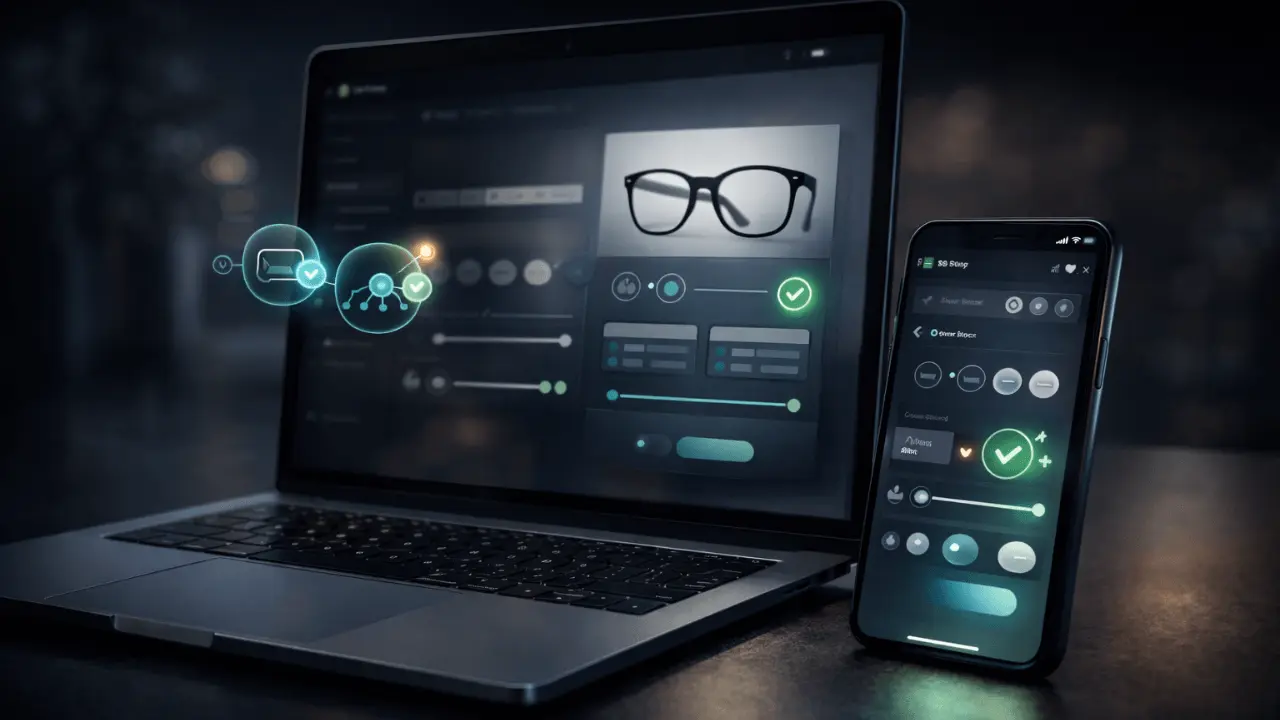
An advisor tool is made for phones. It goes step-by-step:
- One Thing at a Time: It only shows one question. This is easy to see on a phone.
- Big Buttons: It uses big buttons. They are easy to tap.
- Simple Pictures: It uses pictures to show the difference between lenses.
This feels like a chat, not a test. It is much more fun to use.
The step-by-step way is good for the brain. It is called “chunking.” It breaks a big task into small, easy steps. Each step is a win. This keeps the customer going until the end.
Why This Matters:
- Clear: Simple words and steps mean fewer mistakes.
- Easy for All: It makes buying glasses easy for everyone.
Google likes sites that are easy to use on phones. A good tool helps you rank higher. It helps your customers and your store.
Reason #5: Reduced Support Load for Store Owners
Every time a customer asks a simple question, your team has to stop. They have to answer emails or calls. This takes time and money.
An advisor tool is like a 24/7 helper. It answers the easy questions before they reach you.
Less Fixing Orders
The tool also stops mistakes. When a customer makes a mistake, your team has to:
- Find the mistake.
- Call or email the customer.
- Wait for an answer.
- Fix the order.
This takes a lot of time. It can take days. This is a waste of money.
Think about the cost. If a helper spends 30 minutes fixing one order, that is a lot of time. If they do it 10 times a day, it is a big loss. The tool does this work for free. It saves you real money.
A good advisor tool catches mistakes before the customer pays. This means your team spends less time fixing orders and more time growing the business.
Better Use of Time:
- Before: Your team spends 80% of their time on easy questions.
- After: Your team spends 80% of their time on big things. They can help with style or build trust.
This shows Google that your store is professional. It helps your reputation.
Reason #6: Increased Trust in Online Eyewear Shopping
Buying glasses is about trust. People trust you with their eyes. This is very important.
In a real store, you trust the person in the white coat. Online, trust is hard to get.
Why It Feels Risky
People think buying glasses online is risky because:
- They cannot try them on: They worry about how they look.
- They cannot talk to an expert: They worry about picking the wrong lens.
An advisor tool solves the second problem.
How It Acts Like a Real Helper:
The tool brings expert help to your site. It explains why a lens is good. It acts like the person in the store.
- Clear: Good help stops doubt.
- Safe: The steps make the customer feel cared for.
- Sure: By the end, they are sure they made the right choice.
This is very important for Google’s consideration of EEAT (Experience, Expertise, Authoritativeness, and Trust). It is Google’s methodology of considering whether a website is trustworthy and legitimate.
Imagine a customer seeing a piece of software that prevents me from making mistakes; that’s a caring company. We are here for you. Establishing this sort of trust is invaluable to an online shop. A store with this kind of software is the sort of shop that will be number one on Google and return like a true professional.
Reason #7: Scales Your Store Without Hiring More Staff
Growing a store is hard. How do you handle more orders without more staff?
If you need people to answer every question, you cannot grow fast. You would have to hire too many people.
An advisor tool is a one-time buy. It can handle as many orders as you want.
The Helper That Never Sleeps
- Always On: The tool works 24 hours a day. It never takes a break.
- Same Good Help: Every customer gets the same great help. This is hard for people to do.
- Works Everywhere: As you sell to more countries, the tool is ready. You do not need to hire people in every time zone.
Helping Small Teams:
That’s huge for small shops. Transferring lenses enables a smaller team to run a big brand. You leave time open for advertising and innovation. They take care of the trouble of selecting lenses.
The eyewear industry is experiencing rapid growth. It will be $73.5 billion by 2034. You need a solution that can expand with you. An advisor tool is that solution. It allows you to expand without increasing staff.
How a Prescription Lens Advisor Fits into a Shopify Store
If you use Shopify, adding a tool is easy. It fits right into your site.
Where to Put It
The tool should be where people pick lenses.
- On the Product Page: After they pick a frame, the tool starts.
- As a Pop-up: It can show up as a clean window. It walks them through the steps. Then it adds the lenses to the cart.
- In the Cart: It can show a summary. This gives the customer one last look to feel sure.
Works with Your Site
A good tool works with your theme. You do not have to change your whole site. It just replaces the old, hard form.
For example, tools like “Prescription Eye Lens” are made for sites like Shopify. They are easy to set up. The goal is to make it easy for the customer. They only see the helpful guide.
Best Practices for Using a Prescription Lens Advisor
Just having the tool is not enough. You have to use it the right way. Here is how:
1. Keep It Simple
The goal is to make things easy. Do not use hard words.
- Bad: “What is your preferred lens index?”
- Good: “Do you want your lenses to be thin?”
The tool should do the hard work behind the scenes.
2. Test on Phones
Most people shop on phones. You must test your tool on a phone.
- Check: Are the buttons big? Is the text easy to read? Does it load fast? If it is hard to use on a phone, you will lose sales.
3. Use Simple English
Always use words that a 7th-grade student can understand. This makes sure everyone can use your site.
- Instead of: “This coating stops ocular fatigue.”
- Use: “This coating stops your eyes from getting tired.”
4. Test Often
Things change. You should test your tool often. Try different prescriptions. Make sure the help is always right.
If you do these things, your tool will be a great sales helper. It will not just be another piece of software.
Conclusion: Is a Prescription Lens Advisor Worth It?
The online eyewear market is huge. But customers want more help now. They want the same care they get in a real store.
An advisor tool is the answer.
| Problem | Benefit | Fact |
|---|---|---|
| Confusion | More sales, fewer left carts. | Tools cut choice time by 50%. |
| Wrong Orders | Save money, make more profit. | Returns can be 25% of sales. |
| Small Staff | Grow 24/7. | The market will be $73.5B by 2034. |
| No Trust | Better brand name. | Trust helps you rank on Google. |
In short, an advisor tool is a must-have. It is not just a nice extra. It is how you stay in business and grow.
It is time to look at your site. Are your customers confused? Are returns high? Is your team busy with easy questions? If yes, then you need a Prescription Lens Advisor. It is the best way to turn browsers into happy customers.
Frequently Asked Questions (FAQs)
What is a prescription lens advisor?
A prescription lens advisor is an online guide to the customer, giving information about the availability of, and helping to choose the best prescription lenses, according to the customer’s contact lens prescription, needs, and lifestyle. It can also be called a virtual optician.
How does a prescription lens advisor improve customer confidence?
It guides the customer through lens options, asks questions relating to their visual lifestyle, and gives personalized product recommendations. It removes the fuss about choosing the right lens, and customers have the reassurance that they are not going wrong.
Can a prescription lens advisor help reduce returns?
Definitely. If customers are advised on the right lens suitable for their prescription and use, like recommending high-index for high powered prescription or blue light blocking for people who spend long hours on screen, it bodes well for reducing returns.
How does it boost conversion rates?
Simplifies the choice of lenses, reduces the overwhelming nature of choosing by offering clear and relevant options, and speeds up the experience so customers can check out and purchase.
Is a prescription lens advisor only for large online eyewear retailers?
Can I use it? Can I make use of it? That’s definitely a yes. It’s very useful for an online eyewear business of any size. It is an investment that is worth making, with improvements in business performance, better customer experience, and throughput.
What kind of information does the advisor typically ask for?
Generally, users will provide information about the customer’s eyeglass prescription (sph, cyl, axis, add), lifestyle (computers, drive all day, outdoors), and visual needs if known.

Shopify Expert
Dipen Panchal, Shopify Tech Lead at Setubridge Technolabs, brings over a decade of expertise as a Shopify Expert. Passionate about e-commerce growth, he specializes in UI/UX design, crafting intuitive, engaging solutions tailored for merchants and B2B clients to enhance user experiences.