




Fast Bundle (which has now been rebranded to FBP: Fast Bundle & Upsell App) is truly a good bundle app. It comes with the “Built for Shopify” tag, has approximately 3,000 reviews with an average 5.0 rating, is used by about 20,000+ stores, and supports all kinds of bundles – from “mix & match” to AI “Frequently Bought Together”.
So why do merchants go looking for alternatives?
In almost every case we’ve seen, it comes down to one of three things, plus, since July 2026, a fourth situation that’s temporary and worth understanding properly before you act on it:
- The pricing model is revenue-capped. Fast Bundle’s plans are tied to how much bundle revenue you generate: $19/month up to $1,000 in monthly bundle sales, $49 up to $3,000, and $139 up to $10,000. The better your bundles perform, the more you pay. That’s fine at first and expensive later.
- It’s frontend-first. Fast Bundle is excellent at the storefront experience. It’s less suited to merchants who need SKU-level breakdown for a 3PL, WMS, or ERP.
- The free tier is for development stores only. You can’t run a live store on the free plan, which makes long-term evaluation harder.
If none of those apply to you, Fast Bundle is a perfectly good place to stay. If one or more do, here are the seven alternatives worth your time.
How we put this together: We went through all apps’ live listings on the Shopify App Store, compared their pricing models for each feature, and tried installing several of them. We don’t have any business ties to any of the apps listed here; there are no affiliate links, sponsorship deals, or any other kind of paid promotion of the apps mentioned below. We tell you outright when one of the apps is simply better for the task at hand.
Quick comparison table
| App | Rating (reviews) | Pricing model | Entry paid price | Cost at $10K/mo bundle sales | Built for Shopify | Best for |
|---|---|---|---|---|---|---|
| Kaching Bundles App & Upsells | 5.0 (4,900+) | Free plan available(Dev) | $14.99/mo | $59.99/mo | Yes | Quantity breaks, A/B testing |
| Bundler – Product Bundles | 4.9 (2,400+) | Free plan available | $8.99/mo | $19.99/mo | Yes | Budget-conscious, unlimited free revenue |
| Pumper Bundles Quantity Breaks | 4.9 (3,100+) | Free plan available | $9.99/mo | $49.99/mo | Yes | Volume discounts + free gifts |
| AI Product Bundle Builder (Essenify) | 4.9 (20) | Free plan available | $5.99/mo | $49.99/mo | Yes | Flat-fee predictability, build-a-box |
| Simple Bundles & Kits | 4.8 (720+) | Free plan available | $14/mo | $149/mo | Yes | 3PL, WMS, ERP, SKU accuracy |
| Easy Bundles: Bundle Builder | 4.9 (1,000+) | Free plan available | $29/mo | $99/mo | Yes | Mix & match, build-a-box |
| Shopify Bundles (native) | 2.8 (530+) | Free | $0 | $0 | N/A | Simple fixed bundles only |
Why the pricing model matters more than the feature list
Most bundle app comparisons are a feature checklist. That’s the wrong lens, because by 2026 the top ten apps in this category have converged on nearly identical feature sets. Mix and match, quantity breaks, BOGO, build-a-box, FBT almost everyone has all of it.
What actually differs is how you get billed, and the gap is large enough to change which app is right for you.
Bundle apps price in one of two ways:
Revenue-capped (usage-based). You pay more as your bundles generate more. Fast Bundle and Kaching both work this way. The logic is fair on paper: you pay in proportion to value received, but it has a sharp edge: your app bill scales during exactly the months you’re busiest. BFCM, holiday season, a viral product. Some merchants discover their bundle app has quietly become one of their higher monthly costs.
Flat-rate. You pay a fixed monthly fee regardless of how much revenue the bundles drive. Bundler, Simple Bundles, and our own app work this way. Less “fair” in the abstract, far easier to forecast.
Two honest caveats before you use that table as a weapon:
- The revenue definitions aren’t identical. Fast Bundle caps on bundle sales; Kaching caps on additional revenue generated. Those measure different things, and a store could hit one cap well before the other.
- Cheaper is not automatically better. If Fast Bundle’s AI bundle image generator, ten-language support, or PageFly integration is load-bearing for your store, $139 is a rational price to pay. Pricing model is a decision input, not a verdict.
What Fast Bundle actually does well
It would be dishonest to write a “Fast Bundle alternatives” post that pretends Fast Bundle is bad. It isn’t. Here’s a fair accounting.
Strengths:
- Bundle-as-product. Fast Bundle’s combo product feature, where a bundle behaves as a single purchasable product with its own page, is well-executed and one of the reasons merchants pick it over cart-level discount apps.
- Breadth of bundle types. Mix & match, volume discounts, quantity breaks, BOGO, Buy X Get Y, add-ons, fixed bundles, subscription bundles, AI-powered Frequently Bought Together.
- Internationalisation. Support for ten languages including Spanish, French, German, Portuguese, Italian, Turkish, Swedish, Dutch and Danish, plus multi-currency. Genuinely ahead of most competitors here.
- Integrations. Shopify POS, PageFly, Recurpay, Subify, cart drawer apps.
- Discount hygiene. Merchants repeatedly note that Fast Bundle applies a single clean discount rather than generating a pile of unique discount codes cluttering the Shopify admin.
- Support. Consistently the single most-praised thing in their reviews, across years and languages.
Where merchants run into friction:
- Revenue-capped plans that scale steeply.
- No free plan for live stores; free is development stores only.
- Limited SKU breakdown and backend logic for warehouse-heavy operations.
- Some historical reviews mention arbitrary restrictions between bundle types, though the pricing model has been reworked since.
If you’re leaving Fast Bundle, be clear with yourself about which of these is your actual problem. It determines which alternative below is right.
Important: Fast Bundle’s July 2026 security incident
This section describes a situation that was still developing at the time of writing. It was last verified on 25 July 2026 against Fast Bundle’s official status page. Check that page for the current position before acting on anything below.
If you landed here because your bundles vanished, here is the factual position, stated as carefully as we can state it.
Fast Bundle was temporarily removed from the Shopify App Store following a security incident, while the company completed a forensic investigation and Shopify’s review process. According to Fast Bundle, the investigation found no evidence that merchant or customer data was compromised.
The timeline
All of the following comes from Fast Bundle’s official status page, which is the primary source and the one you should check for updates.
| Date (UTC) | What Fast Bundle reported |
|---|---|
| 17 July, 16:21 | A security attack was detected. The issue was raised via their support team, and their technical team began investigating |
| Shortly after | The issue was identified and resolved within Fast Bundle’s own systems |
| 19 July | As a precautionary measure, Shopify removed Fast Bundle from the App Store and deactivated the app for existing users |
| 19 July, 10:00 | Shopify requested two further items: an independent third-party Vulnerability Assessment and Penetration Testing (VAPT) report, and a formal Incident Report. A specialist third-party security firm was engaged |
| 20 July, 07:30 | Penetration testing completed. Fast Bundle reported no vulnerabilities found in the areas reviewed, and no indication that any customer, store or shopper data was accessed, exposed or leaked |
| 21 July, 06:42 | Shopify confirmed reinstatement could begin once the Incident Report was reviewed and approved |
| 22 July, 08:45 | The Incident Report was submitted to Shopify. Independent penetration testing still underway |
| 23 July | Shopify reviewed and verified the third-party incident report. Reinstatement in progress. Fast Bundle stated that Shopify would restore shops to their previous subscription plans, with existing app configurations intact |
At the time of publication, Fast Bundle’s status page showed three indicators: technical issue resolved, App Store listing reinstatement in progress, and no evidence of exposure.
What we are deliberately not saying
We are not claiming that Fast Bundle suffered a data breach, that merchant data leaked, or that user security was compromised. None of that has been publicly established, and it would be irresponsible for a competitor to imply it.
It’s equally worth being precise in the other direction: the “no evidence of exposure” finding is Fast Bundle’s own conclusion, supported by a third-party report that Shopify has reviewed but which has not been published. That is a meaningful and reassuring signal. It is not the same thing as an independent public audit, and you should weigh it as what it is.
One detail that’s widely misreported
Several write-ups have described the app as simply “unavailable for new installs.” That understates it.
Fast Bundle’s own status page states that Shopify deactivated the app for existing users, and that Fast Bundle “may show as uninstalled on your store.” Merchants with live bundles were affected, not just prospective customers. If your bundle pages broke in mid-July, this is why.
Fast Bundle also noted that Shopify retains app data for up to 30 days following an uninstall, and that it expected merchant configurations to remain intact. Shopify’s own documentation is more cautious, warning that settings or data from an uninstalled app might not always be restored, so keep your own record regardless.
A warning about lookalike apps
Fast Bundle has publicly warned that several unaffiliated apps added the words “Fast Bundle” to their names while the official listing was down, and has published a list of them.
If you are migrating, verify the developer name on the App Store listing rather than matching on the app name. Every app in this comparison is listed with its developer for exactly that reason.
We are not naming those apps here. We haven’t independently investigated them, and neither had Fast Bundle when it issued the warning, repeating accusations we can’t verify isn’t something we’re willing to do, even about apps we compete with.
Should you switch, or wait?
Let us be straightforward, given that we sell a competing app: waiting is a legitimate choice, and for many merchants it’s the right one.
Reasons to wait:
- Your bundle configurations are complex and rebuilding them is a multi-day job
- Fast Bundle reported that Shopify would restore previous plans and configurations intact
- You value the ten-language support, bundle-as-product combos, or PageFly integration that few competitors match
- Migrating under time pressure is how merchants break checkout
Reasons to move now:
- You have paid traffic landing on broken bundle pages today, and revenue is actively leaking
- The revenue-capped pricing was already a problem for you, and this is the prompt, not the reason
- You need SKU-level fulfillment behaviour Fast Bundle didn’t offer anyway
- You want a vendor whose free tier lets you keep a tested fallback installed permanently
If you’re in the first group, close this tab and go read the status page. We’d rather you make a good decision than a fast one.
If you’re in the second group, protect the revenue first: build a temporary fixed bundle with Shopify’s free native app or redirect the campaign, then choose your permanent stack calmly. The comparison below is organised by what you actually need, not by which app we’d like you to install.
The 7 Best Fast Bundle alternatives
1. Kaching Bundles & Upsells: Best for quantity breaks and A/B testing
5.0★ (4,900+ reviews) · Built for Shopify · Free to install
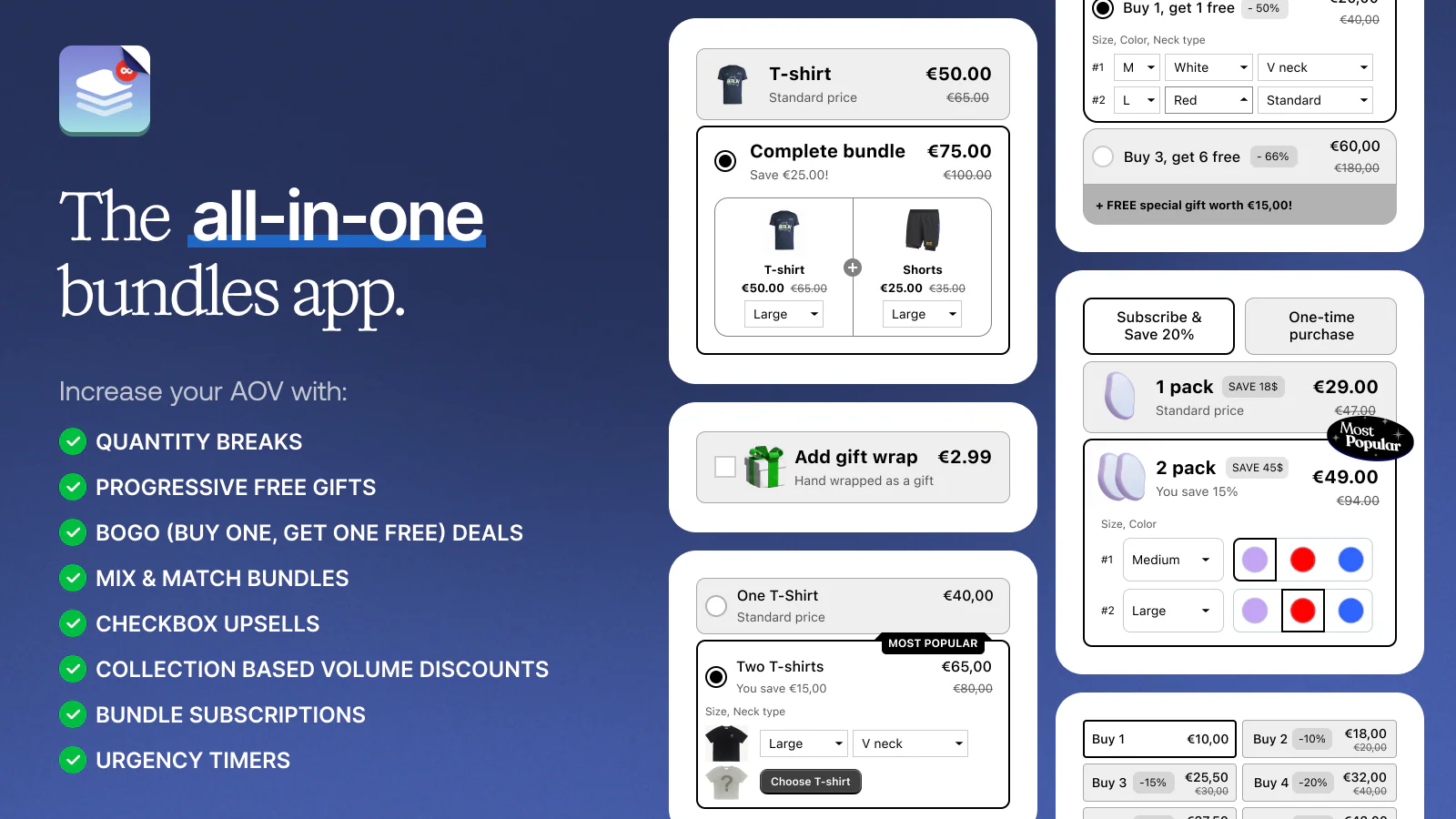
The most-reviewed app in this comparison, and it earns it. Kaching’s core strength is quantity break and volume discount widgets that look native to almost any theme with minimal fiddling.
Standout feature: built-in A/B testing. You can run competing bundle configurations against each other and let data decide, rather than guessing which layout converts. Very few apps in this category offer this natively.
Pricing:
- Free to install. – 7-day free trial.
- Paid plan starts from $14.99/mo.
Pros: enormous review base, excellent analytics dashboard showing additional revenue generated, A/B testing, live chat support that reviewers rate highly, nine languages, works with PageFly, GemPages, EComposer, UpCart.
Cons: it’s also revenue-capped, so you haven’t escaped Fast Bundle’s core pricing issue; you’ve just moved to a cheaper version of it. Less focused on bundle-as-product combos than Fast Bundle. No SKU breakdown for fulfillment.
Choose it if: quantity breaks and volume discounts are your primary tactic and you want to optimise them with real testing.
2. Bundler – Product Bundles: Best free plan in the category
4.9★ (2440+ reviews) · Built for Shopify · Free plan available
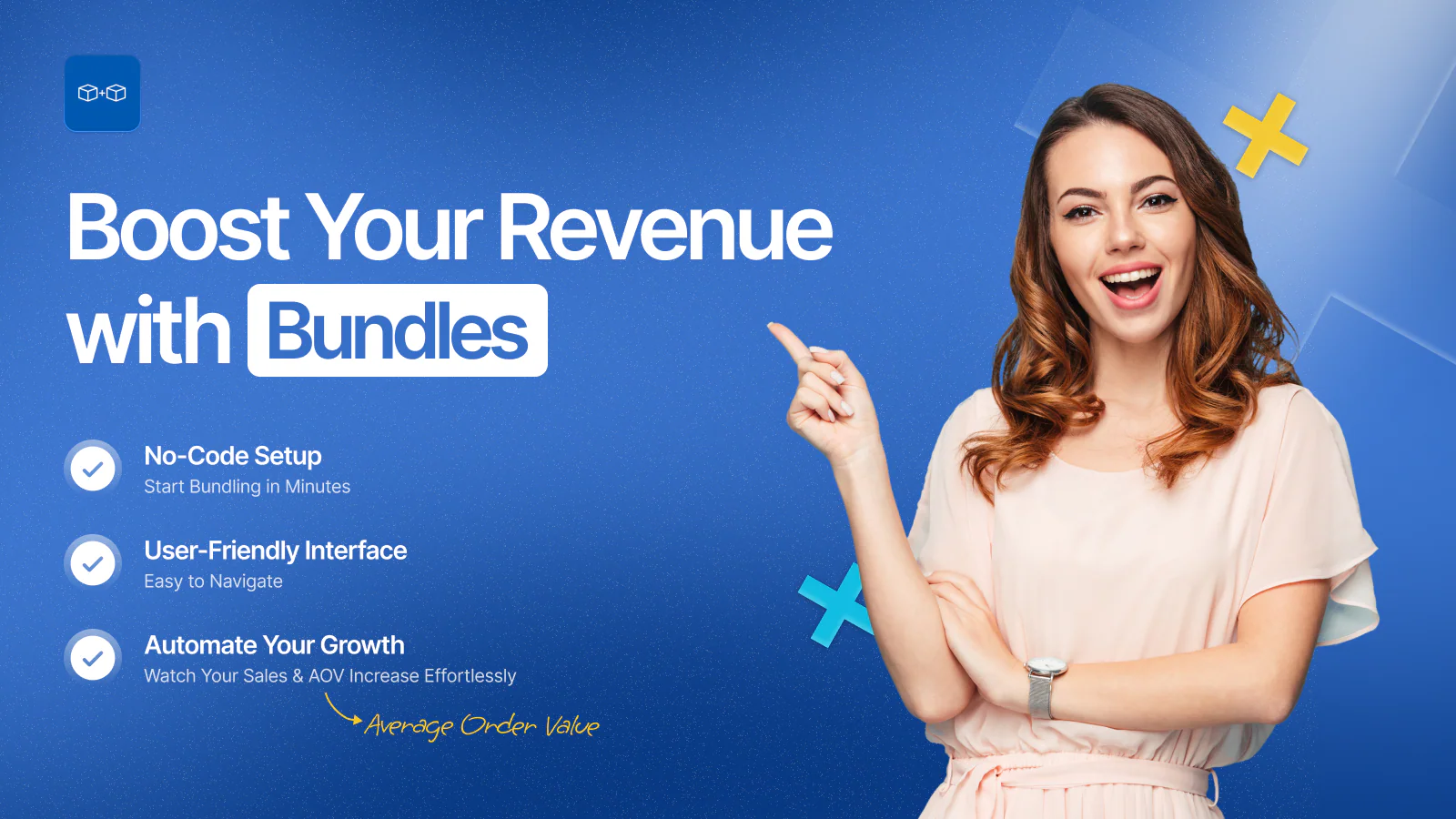
Bundler has the most generous free tier we found. The free plan includes unlimited revenue and orders plus Buy X Get Y, volume discounts, flexible discount types, product page upsells, Shopify POS support, and auto-applied discounts.
Pricing:
- Free to install. – 7-day free trial.
- Paid plan starts from $8.99/mo.
Pros: genuinely usable free plan, flat pricing throughout, seventeen languages, the widest in this comparison, running since 2019, POS support, bundle landing pages and shortcodes.
Cons: no SKU-level breakdown for 3PL or ERP workflows. Analytics are locked behind the top tier. One recent reviewer reported problems with products carrying very high variant counts (80+), which the developer responded to publicly; worth testing if that describes your catalogue.
Choose it if: you’re cost-sensitive, you sell in many languages, or you want to run bundles at zero cost while you validate the strategy.
3. Pumper Bundles Quantity Breaks: Best for volume discounts plus free gifts
4.9★ (3,140+ reviews) · Built for Shopify · Free plan available
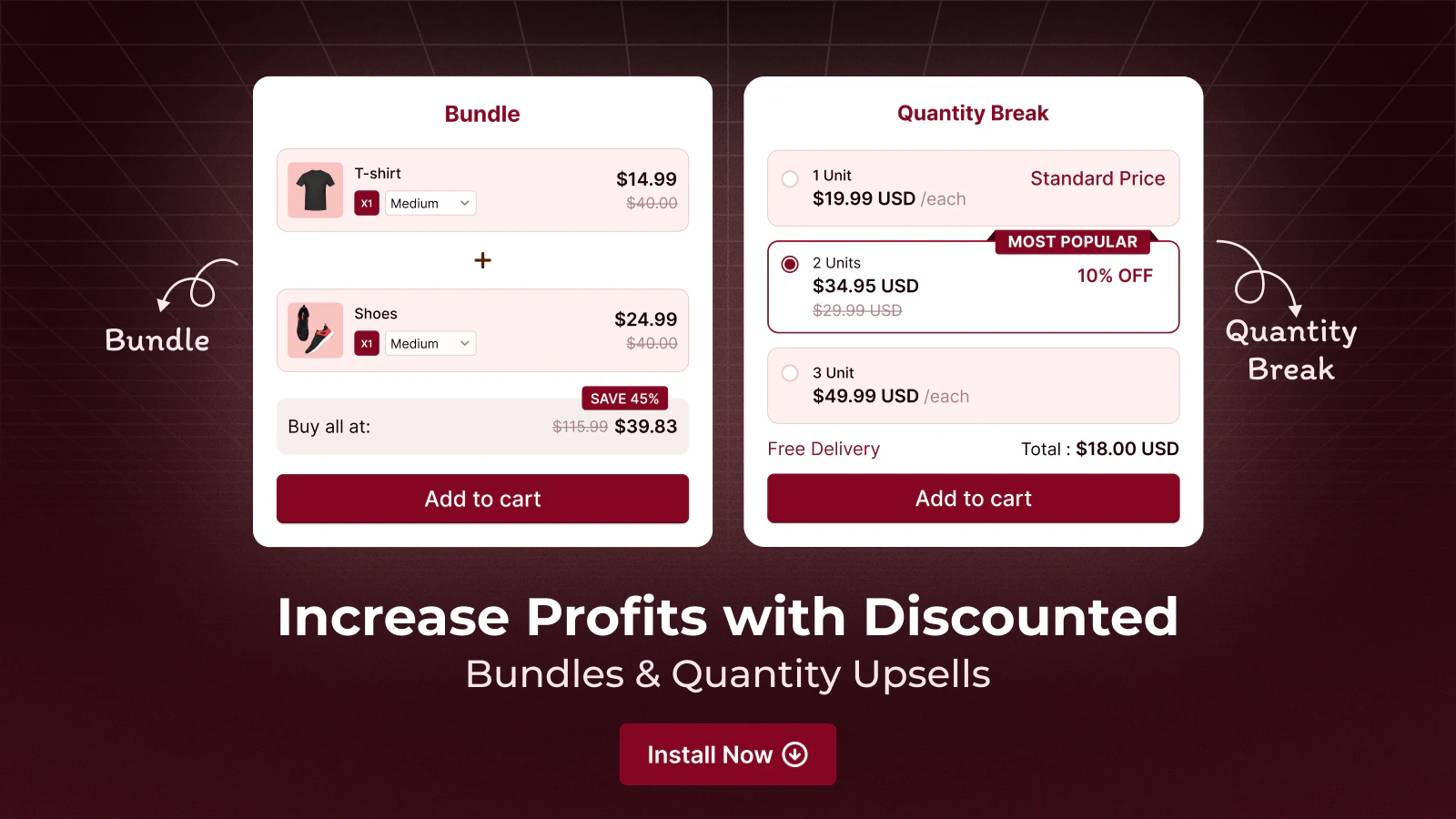
One of the most-installed apps in the product bundles category. Pumper combines bundle offers, free gift mechanics, and volume discounts in a single widget, which means one less app for merchants who’d otherwise run a separate gift-with-purchase tool.
Pricing:
- Free to install. – 7-day free trial.
- Paid plan starts from $9.99/mo.
Pros: very large review base, free plan available, combines three tactics (bundles, gifts, volume discounts) that often require separate apps, built for Shopify.
Cons: less emphasis on build-a-box and mix-and-match configurators than dedicated bundle builders. Check current plan limits directly on the listing; they’ve changed over time.
Choose it if: your AOV strategy leans on volume discounts and free gift thresholds rather than curated bundle products.
4. AI Product Bundle Builder: The underrated flat-fee option
4.9★ (20+ reviews) · Built for Shopify · Free plan available
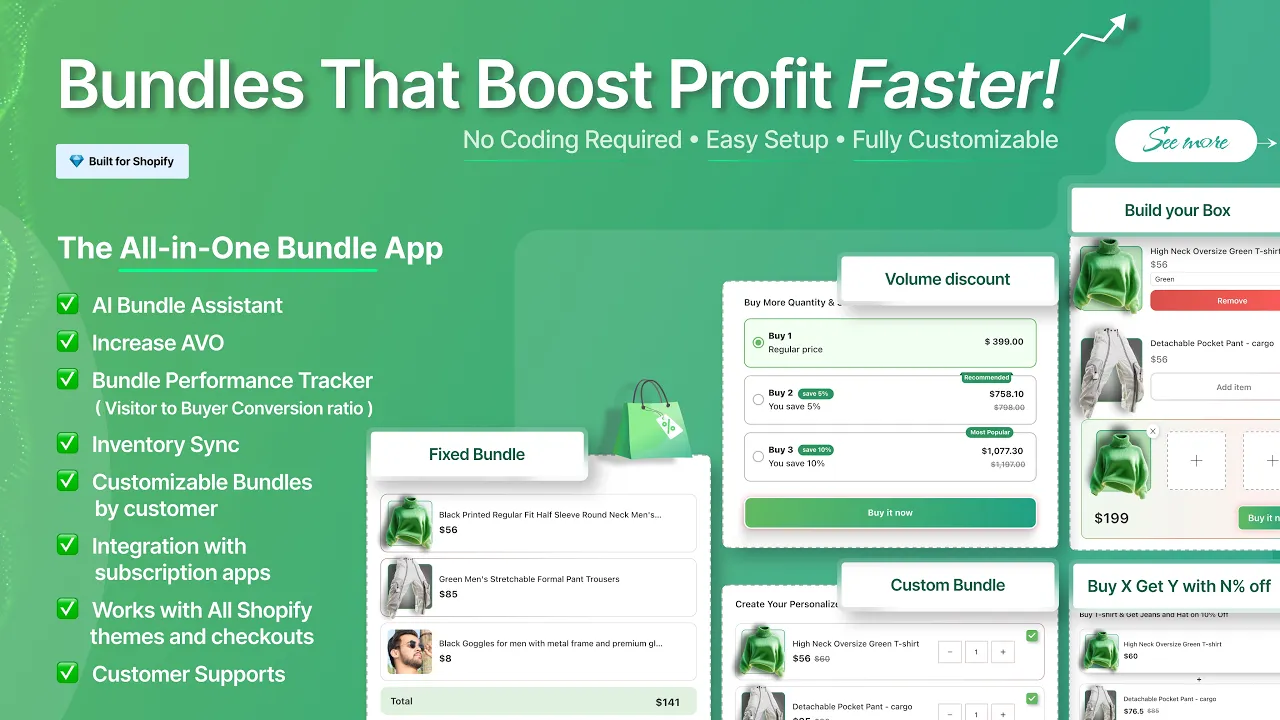
This is the one we didn’t expect to include. It has 20 reviews against Kaching’s 4,900 and Fast Bundle’s 3,000, and on review count alone, it has no business appearing in a list like this.
We installed it anyway, because it was one of the few apps offering the full bundle type range on genuinely flat pricing. It turned out to be the easiest app to set up of everything we tried.
What it does: Fixed bundles, custom bundles, build your box (with limited and unlimited pick modes), Buy Together, Buy X Get Y, volume discount bundles, mystery boxes, gift boxes, multipacks, wholesale bundles, and Frequently Bought Together. Bundles can display on any page of the store, not just product pages. Inventory syncs automatically to prevent overselling, and there’s CSV import for migrating a large bundle catalogue.
The AI component is an order-based bundle suggestion; it reads your actual order history and proposes combinations, rather than generating generic recommendations.
Pricing:
- Free to install. – 15-day free trial.
- Paid plan starts from $5.99/mo.
Pros:
- Flat pricing with no revenue cap the cheapest way to run bundles at $10K/month of any paid app here
- Free plan works on live stores, so you can validate properly before paying
- 15-day trial versus the 7-day standard in this category
- Built for Shopify badge, despite the small review count
- Mystery box and build-a-box modes that several larger competitors don’t offer
- Works with Checkout, POS, GoKwik, Recurpay, Order Printer
Cons, and the first one is significant:
- 16 reviews. This is the real caveat, and we’re not going to soften it. Fast Bundle has around 3,000 and Kaching close to 5,000. A small review base means less public evidence of how the app behaves at scale, under load, or when something goes wrong. If you want the reassurance of a large, long public track record, choose Kaching or Bundler instead.
- Three languages (English, French, German) versus Fast Bundle’s ten. If you sell into Japan, Turkey or Scandinavia, Fast Bundle or Bundler covers you better.
- Smaller integration ecosystem than the category leaders.
- No built-in A/B testing. Kaching is clearly stronger here.
- No SKU-level breakdown for 3PL workflows. Simple Bundles is the right choice if that’s your constraint.
Choose it if you want the full bundle-type range at a predictable flat fee, you specifically need build-a-box or mystery box, or you want to test on a free live-store plan before committing.
Don’t choose it if: you need broad language support, native A/B testing, warehouse-grade SKU handling, or you’re simply not comfortable running revenue-critical infrastructure on an app with a small review base. That last one is a perfectly rational position.
5. Simple Bundles & Kits: Best for 3PL, WMS and ERP Workflows
4.8★ (720+ reviews) · Built for Shopify · Free plan available
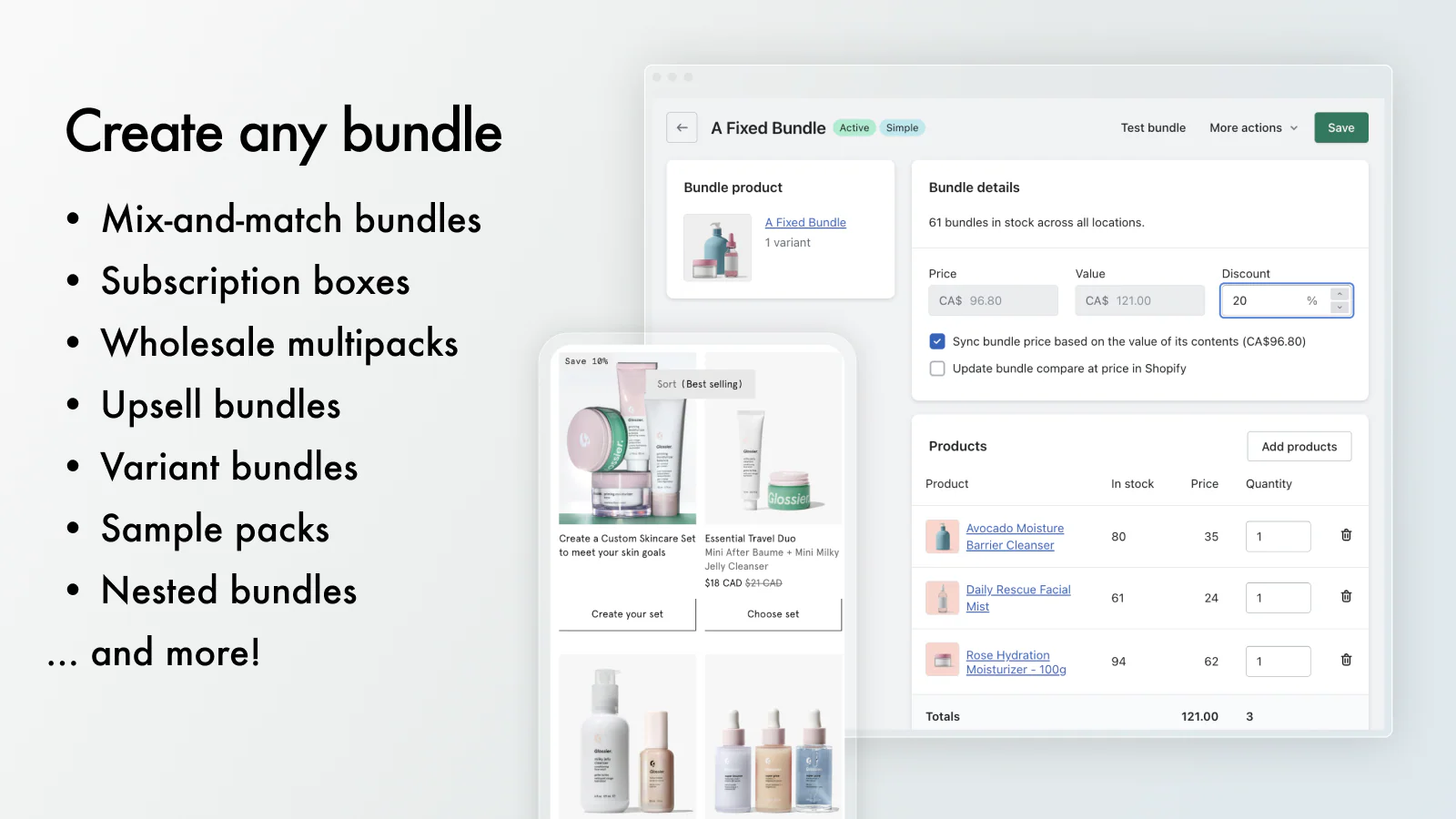
If your bundle problem happens after the order rather than before it, this is the app.
Simple Bundles splits the bundle into separate SKUs per order. The 3PL, warehouse management software, or ERP gets regular line items and not some bundle object that they don’t understand, and so the pick lists will be right and the stock is correctly reduced from the SKUs. It also avoids the 2,048-variant limit from Shopify, which comes up quickly with mix-and-match bundles.
Pricing:
- Free to install.
- Paid plan starts from $14/mo.
Pros: Best-in-class inventory and order fulfillment accuracy, integrations with POS, Shopify Flow, ShipStation, Amazon by Codisto, Hydrogen, and subscription apps. Supports B2B multipack subscriptions. Flat pricing.
Cons: English only. Deliberately light on frontend flash; if you want a heavily designed, animated bundle configurator, this isn’t it. Storefront customisation is weaker than Fast Bundle or Kaching.
Choose it if: you ship from a 3PL, you’ve had inventory mismatches or wrong items picked, or you’re running an ERP. This is the clearest “better than Fast Bundle” case in the whole list. Fast Bundle simply doesn’t compete on the operational side.
6. Easy Bundles: Bundle Builder: Best mix-and-match configurator
4.9★ (1,000+ reviews) · Built for Shopify · Free to install
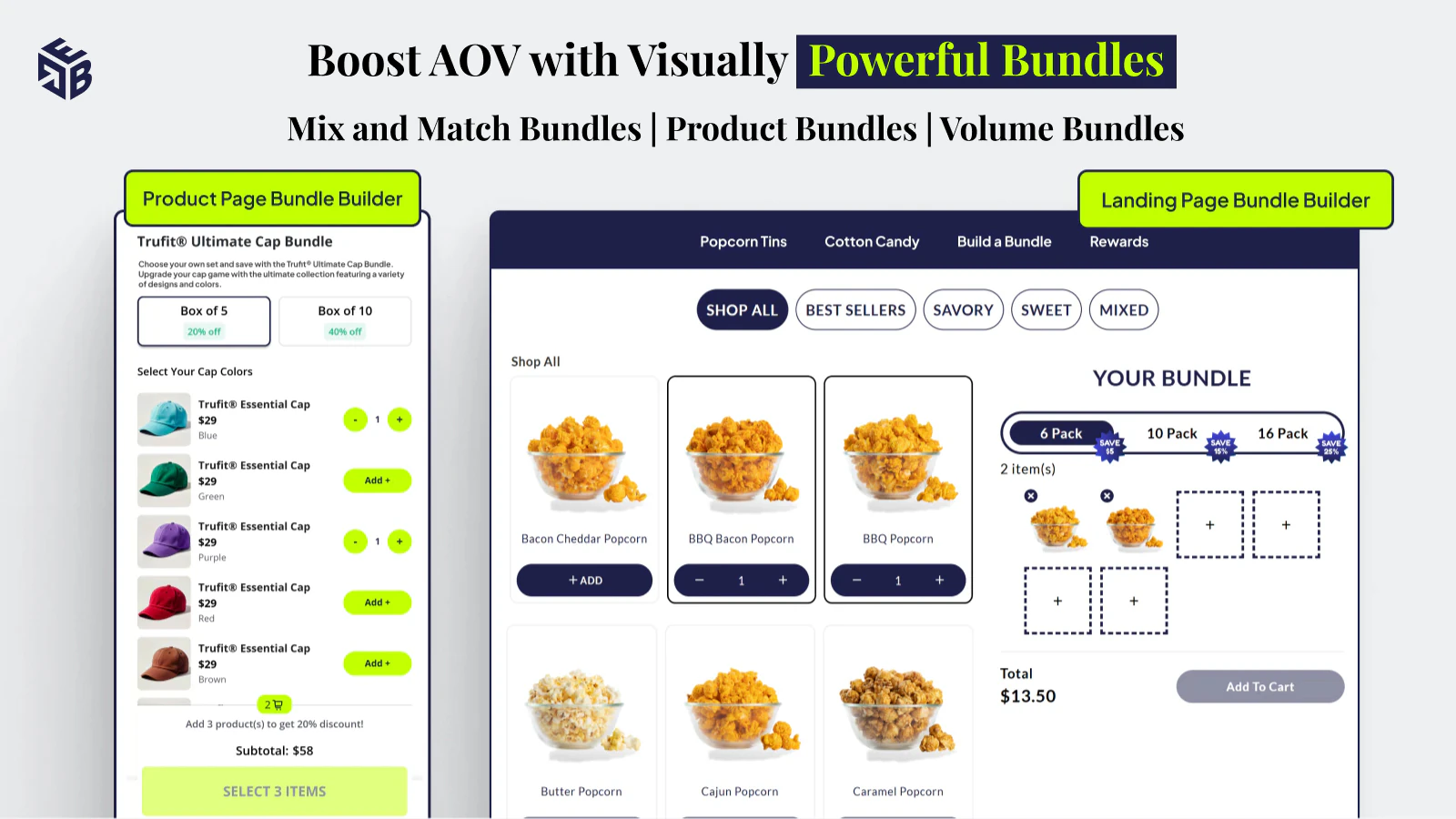
A dedicated bundle builder focused on mix-and-match and build-a-box experiences, the “pick any 4 from this collection” flow that subscription boxes, gift sets, and sample packs depend on.
Pricing:
- Free to install. – 15-day free trial.
- Paid plan starts from $29/mo.
Pros: strong configurator UX, large review base, built for Shopify, free to install, tracks each bundle component separately so inventory and discount codes behave correctly.
Cons: narrower than the all-in-one apps; if you also want quantity breaks, FBT and BOGO in the same tool, you may end up running two apps.
Choose it if: build-your-own-box is your product, not a side offer.
7. Shopify Bundles (native): Best for simple fixed bundles at zero cost
Free · First-party Shopify app · Rated around 2.8★
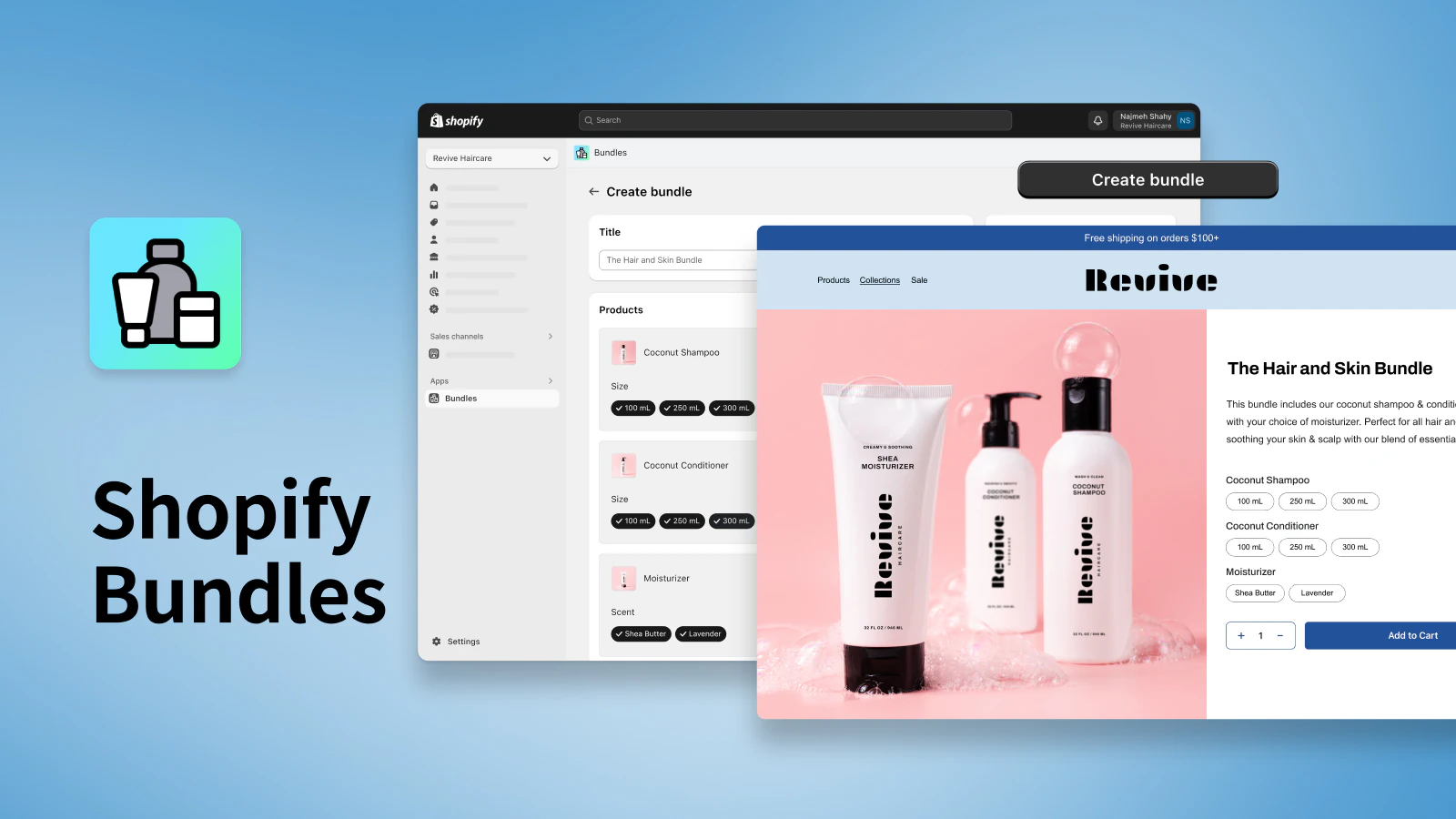
Before you pay anyone, check whether you need to. Shopify’s own free Bundles app creates fixed bundles a defined set of products sold as one SKU directly in the admin, with automatic component inventory sync. Setup takes minutes.
What it does well: It is free, has no revenue limit, is first party, and for a basic starter kit/gift set bundle, it will do nicely.
What it can’t do: No mixing and matching, no bulk purchasing, no quantity discounts. The pricing for bundles will not update automatically based on the price changes of the components in the bundle; you’ll have to modify them yourself. Lack of specific analytics for the bundles. It is incompatible with the official “Subscriptions” app of Shopify. It cannot track inventory per location, making it prone to overselling when using more than one warehouse for fulfillment.
Choose it if: you sell fixed bundles only, you’re cost-sensitive, and your store is already carrying more third-party JavaScript than you’d like.
One related note: if you’re on Shopify Plus with developer resources, you can build bundle logic directly on Shopify Functions. Shopify Scripts was sunset on 30 June 2026, so any bundle logic still riding on Scripts needs migrating; worth confirming your setup isn’t affected.
How to choose: a decision path
Work down this list and stop at the first line that describes you.
- You only sell fixed bundles and want to spend nothing → Shopify Bundles (native).
- Your bundles break at the warehouse → wrong picks, inventory mismatches, 3PL confusion → Simple Bundles & Kits.
- Build-your-own-box is your core product → Easy Bundles: Bundle Builder, or AI Product Bundle Builder if you also need fixed bundles, FBT and volume discounts in the same app.
- Quantity breaks are your main tactic, and you want to A/B test them → Kaching Bundles.
- You want maximum capability at zero cost while you validate → Bundler’s free plan.
- You want the full bundle range on a flat fee that won’t scale with success → AI Product Bundle Builder.
- You need ten-language support, bundle-as-product combos and a long track record, and the revenue-based pricing is acceptable → stay on Fast Bundle. It’s a good app.
Migrating away from Fast Bundle without losing sales
Switching bundle apps is riskier than switching most other app categories, because bundles touch pricing, inventory, and checkout simultaneously. A checklist:
- Document every live bundle first. Type, products, variants, discount logic, and where it displays. Screenshot the configuration. Most merchants discover mid-migration that they’d forgotten a bundle running on a collection page.
- Install the new app before uninstalling the old one. Running both briefly is fine; running neither is.
- Check for orphaned discounts. Some bundle apps leave automatic discounts or discount codes behind on uninstall. Audit Discounts in Shopify admin after removing the old app.
- Verify theme app blocks and script tags are gone. Leftover code from an uninstalled app is a common cause of mysterious layout breakage and page speed regression.
- Test with a real order. Place a genuine test purchase through each bundle type. Confirm the discount applies, the correct components decrement inventory, and the order reaches your fulfillment system in a form your warehouse understands.
- Watch discount stacking. Shopify applies only one product discount per line item. If your bundle discount conflicts with another active automatic discount, Shopify picks the larger and ignores the other. Test this against your existing promotions before going live.
- Don’t migrate during a peak period. Not the week before BFCM. Not during a launch.
- Keep the old app installed for a week after cutover. Cheap insurance.
Frequently asked questions
Is Fast Bundle worth it?
For merchants who need broad bundle type coverage, strong multilingual support and bundle-as-product combos, yes. The main reasons to look elsewhere are its revenue-capped pricing, the lack of a free plan for live stores, and limited SKU breakdown for warehouse-heavy operations.
What’s the cheapest Fast Bundle alternative?
Shopify’s native Bundles app is free but only handles fixed bundles. Among full-featured apps, Bundler’s free plan includes unlimited revenue and orders. For paid flat-rate plans, AI Product Bundle Builder starts at $5.99/month and Bundler’s Premium at $9.99/month.
Which bundle app is best for inventory and 3PL?
Simple Bundles & Kits. It breaks bundles into individual SKUs at the order level so warehouses, WMS, and ERP systems see standard line items. This is the one area where Fast Bundle is clearly not the strongest option.
Can I create bundles on Shopify without an app?
Sort of. The free native Bundles app for Shopify can deal with fixed bundles. Multipacks can be set up as regular variants that have a price and SKU all of their own. Automatic Buy X Get Y discounts native to the platform will work well if you want a “buy together and save” type arrangement, assuming you’re fine with your customers picking out both items themselves.
Do bundle apps slow down my store?
They can. Any app injecting storefront JavaScript adds weight. Apps carrying the “Built for Shopify” badge have passed Shopify’s performance standards, which is a meaningful filter; every app in this comparison except the native one carries it. Test your Core Web Vitals before and after installing anything.
Will my bundle discount stack with my other promotions?
Usually not. Shopify applies one product discount per line item, and when two automatic discounts conflict, it applies the larger and ignores the other. Test your bundle against your existing active discounts before launch.

Shopify Expert
Dipen Panchal, Shopify Tech Lead at Setubridge Technolabs, brings over a decade of expertise as a Shopify Expert. Passionate about e-commerce growth, he specializes in UI/UX design, crafting intuitive, engaging solutions tailored for merchants and B2B clients to enhance user experiences.