




It’s 11:40 p.m. in Columbus, Ohio. A shopper has a winter jacket in her cart and one question: “Will this arrive before Thanksgiving?” She types it into your contact form and waits. Nobody replies, so she closes the tab and buys the same jacket somewhere else.
That sale was not lost on price or product. It was lost because a simple question went unanswered at the wrong moment. Most online stores convert only 2.5% to 3% of their visitors. Many of the shoppers who leave had a question nobody was awake to answer.
A free AI chatbot for Shopify closes that gap. It answers shoppers 24/7 using your products, policies, and order data. This guide shows how a Shopify AI chatbot lifts sales and cuts support work. You will also learn how to set one up in an afternoon and measure whether it pays off.
Key Takeaways
- A free AI chatbot for Shopify answers product, shipping, and order questions 24/7 using your own store data.
- Unanswered pre-purchase questions cost sales, since most stores convert only 2.5% to 3% of visitors.
- AI Shopping Assistant Chatbot by SetuBridge offers unlimited AI chats on its free plan for stores with up to 50 products.
- A well-trained bot resolves roughly 40% to 60% of routine questions, while people handle refunds and complaints.
- Clean product data and clear policies decide answer quality more than any single feature.
- A 30-day pilot tracking chat-assisted conversion, order value, and resolution rate shows whether to upgrade.
- US shoppers should always know they are chatting with AI and have an easy path to a person.
What Is a Free AI Chatbot for Shopify?
A free AI chatbot for Shopify is an app from the Shopify App Store that sits on your storefront. It reads your products, policies, and orders, then answers shoppers in natural language. It works 24/7, with no staff online. Free plans usually limit usage or catalog size, while paid plans unlock more products and reporting.
AI chatbot vs. rule-based bot vs. live chat vs. email form
Shopify merchants usually choose between four ways to answer shopper questions. Each one handles timing and understanding differently. The table shows which option covers which job.
| Option | Understands free-form questions? | Learns from your store? | Works after hours? | Typical cost |
| AI chatbot | Yes | Yes: products, policies, orders | Yes, 24/7 | Free plans available; most small stores pay $20 to $100 a month on paid plans |
| Rule-based chatbot | Only preset keywords | No, follows fixed scripts | Yes | Often free |
| Live chat (human) | Yes | Through your team’s knowledge | Only when staffed | Staff time |
| Email or contact form | Yes | Through your team’s knowledge | Replies wait until someone checks | Free |
One point often confuses merchants. Shopify Sidekick is an AI assistant, but it helps you inside the Shopify admin. It does not chat with shoppers on your storefront.
How it works behind the chat widget
- Catalog sync: The app imports product titles, variants, prices, and descriptions.
- Knowledge sources: You add FAQs, policy pages, size guides, or PDFs.
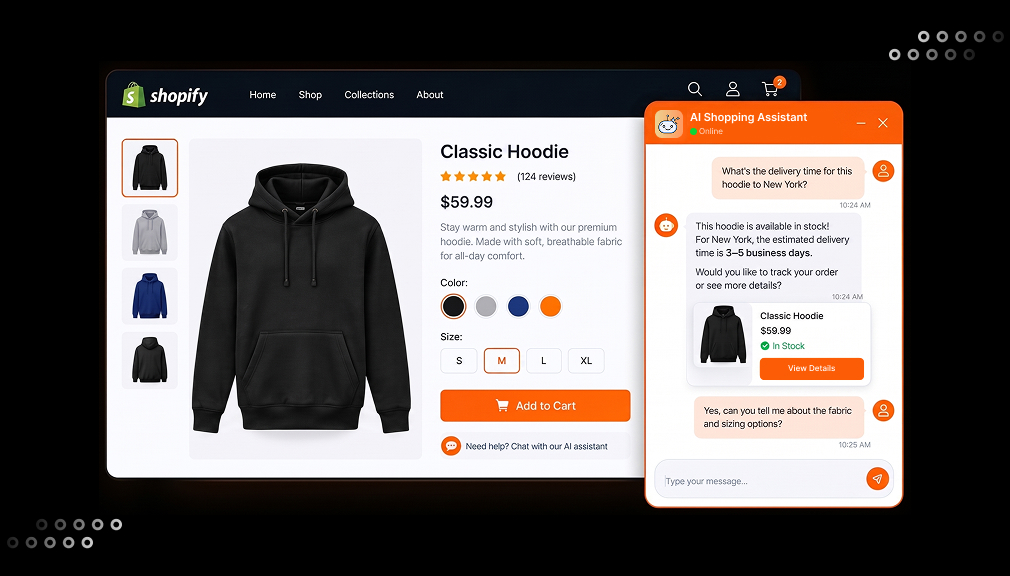
- AI answer: A shopper asks a question, and the AI writes a reply from your data.
- Product cards and cart: The bot shows matching products, and some plans add them to the cart.
- Human handoff: Refunds, complaints, and tricky cases go to you or your team.
What “free” usually means
Most Shopify chatbot apps use a freemium model. The free plan gives you the core AI chat with some limits. Common limits include conversations, tokens, credits, product count, and app branding. Paid tiers usually add analytics, more languages, longer chat history, and chat-to-cart.
Why Shopify Stores Are Adding AI Chatbot
Shopper patience has dropped, and small teams cannot cover every hour. A Shopify AI chatbot fills that gap without hiring. Brands already see results. In Gorgias’s 2026 study, 79% of brands said AI chat increased sales and conversions.
Shopper expectations are also shifting fast. The same report found that 94% of brands expect 24/7 AI chat to become the standard. Shoppers are also ready to buy inside a chat window. In one 2026 survey, 72% of consumers would consider completing a full purchase in an AI chat.
Now look at the small-team math. A US store sells across six time zones, from Maine to Hawaii. One owner cannot answer DMs, email, and chat from 7 a.m. Eastern to midnight Pacific. An AI shopping assistant covers those hours while you sleep, pack orders, or plan your next drop.
Fast answers also shorten the path to purchase. When an AI assistant recommends products, 80% of the resulting purchases happen the same day. Quick replies keep shoppers on your site while their buying intent is still high.
Conversion numbers vary widely by source, so plan with ranges. One widely shared figure shows AI chat users converting at 12.3% versus 3.1% for non-users. Shoppers who chat often arrive with stronger intent, so treat that as an upper range. A conservative estimate puts the overall conversion lift at about 3% to 10%. Even the low end adds real revenue for most stores.
Timing matters too. Black Friday falls on November 27, 2026, with Cyber Monday on November 30. Question volume peaks when your support time is thinnest. A chatbot set up in early November has time to learn before the rush.
7 Ways a Free AI Chatbot Boosts Shopify Sales
Each tactic below starts with a real merchant problem. You will see what the chatbot does, a sample shopper question, and the number to watch. Use these as a checklist when you train and review your bot.
1. Guided product discovery
Shoppers often know their need but not your product names. Browsing 40 collection pages feels like work, so they leave. An AI chatbot turns a plain request into a short list of matching products. Sample: “I need running shoes for flat feet under $120.” Watch the product-card click rate inside chat.
2. Answering pre-purchase questions instantly
Sizing, materials, compatibility, and shipping cutoffs block more sales than price does. A shopper who cannot confirm a detail usually waits, and waiting turns into leaving. The chatbot answers from your product data in seconds. Sample: “Is this rug safe for a home with a dog?” Watch the chat-assisted conversion rate.
3. Chat-to-cart and chat-to-checkout
Every extra click between “I want this” and payment loses buyers. Some chatbots can add an item to the cart or share a secure checkout link. The shopper goes from question to purchase in one window. Sample: “Add the medium in navy to my cart.” Watch how many chats end in a cart action.
4. Helpful cross-sells
Random upsell pop-ups feel pushy and get ignored. A chatbot suggests add-ons tied to the exact question the shopper asked. That feels like help from a good store clerk. Sample: “What cleaner works with this leather bag?” Watch average order value (AOV) on chat-assisted orders.
5. Rescuing hesitant carts
The average cart abandonment rate sits at 70.19%, based on Baymard Institute data. Many carts stall on one doubt about returns, fees, or delivery dates. A chatbot answers that doubt while the shopper is still on the page. Sample: “Can I return this if it doesn’t fit?” Watch the cart-to-order rate for chatting shoppers.
6. Serving multilingual US shoppers
About 22% of US residents speak a language other than English at home. Spanish leads, followed by Chinese in several states. A shopper who can ask in their own language trusts the answer more. Check whether your plan includes multilingual chat, since many apps place it on paid tiers. Watch conversion for non-English chats.
7. Turning repeat buyers into repeat sales
Returning customers often ask, “What did I order last time?” A chatbot with order access can look up past purchases and suggest refills or next items. That saves the customer time and brings them back sooner. Sample: “I need more of the coffee I bought in August.” Watch the repeat purchase rate from chat.
The Best Free AI Chatbot App for Shopify: AI Shopping Assistant Chatbot
For most small US stores, the best free AI chatbot keeps answering all month. The free plan of this Shopify chatbot app has no monthly cap on AI chats. That means every shopper gets a reply, even when holiday traffic spikes overnight.
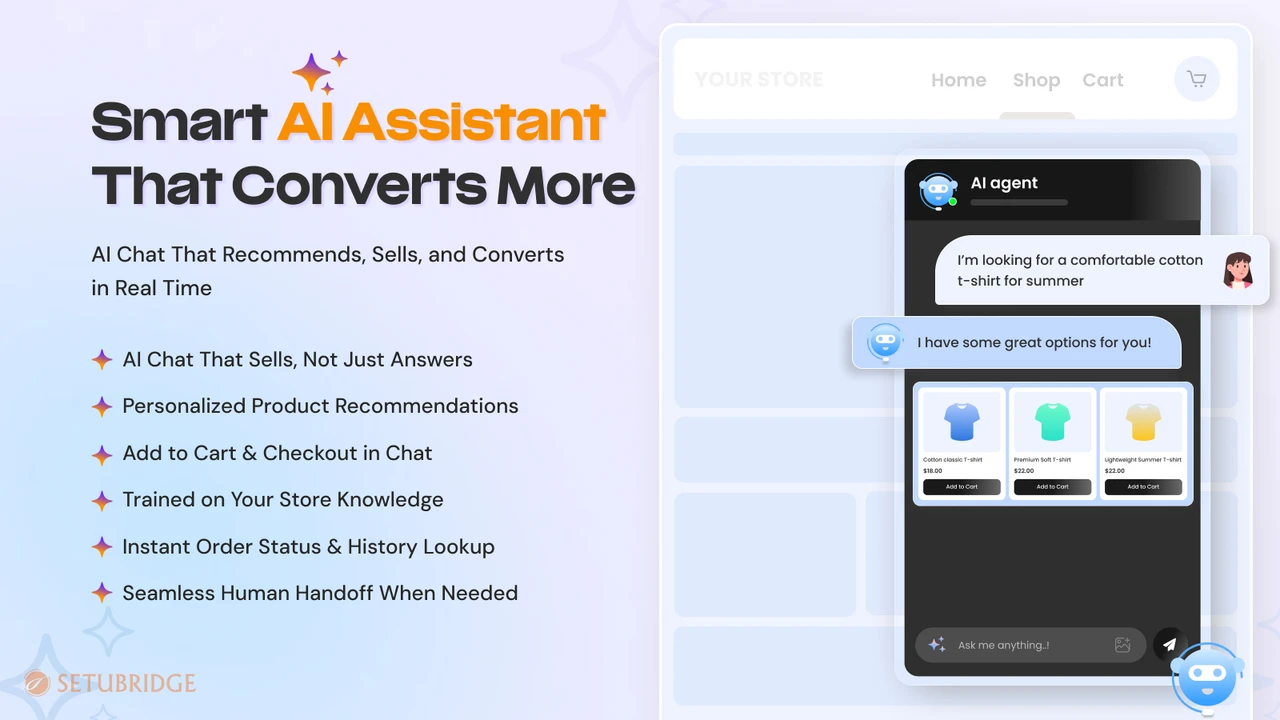
AI Shopping Assistant Chatbot by SetuBridge works as a 24/7 AI shopping assistant on your storefront. It reads your product catalog and store knowledge, then answers shopper questions in plain language. Shoppers can ask for product ideas, compare items, and get policy answers without leaving the page. On paid plans, they can also add items to the cart straight from the chat.
The app targets one clear problem for small stores: shopper questions that go unanswered after hours. Its free plan includes unlimited AI chats, so the assistant never goes quiet mid-month. It covers up to 50 products, which suits a new store or a bestselling collection. The app launched on the Shopify App Store in March 2026 and supports 11 languages, including Spanish and Chinese.
What the free plan includes
| Free plan feature | What it does for your store |
| Unlimited AI chats/conversations | Answers every shopper, day or night, with no monthly cap |
| Up to 50 products | Covers a new store, a starter catalog, or your top collection |
| AI-powered chat widget | Lets shoppers ask questions in their own words on desktop and mobile |
| AI product search and recommendations | Turns “I need a gift under $50” into matching products |
| Store policies auto-sync | Keeps shipping, return, and refund answers in line with your published policies |
Why unlimited AI chats matter for a small store
Many free chatbot plans set a usage limit by conversations, tokens, or credits. That works for testing, but shopper traffic never arrives evenly. One Black Friday email can bring a week of questions in a single evening. With unlimited AI chats, every shopper gets an answer, and you collect a full month of data to judge results.
Where it fits in your workflow
- New and small US stores with up to 50 products that need 24/7 answers.
- Solo owners who want to test AI chat on real traffic before paying for anything.
- Seasonal sellers who expect BFCM or holiday spikes cannot staff.
When to upgrade
The free plan is built for answering questions on a focused catalogue. Growing stores often need more products, chat-to-cart, or revenue tracking. Each paid tier comes with a 7-day free trial, so you can test before you commit.
- Standard ($19.99/month): up to 500 products, add to cart from chat, full widget styling, and no “Powered by” branding.
- Growth ($49.99/month): up to 2,000 products, conversion analytics, revenue tracking, and multi-language AI chat.
- Premium ($99/month): up to 5,000 products, 1,500 knowledge sources, and unlimited chat history.
Before you install any chatbot, read the data permissions it asks for on its App Store listing. This app requests access to products, customers, and the last 60 days of orders. That access is what lets it answer order-status and product questions.
How Free Shopify AI Chatbot Plans Compare
Free plans differ most in how they measure usage, not in whether they use AI. The table below turns each plan into something you can plan around: answers per month and catalog size. Data comes from each app’s Shopify App Store listing as of October 28, 2026.
| App | Free plan usage | Products on free plan | Store data it learns from | Free plan highlight | Free answers per 30 days |
| AI Shopping Assistant Chatbot by SetuBridge | Unlimited AI chats | Up to 50 | Products and store policies (auto-sync) | AI product search and recommendations | No set limit |
| HeiChat: ChatGPT Sales Chatbot by heicarbook | 800k free tokens, then $1 per 200k tokens | 100 products to recommend | Store policies, PDF and TXT files, 20 knowledge bases | Switch between AI models; mobile app | Depends on reply length |
| StorePal AI Chatbot Assistant by StorePal AI | 20 credits refill daily (1 credit = 1 AI answer) | Unlimited store and product data | Product details | “Ask AI” button on product pages; free chat tester | About 600 (20 × 30 days) |
| Shopify Inbox by Shopify | Free app | Full catalog | Catalog, inventory, policies, and store content | AI sales associate; 21 languages | Not stated on listing |
How AI Chatbots Lighten Your Customer Support Load
Support questions repeat far more than they vary. A Shopify AI chatbot handles the repeats, so you spend time on cases that need a person. The goal is not to replace you. It is to keep you out of the same five conversations every day.
Ending “Where is my order?” tickets
“Where is my order?” (WISMO) is one of the most common support questions in ecommerce. A chatbot with order access looks up status and tracking in seconds. The customer gets an answer without waiting for your email reply. You get fewer tickets in your inbox every morning.
Policy answers that stay consistent
When three people answer return questions, you get three different answers. A chatbot trained on your actual policy pages gives the same answer every time. Apps with policy auto-sync update those answers when you edit a policy. That protects you from promising something your policy does not allow.
True 24/7 coverage without night shifts
Shoppers buy at night, on weekends, and on holidays. Hiring for those hours rarely makes sense for a small store. A chatbot covers them at no extra staff cost. Your morning starts with orders, not a backlog.
Knowing when to hand off to a person
Some conversations need a human touch: refunds, complaints, discount requests, and upset customers. Set clear rules so the chatbot passes these to you with the full chat history. This is normal and healthy. In fact, 86% of brands report that at least 25% of AI chats escalate to people.
Chat logs as free customer research
Every chat tells you what shoppers wanted to know but could not find. Repeated questions point to missing size charts, unclear policies, or weak product photos. Some questions even reveal products shoppers want you to stock. Read transcripts weekly and fix the top three gaps.
Set realistic expectations: A well-trained AI chatbot resolves about 40% to 60% of routine questions on its own. Treat higher claims as a best case, not a plan. Even 40% can free up hours each week for a solo owner.
Who Should Use a Free AI Chatbot (and Who Should Wait)
A free AI chatbot works best when shoppers ask the same questions often. It helps less when your product data is thin or unclear. Use the table to judge your fit before you install anything.
| Store profile | Fit | Why |
| New store, under 50 products, low traffic | Strong | A free plan covers the volume, and 24/7 answers build early trust |
| Solo owner or 1–3 person team | Strong | Offloads repeat questions so you can focus on growth |
| Products with many specs or sizes (apparel, beauty, electronics, home) | Strong | Pre-purchase questions block sales in these categories |
| Dropshipping or long shipping times | Good | Absorbs “Where is my order?” volume |
| High-ticket or custom products | Good, with handoff | Qualifies interest, then routes serious buyers to you |
| Regulated claims (supplements, CBD, medical devices) | Use caution | The bot must stick to approved wording and never invent health claims |
| Stores with messy or missing product data | Wait | Fix descriptions first, because a bot repeats whatever data it gets |
The Free Plan Reality Check
Free plans are built to prove value before you pay. Know what you get before you plan your holiday season around one. Free tiers usually differ in conversations, product count, knowledge sources, branding, chat history, and analytics.
Run the simple math first. A 50-conversation monthly cap works out to about 1.7 chats a day. That is enough to test the idea, but not to cover BFCM. So check whether a free plan limits conversations, products, or both.
Pricing models matter once you upgrade. Some apps charge per conversation, some per reply, some per resolution, and some use flat tiers. Per-conversation and per-resolution bills can jump in November when chat volume spikes. Flat tiers give you a predictable monthly cost.
5 signals you have outgrown the free plan
- You hit a usage cap before the month ends.
- Your catalog grows past the free product limit.
- You need revenue tracking to prove chat sales.
- Many shoppers write in Spanish or another language.
- “Powered by” branding no longer fits your store’s look.
Conclusion
A free AI chatbot for Shopify is a low-risk way to answer shoppers 24/7. It turns late-night questions into sales and keeps repeat support tickets out of your inbox. The best results come from clean product data, clear policies, and honest AI disclosure. Pick one free Shopify chatbot app, run a 30-day pilot, and track conversion, order value, and resolution rate. Let your own numbers decide whether to stay free or upgrade.
FAQs
Does Shopify have a built-in AI chatbot?
Yes. Shopify Inbox is Shopify’s free chat app, and it now includes an AI sales associate. Shopify Sidekick also uses AI, but it helps merchants in the admin, not shoppers.
Is a free AI chatbot good enough for a small Shopify store?
For many small stores, yes. A free plan can answer product, policy, and order questions around the clock. Upgrade when you outgrow product limits or need revenue tracking.
How much does a Shopify AI chatbot cost after the free plan?
Most small stores pay $20 to $100 a month on paid plans. Check whether the app bills per conversation, per reply, or a flat monthly fee.
Will a chatbot slow down my Shopify store?
Most chat widgets load separately from your main page content. Test your store speed before and after installing to be sure.
Can an AI chatbot answer “Where is my order?”
Yes, if the app has access to your order data. It looks up the order status and tracking details in seconds.
Do I need to tell US customers they are chatting with AI?
It is the safest choice. Some states, like Utah, require disclosure when a shopper asks, and more rules are coming. A short label in the welcome message covers you.

Shopify Expert
Dipen Panchal, Shopify Tech Lead at Setubridge Technolabs, brings over a decade of expertise as a Shopify Expert. Passionate about e-commerce growth, he specializes in UI/UX design, crafting intuitive, engaging solutions tailored for merchants and B2B clients to enhance user experiences.