





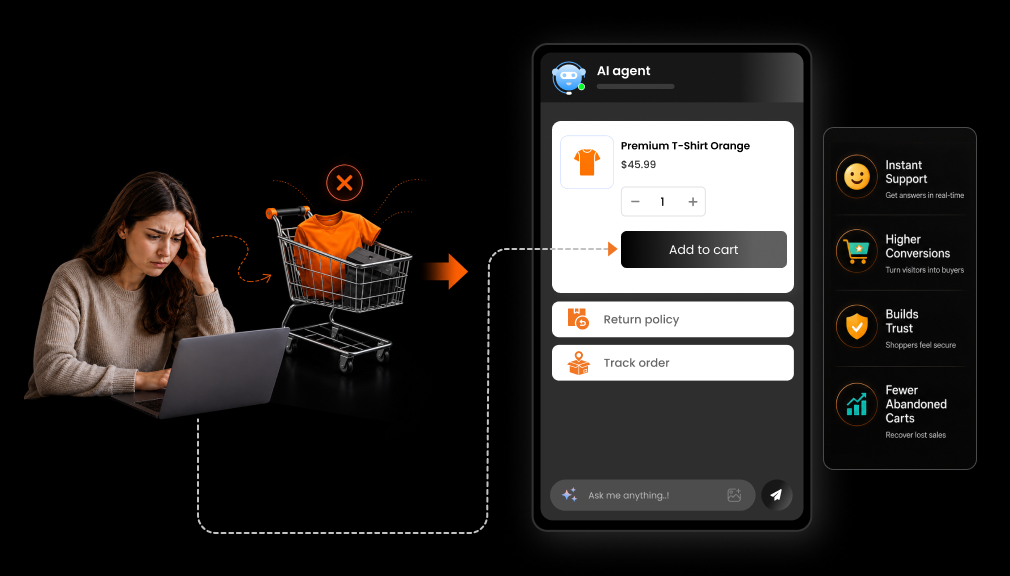
A shopper lands on your Shopify store at 11 p.m. She likes a jacket but has one small question. “Will this fit me?” She looks for an answer but finds none. So she closes the tab and moves on.
No one was there to help her. She had her card ready, but her doubt stopped her. You never even saw her visit. This happens on Shopify stores every hour of every day. Real buyers leave over small, unanswered questions.
Now imagine a different moment. A friendly AI shopping assistant pops up in the corner. It answers her fit question in seconds, using your size guide. It even suggests a matching scarf and adds both to her cart. She checks out happy, and you made the sale.
That is what an AI shopping assistant does for your store. It helps shoppers the moment they hesitate. This guide shows why shoppers leave without buying. It also shows how an AI shopping assistant wins them back.
The Silent Exit: Why Most Shoppers Leave
Here is a hard truth for every store owner. Most people who visit your store never buy. In fact, about 97% of shoppers leave without a purchase. On top of that, cart abandonment now tops 70%.
Many merchants assume the reason is price. But price is rarely the whole story. Shoppers often leave because something small got in the way. A missing answer, too many choices, or a moment of doubt can end the sale.
The good news is that these problems are fixable. Each one happens at a clear point in the journey. An AI shopping assistant meets shoppers at those exact moments. Let us look at the top reasons buyers leave.
Reason 1: Their Questions Go Unanswered
Every shopper has questions before they buy. Will it fit? Is it in stock? When will it arrive? When these questions go unanswered, trust drops fast.
The data here is striking. A Forrester study found 53% of shoppers abandon a purchase without a quick answer. Meanwhile, 73% of shoppers now expect instant responses. If your store stays silent, they leave.
An AI shopping assistant answers these questions right away. It reads your product catalog, FAQs, and pages to reply. So shoppers get correct answers in seconds, day or night. No one waits, and no sale slips away.
Reason 2: They Can’t Find the Right Product
A large catalog can overwhelm your shoppers. Too many choices often lead to no choice at all. This is called decision paralysis, and it quietly kills sales. Shoppers get stuck, give up, and leave.
Search and filters do not always help either. One study found 27% of shoppers leave when shown too many options. They cannot narrow things down, so they quit. Your catalog holds the right product, but they never find it.
An AI shopping assistant works like a smart sales clerk. It asks simple questions about needs and budget. Then it suggests the best matches from your store. This guided help turns aimless browsing into buying.
Reason 3: They Hesitate at the Cart
Sometimes shoppers add an item, then freeze. A last-minute doubt creeps in before checkout. Maybe they worry about sizing, shipping, or returns. With no help, they close the tab and forget.
An AI shopping assistant steps in at this key moment. It answers doubts about fit, delivery, or returns in real time. It can even offer a nudge when a shopper tries to leave. Proactive AI chat recovers up to 35% of abandoned carts.
Compare that to email recovery, which saves far less. An AI shopping assistant acts while the shopper is still there. That timing is what makes it so powerful. It saves the sale before it is lost.
How an AI Shopping Assistant Wins Shoppers Back
So what happens when you fix these leaks? The results are bigger than most merchants expect. An AI shopping assistant does more than answer questions. It actively guides shoppers toward checkout.
The numbers make the case clearly. Shoppers who engage an AI chatbot convert at 12.3%, versus 3.1% for those who don’t. That is nearly a 4x jump in conversion.
The gains do not stop at conversions. Shoppers who use an AI assistant are 40% more likely to click through and 25% more likely to buy. And smart recommendations lift average order value by 8–20%.
In short, an AI shopping assistant sells while you sleep. It guides, answers, and recommends at every step. It turns quiet browsers into confident buyers. That is real revenue from traffic you already have.
It Also Cuts Your Support Workload
An AI shopping assistant does more than drive sales. It also lightens the load on your support team. Shoppers can check order status right inside the chat. They can ask about returns or track a package on their own.
This self-service saves your team hours each week. AI can resolve routine tickets with about a 71% success rate. When a case is sensitive, the chat hands off to a human. So refunds and complaints still get a personal touch.
How to Add an AI Shopping Assistant to Your Shopify Store
Adding an AI shopping assistant is easier than you think. You have two main ways to do it. One is quick and built for the job. The other is slow and full of gaps.
Option 1: Shopify App-Based Solution (Recommended)
The simplest way to prevent shoppers from leaving your store without buying is to use a dedicated AI Shopping Assistant Shopify app. It installs in minutes with no coding required, connects to your product catalog, and instantly answers customer questions, helping you recover lost sales, increase conversions, and deliver a better shopping experience.
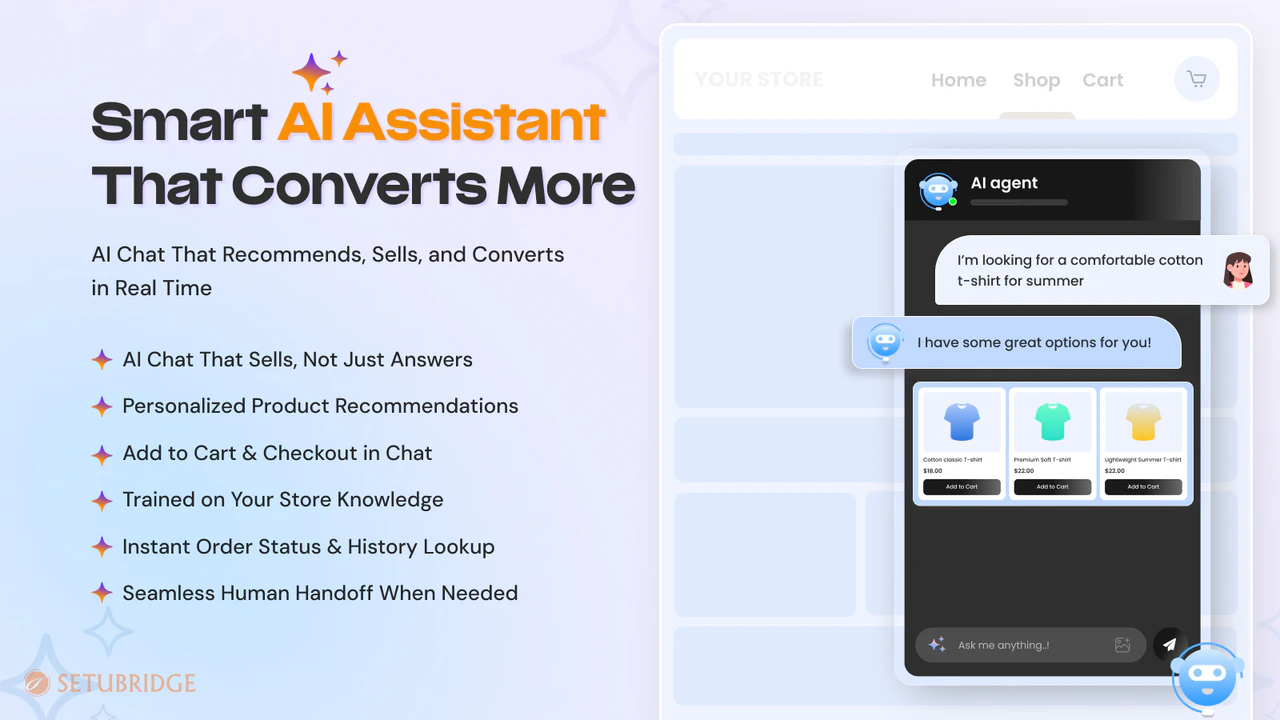
Setup is simple and needs no developer. First, you train the assistant on your data. You add product details, FAQs, PDFs, and pages. Then you style the chat widget to match your brand.
This method handles the hard parts for you. It recommends products, adds to cart, and checks orders. It also escalates tricky cases to your team. For most merchants, this is the smart, safe choice.
Option 2: Generic Chat or DIY Setup
You could also piece together a solution by hand. This might mean a basic live chat or a simple rule-based bot. These tools can help a little, but they fall short fast. For a growing store, the gaps add up quickly.
- Needs staff online. Live chat only works when a human is free to reply.
- No product smarts. Basic bots can’t recommend items or read your catalog.
- Rigid answers. Rule-based bots follow scripts and miss real questions.
- No order lookup. Most simple tools can’t check order status or history.
- Weak at scale. Manual chat cannot handle busy sales or late-night traffic.
- More upkeep. You must update scripts and answers by hand, again and again.
For these reasons, most Shopify merchants choose a purpose-built app. It offers real AI help with far less effort. An AI shopping assistant should grow your sales, not your workload. The app-based path keeps your focus on your store.
Key Takeaways
- Around 97% of visitors leave your store without buying, often over small doubts.
- Shoppers leave when questions go unanswered, choices overwhelm, or doubt hits the cart.
- An AI shopping assistant answers instantly using your own product data.
- It guides product discovery, recovers carts, and lifts average order value.
- Shoppers who engage an AI chatbot convert at nearly 4x the normal rate.
- It also cuts support work by handling order lookups and routine questions.
- A Shopify app is the fastest, safest way to add an AI shopping assistant.
Frequently Asked Questions
Why do shoppers leave a Shopify store without buying?
Most shoppers leave because a small barrier stops them at a key moment. Common reasons include unanswered questions, too many choices, and last-minute doubt at the cart. Studies show 53% of shoppers abandon a purchase if they cannot get a quick answer. An AI shopping assistant removes these barriers by helping shoppers in real time.
How does an AI shopping assistant increase Shopify sales?
An AI shopping assistant increases sales by guiding shoppers from question to checkout. It answers product questions, suggests the right items, and adds them to the cart. Shoppers who engage an AI chatbot convert at 12.3%, versus 3.1% for those who do not. That is nearly a 4x lift in conversions from the traffic you already have.
Can an AI chatbot recover abandoned carts on Shopify?
Yes, an AI chatbot can recover many carts that would otherwise be lost. It answers doubts about fit, shipping, or returns right before checkout. It can also nudge shoppers who try to leave the page. Proactive AI chat has been shown to recover up to 35% of abandoned carts.
How can I reduce cart abandonment with an AI shopping assistant?
You reduce cart abandonment by answering objections at the moment they arise. An AI shopping assistant explains sizing, delivery, and returns in real time. It helps shoppers feel sure before they leave the cart page. This timely help keeps more shoppers moving toward checkout.
Does an AI shopping assistant reduce customer support tickets?
Yes, an AI shopping assistant handles many routine questions on its own. Shoppers can check order status, track packages, and ask about returns in chat. AI can resolve these routine tickets with about a 71% success rate. This frees your team to focus on complex or sensitive cases.
What is the best AI shopping assistant app for Shopify?
The best AI shopping assistant app is one trained on your own store data. It should recommend products, add to cart, and look up orders accurately. It should also let you escalate sensitive chats to a human. This mix of sales and support features makes it a strong fit for most stores.
How do I add an AI shopping assistant to my Shopify store?
The easiest way is to install a dedicated app from the Shopify App Store. You train it on your products, FAQs, and pages, then style the widget. It goes live in minutes and needs no code or developer. From there, it starts helping shoppers and driving sales right away.
Stop Losing Sales You Already Earned
Every visit to your store is hard-won and valuable. Yet most of those visitors leave without buying. They go quiet over a question, a choice, or a doubt. Each one is a sale that was almost yours.
An AI shopping assistant helps you win those sales back. It answers, guides, and reassures at the exact right moment. Forrester expects 1 in 4 shoppers to use a retail chatbot in 2026. Add an AI shopping assistant now, and turn lost visits into loyal customers.

Digital Marketing Head
Vijay Chavda is the Digital Marketing Head at SetuBridge Technolabs with 14 years of expertise in driving growth strategies. Beyond marketing, he is skilled in data analysis, leveraging Power BI and Tableau to turn insights into action, blending creativity with analytics for impactful business results.