





Suppose that you own a clothing store on the high street. Customers come in and browse around, picking up shirts, jeans, jackets, all the time bringing them along while they walk towards the till, and then all of a sudden they abandon everything and walk out?
This is not only a one-off; in fact, it happens every single day on Shopify stores globally. It happens millions of times online. The problem for store owners is that they practically never get the opportunity to ask customers why they left.
Key Takeaways
- 70.22% of all online shopping carts are abandoned globally in 2026 (Baymard Institute).
- Mobile shoppers abandon even more up to 76.98% of the time.
- More than half of abandoners never type their email, making traditional recovery blind to them.
- Proactive, real-time AI chatbots can lift checkout conversions by up to 35.26%.
- A 3-step email sequence, SMS alerts, and one-tap payments remain essential safety nets.
- The 2026 rule: talk to customers while they are still on your site, not after they leave.
According to research from Baymard Institute, the average global cart abandonment rate in 2026 is 70.22%, meaning most online shoppers leave before completing checkout. This indicates that on average, 7 out of 10 buyers leave items in their cart without even purchasing them. Mobile shopping now drives over 60% of eCommerce traffic, but it also has the highest abandonment rates. Recent research shows that nearly 3 out of 4 mobile shoppers leave without completing checkout, with some studies reporting mobile cart abandonment rates as high as 85%.
Put simply, what is that number worth in hard cash? A $50,000/month online store could be losing you an extra $100,000+ in sales a month, every month, while customers have already made it to that final checkout step.
“Cart abandonment is not a checkout problem. It is a communication problem.”
The Shift in 2026: Chasing Customers vs. Stopping Them Early
All you had to do was hope that the shopping cart abandonment recovery email had arrived, then offer a tiny discount. It was a serviceable plan ten years ago, back when inboxes weren’t as crowded and privacy regulations hadn’t yet tightened.
By 2026, that window will have almost shut. Email boxes are beginning to overflow. Stringent data privacy legislation in Europe, California, and elsewhere has made tracking much trickier. And most crucially of all, more than half of all cart abandoners are leaving before they write their email addresses, meaning the recovery tools can’t find them.
The brightest bunch of Shopify merchants is now changing their whole way of thinking. Reactive chasing (following customers after they leave) gives way to “proactive saving” (nurturing customers while they still have their wallets open and their buying intent at its peak).
This guide will specifically teach you how to do both and how to develop a truly profitable Shopify cart recovery strategy for 2026.
The Psychological Root Causes: Why Do Shoppers Abandon Carts?
What is Checkout Friction?
Let’s first get to know the enemy before we discuss solutions. In eCommerce, the enemy is friction.
Friction refers to anything that makes a job more difficult or time-consuming than it needs to be. For example, imagine you are driving along the highway. To reach your destination quickly, you want a freeway with a recently paved surface and few cars. Now consider the same scenario, but apply all the bumps, detour signs, and red lights. Some drivers will give up entirely and head home.
Online checkout is that highway. Every additional form field, every hidden charge, every unresponded to query is a pothole. Too many potholes, and your customer has driven off.
In order to make sure those cart abandonments are a thing of the past if you’re on Shopify, you’ll need to identify their exact locations first. Here’s the road map. 2026 data.
Top 4 Reasons People Walk Away
1. Unexpected Extra Costs (48%): The most significant abandonment point within the checkout funnel. Imagine a customer added a $29 product to their shopping basket, clicks through to checkout, and suddenly they’ve been slapped with a $12 charge for shipping and handling. That’s when they feel ripped off. Though they’re not, I can guarantee that these more mundane costs appear clearly ideally on the specific product page as early as possible to hugely reduce the Shopify checkout friction.
2. Mandatory Account Creation (26%): Users consider one of the most annoying things about shopping online is that you have to register to buy. Asking new users to go through a lengthy registration process and come up with a login and password before buying one item would have them pack and leave. Requiring registration should be avoided: any way to shop without signing up is essential. Such an option is very easy to set up in Shopify, but few shop owners use it.
3. Unanswered Questions and Micro-Doubt: Does this shirt run small? Does this charger work with my phone? Will this get to my daughter’s house in time for Friday? They’re not true 10-footers, but the moment the shopper has taken 8 seconds to get the answer, their brain utters “Better not buy”. Micro-doubt is the silent killer. It doesn’t shout out, but silently and invisibly processes your potential customer to your competitor, who can respond more quickly.
4. The Mobile Design Trap: Punching in a 16-digit credit card number on an itty-bitty phone keyboard while scrambling to scroll through a long FAQ page is never a picnic. We’re used to tiny screens magnifying every bit of friction. And in 2026, if your checkout isn’t thumb-centered, you’ll be bleeding conversions your rivals don’t even know about.
“Friction does not argue with your customer. It just quietly shows them the exit.”
Head-to-Head: Proactive Prevention vs. Post-Abandonment Recovery
It is useful to lay the two technologies side by side before looking at each technique in detail because it shows you how reactive cart recovery is being displaced by real-time proactive eCommerce fraud prevention.
| Feature | Old-School Recovery (Reactive) | Modern Prevention (Proactive) |
| When it acts | After the customer closes the tab and leaves. | During the live shopping session, while the user is browsing. |
| Primary Channels | Delayed emails, SMS texts, and social media retargeting ads. | Live on-site chatbots, automated helpers, and smart pop-ups. |
| How it solves doubts | Cannot answer custom questions; usually sends a generic discount code. | Answers exact questions about size, shipping, and returns instantly. |
| Avg. Conversion Impact | Recovers roughly 10%–17% of lost checkouts (Sendtric 2026). | Can lift checkout conversions by up to 35.26% by removing doubt. |
| Main Drawback | Relies on having the customer’s email; fails if they never start checkout. | Requires smart tools to detect user behavior without being annoying. |
The data is clear. Disabling reactive solutions remains something you should be doing, but they are your break-glass, not your game plan. Looking ahead to 2026, the great opportunity is to retain your customers before they even consider jumping to another ship.
Three Traditional Recovery Tactics You Still Need to Run
Despite having the most advanced real-time tools, some customers will still depart. And a strong reactive base is crucial for this very reason. These three tricks are still core for any cart recovery technique on Shopify:
Tactic 1: The Optimized 3-Step Email Sequence
If done well, abandoned cart emails will still recover a significant chunk of your lost revenue. The trick is knowing what to write and when to send it.
Email 1: Send within 1 Hour: Make your message concise, friendly, and helpful. Display the actual abandoned product with a clear shot. Do not include the discount, as you will do that in the next email. Objective it to give out a friendly reminder, a subtle break from the marketing talk. Something the prospective customer would easily relate to. Like: “Hey, you forgot something nice. It is still waiting for you.”
Email 2: Send at 24 Hours: Now, add in social proof. Bring in star ratings and two to three authentic customer testimonials directly related to that product. Empower other Buyers to sell on your behalf. Social proof blows away risk perception and regains confidence.
Email 3: Send at 72 Hours: This is your urge to buy play. Say stocks are getting limited (only if true, don’t fake falsa scarcity) or an exclusive discount code that is valid for a specific time window. Make it a point to specify that it is only valid for a specific period of time.
Make sure every email is mobile-compatible. Don’t copy and paste into a new email every mail; keep it less than 150 words and aim for one call to action. Take out all the clutter.
Tactic 2: Fast-Acting SMS Text Notifications
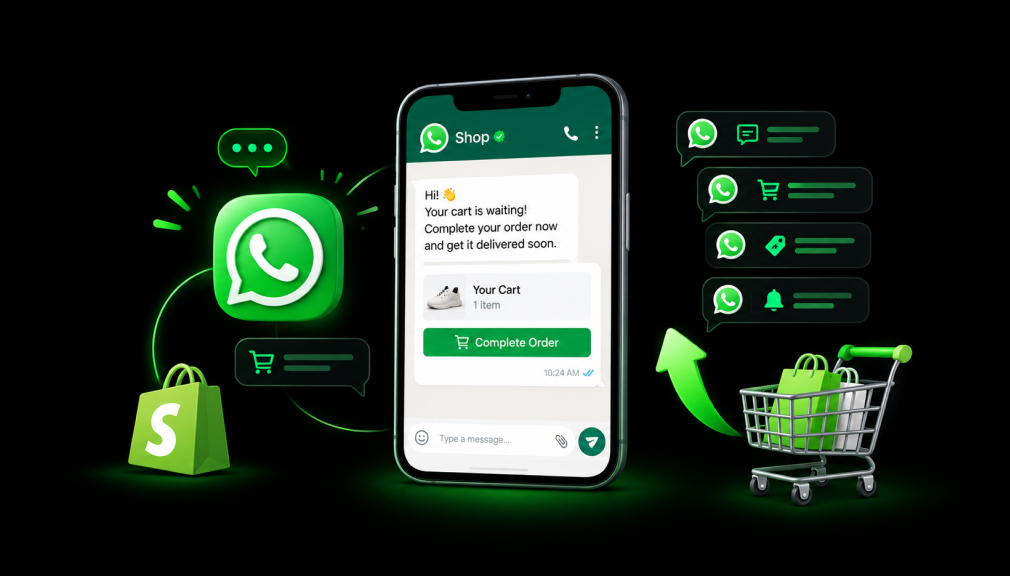
Imagine a tool with an open rate of 98%, versus where email is sitting around (on a good day) 20-25%. That difference alone is enough to tell you why SMS should be in your Shopify cart recovery armory.
The SMS rules are quite tight. Like email, the messages should be short (preferably under 160 characters). They should be personal (avoid sounding automated). And they need to be sent quickly: 3-15 minutes after the cart was abandoned are optimal. Use SMS only for high-value carts (above $75 or $100) so you won’t burden your subscribers with each small purchase.
What might be considered good SMS would be something simple, “Your [Product Name] is running low! Place your order at: [link]. Reply STOP to unsubscribe.” That’s all, just sweet and simple, yet succinct and to the point.
Tactic 3: One-Tap Mobile Payment Integrations
This one is less about recovery and more about avoiding the friction that causes abandonment to happen at all. Letting people use digital wallets such as Shop Pay, Apple Pay, and Google Pay eliminates the largest human physical hurdle in mobile checkout: typing.
Customers who tap-to-pay make out at much higher rates simply because the time from the decision-to-buy to actually buying drops from 2 minutes to 2 seconds. If they are not enabled on your Shopify store today, that is step one.
“The best cart recovery strategy is the one that starts before the cart is abandoned.”
The 2026 Playbook: Stopping Abandonment Before It Happens with Conversational AI
What is Conversational Commerce?
Conversational commerce is the use of text-based chat applications, live chat, intelligent chatbots, and messaging apps to guide consumers through their purchasing experience. It’s like providing every eCommerce shopper with a professional, tireless, 24/7 retail clerk who is capable of answering 300 questions at once at 3 AM.
How does that look in practice for Shopify storefronts specifically? Well, Chatbots that can hear hesitation, chat answers to product inquiries immediately, and assist shoppers with checkout friction without a person on the other end of the keyboard.
The best chatbot for your Shopify store in 2026 is more than just an FAQ bot. It is a proactive, behaviour-aware shopping assistant.
Catching the Zero-Data Abandoner
The most uncomfortable truth in the industry is this: over half of all cart abandoners walk out of your store without ever revealing an email address. That is 50% of your lost revenue that is entirely untouchable by any email recovery measures you’ve ever implemented.
Your abandoned cart emails, your retargeting campaigns, your sms flows, all of these can’t do anything to bring this customer back. You only have, and only have right now, to win this sale when they’re still browsing your product page or CPG languishing on your cart page: reading, considering, pondering.
That’s exactly why real-time eCommerce prevention solutions have become the most talked-about category in the Shopify community. They don’t assume an email address. They assume behavior.
Introducing a Smart Solution: AI Shopping Assistant Chatbot
This real-time approach is best exemplified by the recently launched AI Shopping Assistant Chatbot category of applications in the Shopify App Store. They are a tangible, ready-made, on-the-ground application of the real-time prevention template outlined above.
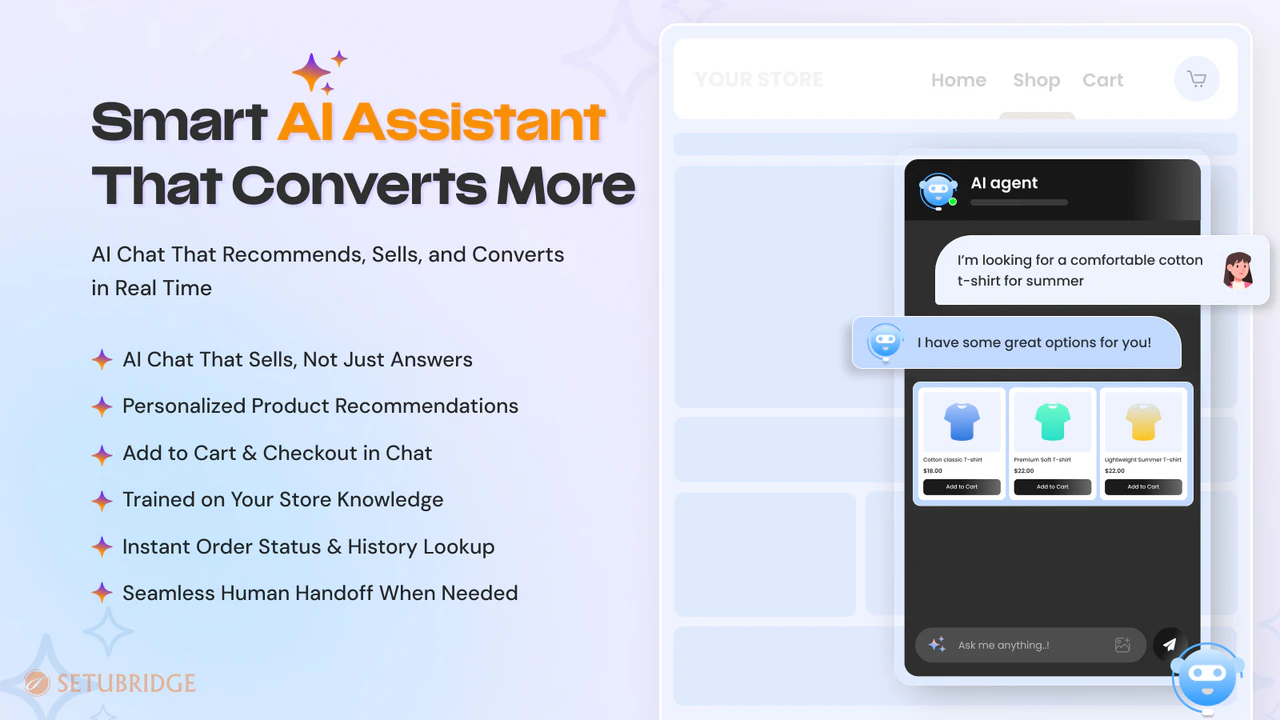
Real-Time Hesitation Tracking: The AI measures how long a customer lingers on the cart page before commenting or proceeding. So if a customer stares at the shipping area for 45 seconds, then the bot interprets it as a hesitation entry point and politely requests,” Interested in our shipping options or Curious about our return policy?” which is similar to a sales assistant coming and asking if they can help. Non condescending, just perfect timing.
Instant Product Clarity: No more making your customer click between your FAQ pages and product description tabs to find the answer they need. The AI reads the product data of your store and answers their questions immediately. “Will this laptop bag fit my 15-inch MacBook?” “Will this moisturizer work on sensitive skin?” The email URL for a Google search, and they disappear forever- answered by the AI, on the checkout page.
Friction-Free Mobile Assistance: On a mobile screen, using menus to search for size guides or delivery timelines is truly painful. Conversational commerce applications eliminate this pain point by enabling consumers to ask direct questions in natural language and receive instant answers all within the checkout flow, no more scrolling, no more searching, no more friction, and way fewer abandoned shopping carts.
Conversational commerce apps are the first line of defense in the 2026 Shopify cart recovery strategy. They don’t just recover the customer after he/she’s lost, they mitigate the risk of losing him/her in the first place, which is always the most profitable solution.
Along with your reactive tools, the 3-step email sequence, SMS notifications, and one-tap payments, real-time AI support provides you with a complete funnel abandonment counterattack against every shopper at every phase of their decision path.
Conclusion and Your Step-by-Step Action Plan
Summary: Small Changes, Big Revenue
Cart abandonment isn’t going anywhere. What has changed in the marathon that is 2026, though, is the approach to it, and more significantly, how it is effectively averted. The successful conversion marketers aren’t always the ones with the largest marketing coffers. Instead, they include those who have taken the friction out of the journey, addressed seller questions in advance and conversed with customers right at those critical moments where a purchase is being contemplated.
Reducing your store’s cart abandonment rate by just 5% has the potential to turn into an extra few thousand dollars/month in revenue – no additional cost of traffic or advertising. It’s money already being lost waiting for your customer to return.
“In 2026, the rule is simple: Do not wait for your customers to leave before you start talking to them. Help them while their wallets are open, and their intent is high.”
Your Action Plan Starts Today
Here is a simple sequence to get started:
- Run your existing checkout flow on your mobile device once. How long does it take you to get to payment? Make note of each step that feels slow, frustrating, or inconvenient.
- If you haven’t done so already, enable guest checkout and all one-tap payment options (Shop Pay, Apple Pay, Google Pay).
- Create an abandoned cart email sequence on your Shopify email app using three emails. Use Email 1 to be ‘useful’, Email 2 to be social proof, and Email 3 to be gentle.
- Implement SMS cart recovery for expensive orders, with a quick send window of 3-15 minutes.
- Add a proactive AI chatbot from the Shopify App Store to intercept hesitant shoppers in real time (leaving more than 50% never even give you their email).
- Check your chat logs once every week or so. Which questions are most users asking your bot? Update the answers in your product descriptions or FAQs.
What you’re aiming for is a checkout that is seamless, transparent, and helpful enough to make customers feel guided rather than pressured. This is how you avoid shopping cart abandonment on Shopify, and keep your store optimised for conversion through 2026 and well into the future.
Frequently Asked Questions (FAQs)
1. What is the average cart abandonment rate on Shopify in 2026?
The average worldwide cart abandonment rate is 70.22% in 2026 (Baymard Institute). The cart abandonment rate for mobile shoppers is much higher, ranging from 75.5 to 76.98, which proves that it is crucial to optimize the mobile checkout process on Shopify.
2. How do I reduce cart abandonment on Shopify without spending more on ads?
To lower your costs in the fastest way, remove any friction in your current checkout, turn on guest checkout, show all shipping costs at the time of product browsing, turn on one-tap checkout (e. g., Shop Pay), and have a live AI chatbot answer questions while your shoppers are still in your store.
3. What is the best time to send an abandoned cart email?
The first email goes out one hour after abandonment when the purchase intent is still warm. Then, a second social proof email is sent 24 hours after abandonment, and the third one should include some gentle urgency or a limited discount 72 hours after abandonment. Please note that you do not send all three emails on the same day.
4. What is conversational commerce, and how does it help Shopify stores?
Conversational commerce makes use of chat tools like a human store clerk and employs them in live (per visitor) chat to help shoppers complete their purchasing decision in a conversation. Chat tools are great for converting Shopify stores. For example, what they do best is picking up moments of hesitation, providing impromptu and instant answers to product questions, while guiding buyers through the friction of checkout. They drive a lot better conversion without more ad spend.
5. Why do more than half of cart abandoners not receive recovery emails?
Over 50% of customers will leave your store before checking an email address. Conventional recovery systems have no insight or control over this group, as they have to know the email address to do a recovery. Only live site activation tools can reach this segment of visitors.
6. What is the best chatbot for a Shopify store focused on cart recovery?
The most recommended shopping assistant chatbot for a Shopify store in 2026 is one that detects hesitation as it occurs for immediate engagement, scans each product page for answering product-related questions, and helps on mobile without breaking the flow. Search for AI Shopping Assistant applications in the Shopify App Store with conversion-lift data and one-click installs.

Digital Marketing Head
Vijay Chavda is the Digital Marketing Head at SetuBridge Technolabs with 14 years of expertise in driving growth strategies. Beyond marketing, he is skilled in data analysis, leveraging Power BI and Tableau to turn insights into action, blending creativity with analytics for impactful business results.