





A shopper finds the perfect frame on your Shopify store. She zooms in, checks the price, and adds it to her cart. Then she pauses and wonders, “Will this even look good on my face?” She closes the tab, and your sale is gone.
This moment happens thousands of times a day across eyewear stores. The good news is that online eyewear statistics show clear patterns behind it. When you know why shoppers hesitate, you can fix the exact step where they leave.
This guide collects the most useful online eyewear statistics for 2027 in one place. You will find eyewear market size data, online buying behaviour, and the factors that make shoppers convert. Each number links to its source, so you can cite it in your own content.
Key Online Eyewear Statistics at a Glance
Short on time? These are the numbers most worth bookmarking for your store planning and content.
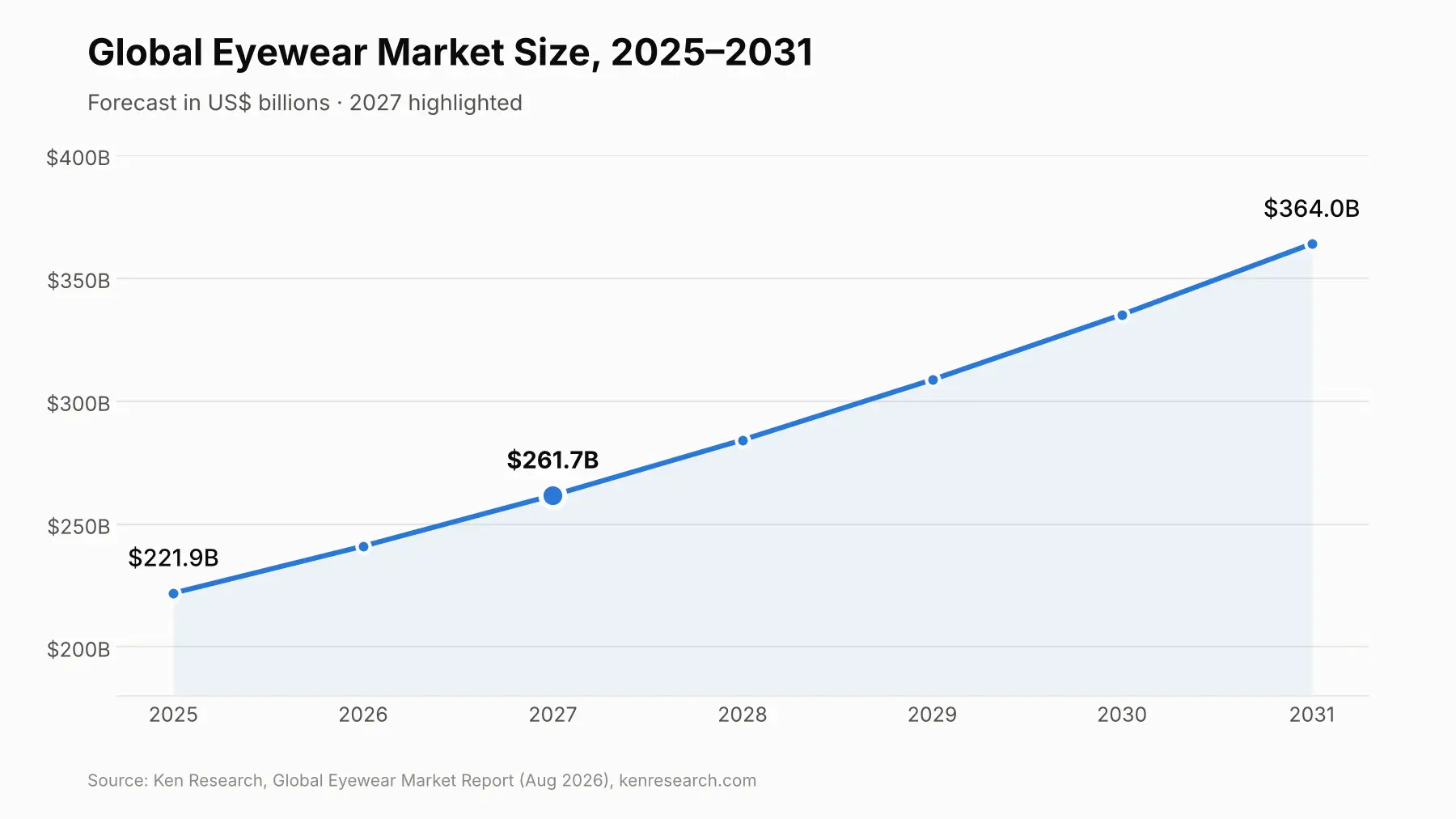
- The global eyewear market is forecast to reach $261.7 billion in 2027.
- At least 2.2 billion people worldwide live with a vision impairment.
- About 94% of U.S. adults use some form of eyewear.
- The U.S. optical industry reached $69.5 billion in 2025.
- Online sales held 35% of the eyewear market in 2025, growing at a 10% CAGR.
- 39% of U.S. contact lens buyers purchased online in Q1 2025.
- Only about 11% of U.S. frames and spectacle lenses were bought online in 2024.
- The average online cart abandonment rate is 70.22%.
- Shoppers who used 3D and virtual try-on at one eyewear brand converted 135% more often.
- 80% of online eyewear buyers look for reviews, and 61% say reviews shaped their choice.
- Half the world, nearly 5 billion people, may be myopic by 2050.
Global Eyewear Market Size: 2025 to 2027 and Beyond
Every research firm sizes the eyewear market a little differently. Some count only frames and lenses, while others add contacts, sports eyewear, and smart glasses. That is why you will see numbers from $160 billion to $222 billion for 2025. The direction is the same in every report: steady growth of roughly 6% to 9% per year.
| Research source | Base year value | Forecast value | Growth rate (CAGR) |
| Ken Research | $221.9B (2025) | $261.7B (2027), $364.0B (2031) | 8.6% |
| Grand View Research | $200.46B (2024) | $335.90B (2030) | 8.6% |
| Fortune Business Insights | $181.75B (2025) | $285.44B (2032) | 6.7% |
| Precedence Research | $170.24B (2026) | $297.53B (2035) | 6.4% |
| Mordor Intelligence | $162.26B (2025) | $215.46B (2030) | 5.8% |
The demand behind these numbers is real and long-term. The World Health Organization reports that at least 2.2 billion people have a vision impairment. At least 1 billion of those cases have not been addressed yet. Every one of those people is a potential eyewear buyer.
What this means for your Shopify store: Eyewear is a need-based category, not a fad. People replace glasses, reorder contacts, and buy sunglasses every year. When you cite market size in your content, quote one source and its year, instead of mixing figures from different reports.
Online Eyewear Market Size and Growth
Online is the fastest-growing sales channel in eyewear, in every major report. The size of the online share, though, depends on who is measuring. Here is what the leading sources say about the online eyewear market.
- Precedence Research puts the online channel at 35% of eyewear revenue in 2025, growing at 10% per year to 2035.
- Ken Research estimates the global online channel share at 24% in 2025.
- Euromonitor reports that e-commerce made up 14% of global eyewear retail sales in 2025.
- Credence Research finds brick-and-mortar stores still held 71.6% of sales in 2025.
- Grand View Research expects e-commerce to record the fastest CAGR from 2025 to 2030.
Why such a wide range, from 14% to 35%? Some reports count only retail sales, while others include direct-to-consumer brand websites. Some include contact lens reorders, which skew heavily online. The safest reading is simple: online is a minority channel today, and it is growing faster than stores.
What this means for your Shopify store: Most eyewear money still moves through physical stores. That gap is your opportunity, not your ceiling. Every shopper you convert online would have bought from a local optician.
Online Eyewear Sales by Product Category
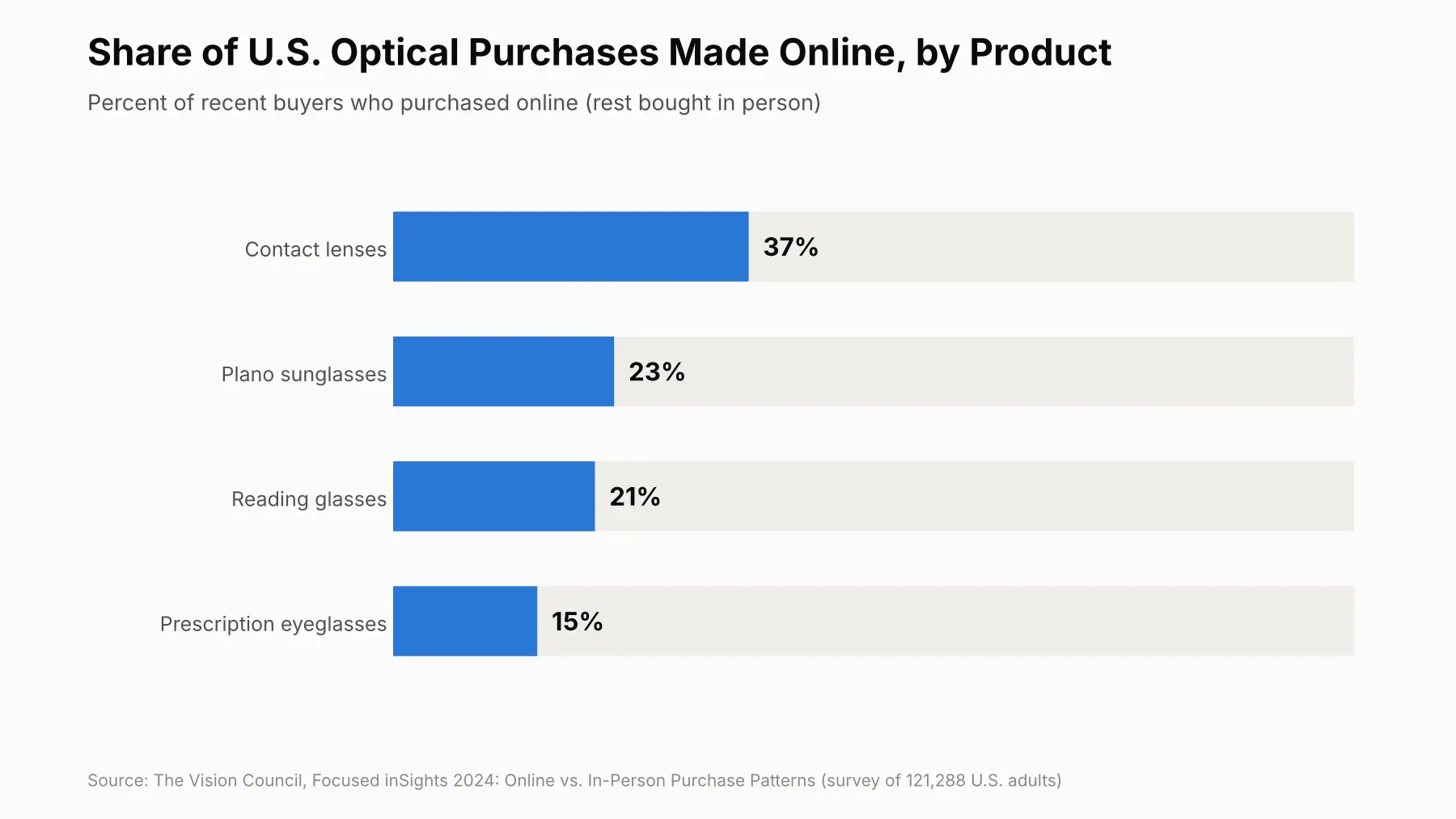
Not every eyewear product sells online at the same rate. Contact lenses lead because reorders are simple, while prescription glasses lag because of fit and lens choices. Knowing this split helps you decide what to stock and where to invest.
| Category | Share of eyewear market (2025) | Expected CAGR (2026 to 2035) | Online signal |
| Prescription eyewear | 50% | 6.0% | About 11% of U.S. frames and lenses bought online |
| Sunglasses | 25% | 7.5% | Only category to gain U.S. unit volume in 2025 (+2%) |
| Contact lenses | 15% | 5.0% | 39% of U.S. contact lens buyers purchased online in Q1 2025 |
| Sports eyewear | 10% | 6.5% | Growing with outdoor and fitness demand |
Share and growth figures in the table come from Precedence Research. Euromonitor also notes that sunglasses and contact lenses grew faster online than spectacles from 2020 to 2025.
Lens upgrades are a hidden revenue line for online stores. Progressive lenses held 25% and photochromic lenses held 18% of the market in 2025. Photochromic lenses are the fastest-growing lens type at 7.2% per year. Shoppers will pay for these upgrades when your product page explains them clearly.
What this means for your Shopify store: Sunglasses and contacts are your easiest online wins. Prescription glasses carry the biggest market share but need a guided buying flow. Treat lens types and coatings as add-ons, not as fine print.
Online Eyewear Statistics for the USA and Tier 1 Markets
If you sell to the USA, UK, Canada, Australia, or Western Europe, you are in the highest-value eyewear markets. Here is how they compare.
United States
The U.S. optical industry grew to $69.5 billion in 2025, even as unit volume fell. Americans bought fewer items but spent more per purchase. Precedence Research values the U.S. eyewear market at $42 billion in 2025, reaching $79.75 billion by 2035. North America held about 35% of global eyewear revenue in 2025.
Europe
Grand View Research names Europe the largest eyewear region in 2024. Ken Research estimates Europe held 35.9% of global eyewear value in 2025. High spending power and strong fashion demand keep the region valuable for premium frames.
Canada and Australia
Myopia is rising fast in both countries. Researchers project 260 million myopes in the U.S. and Canada by 2050, up from 90 million in 2000. In Australasia, myopia is expected to reach 55.1% of the population by 2050.
Asia-Pacific
Asia-Pacific is not a Tier 1 target for most Shopify stores, but it shapes the whole online market. Asia-Pacific overtook North America in eyewear e-commerce sales in 2024. Its online sales exceeded $7 billion in 2025.
What this means for your Shopify store: U.S. and European shoppers are paying more per order. That rewards clear pricing, lens upsells, and trust signals. If you sell across borders, local currency and language matter as much as the product.
Who Buys Eyewear Online: Shopper Demographics
Your buyer is not one person, so your store should not speak to only one. The data points to a broad, mainstream audience with a few clear patterns.
- More than half of U.S. consumers have bought eyewear online at least once.
- Women held 51.3% of global eyewear sales in 2025, helped by multi-pair buying.
- Children held 20% of the market and are the fastest-growing user group, at 7.2% per year.
- 48% of U.S. consumers have employer-provided vision coverage, up in Q4 2025.
- About 250 million U.S. adults regularly use some form of eyewear.
Two groups deserve special attention. Parents are buying more kids’ frames as screen time pushes up childhood myopia. Insured adults want to know if they can use vision benefits or FSA and HSA funds before they check out.
What this means for your Shopify store: Create a kids’ collection with durable frames and simple sizing. Add a short, clear note on your product page about insurance, FSA, and HSA receipts. That one line answers a question that otherwise sends shoppers back to their optometrist.
Online Eyewear Buying Behaviour: How Shoppers Decide
Eyewear shoppers are careful buyers. They compare prices, read reviews, and often research online before deciding where to buy. These statistics show how that decision plays out.
Price and Spending
- 40% of U.S. consumers paid under $100 out of pocket for their most recent glasses.
- The share spending $200 or more on eyeglasses rose from 27% to 28% in Q1 2025.
- Products priced up to $150 held 52.4% of the global market in 2025.
- Online buyers of non-prescription sunglasses spend more on average than in-store buyers.
Research and Timing
- Among online eyewear buyers, 80% looked for reviews before buying.
- 45% of sunglass wearers plan to buy their next pair within six months.
- 52% of past online eyewear buyers made their latest purchase in person.
That last number is a warning sign for every online store. Shoppers who already trusted you once are drifting back to physical stores. Uncertainty about fit and prescription accuracy is the most likely cause, as the next sections show.
What this means for your Shopify store: Your price is rarely the problem. Retention is. Win the second order with prescription reminders, saved lens choices, and an easy reorder path.
What Makes Eyewear Shoppers Convert
This is the section most Shopify merchants need. Each statistic below points to a specific pain point and a specific fix. Use them to find where your store loses buyers.
Pain Point 1: “Will These Frames Suit My Face?”
This is the number one reason shoppers hesitate. Virtual try-on (VTO) answers it directly, and the results are consistent across brands.
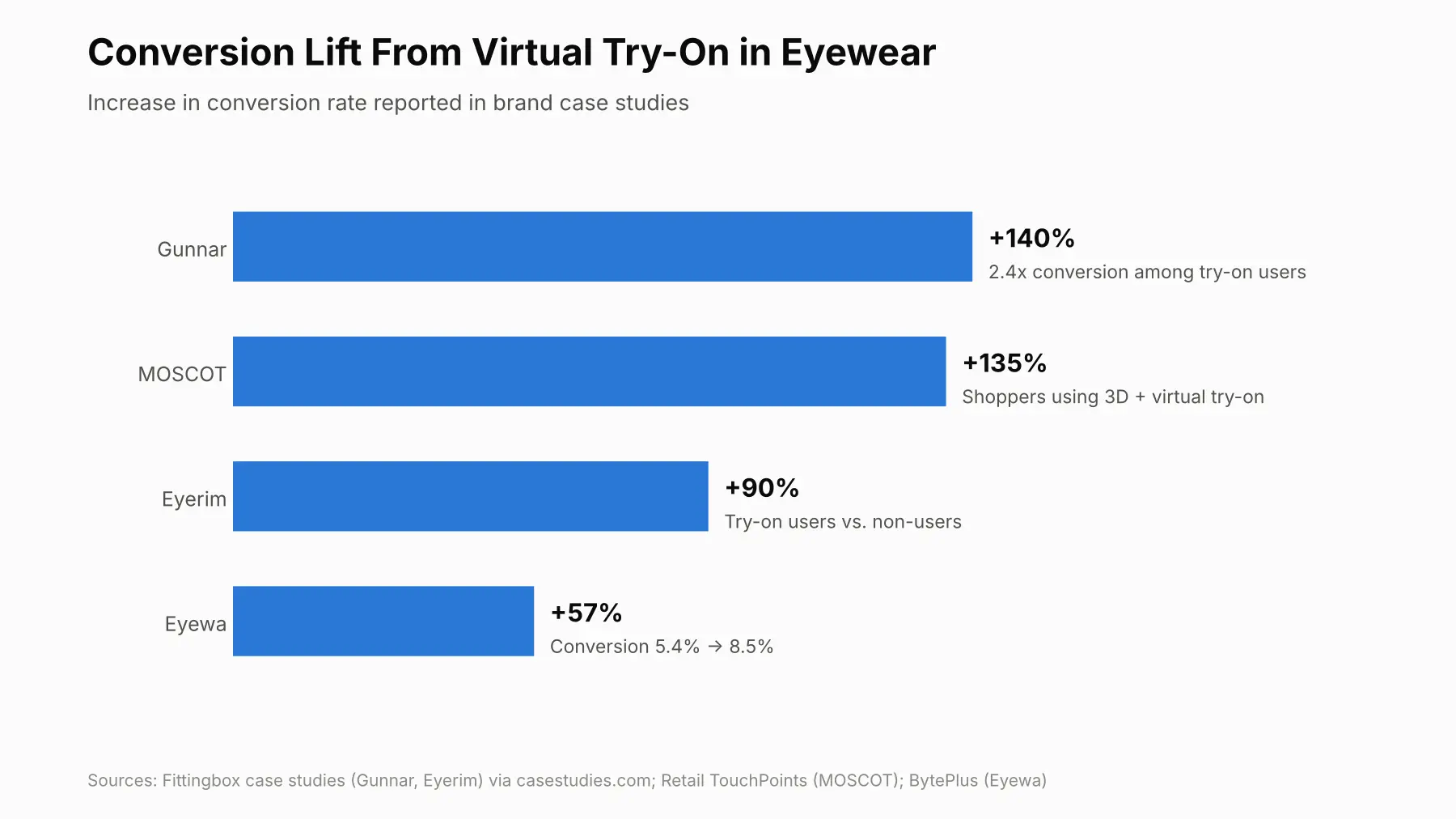
- MOSCOT saw conversion rates rise 135% for shoppers who used 3D and virtual try-on.
- Eyewa lifted its conversion rate from 5.4% to 8.5% after improving AR try-on.
- Gunnar saw conversion among VTO users improve by 2.4x.
- At Eyerim, VTO users converted about 90% more often, and tried 5 frames instead of 3.
- In an AR survey, 76% of shoppers said try-on raised their purchase confidence.
Pain Point 2: “Ordering My Prescription Online Feels Risky”
Prescription glasses are half the eyewear market, yet five out of six prescription glasses purchases still happen in person. Shoppers worry about entering numbers wrong or picking the wrong lens. A step-by-step lens flow fixes this. It asks one question at a time, shows only relevant options, and lets buyers upload a prescription photo.
Pain Point 3: “Can I Trust This Store?”
Reviews carry heavy weight in eyewear. Among online eyewear buyers, 61% of review readers said reviews shaped their final choice. Photo reviews of people wearing your frames work like a second try-on. They show real faces, real fits, and real lens tints.
Pain Point 4: “The Total Is Higher Than I Expected”
Cart abandonment hits every store, and eyewear is no exception. The average documented cart abandonment rate is 70.22%. Extra costs like shipping and fees are the top reason, cited by 48% of abandoners. For eyewear, lens upgrades can surprise buyers at checkout if prices are not shown during selection.
Pain-Point-to-Fix Map
| Shopper pain point | Supporting statistic | Fix on your Shopify store | Where it sits in the journey |
| Unsure about face fit | VTO users converted 135% more at MOSCOT | Virtual try-on button on product and collection pages | Browsing |
| Fear of prescription errors | 5 of 6 Rx glasses still bought in person | Guided lens flow with Rx upload and field rules | Product page |
| Low trust in a new store | 61% say reviews shaped their choice | Photo reviews with face-shape and fit tags | Product page |
| Surprise costs at checkout | 48% abandon over extra costs | Live lens pricing shown at every step | Cart and checkout |
| Not coming back | 52% of online buyers returned to stores | Saved Rx, reorder reminders, review follow-ups | Post-purchase |
Barriers to Buying Eyewear Online and Return Rates
Returns are where eyewear margins quietly disappear. A returned prescription pair cannot be resold, because the lenses were cut for one person. That makes prevention far cheaper than processing a refund.
- Online eyewear return rates typically run 15% to 25%, mostly due to fit and style.
- Eyewear retailers using virtual fitting reported up to a 28% reduction in product returns.
- 85% of prescription eyeglasses are bought in person, the highest of any optical product.
- In-person buyers reported higher satisfaction than online buyers in a survey of 121,288 U.S. adults.
The pattern is clear. Shoppers do not distrust online stores in general; they distrust their own ability to choose correctly. Fit, lens choice, and prescription entry are the three moments where doubt turns into a closed tab.
What this means for your Shopify store: Track your return reasons by category. If most returns say “didn’t suit me,” invest in try-on and fit guidance. If returns say “wrong lens” or “blurry vision,” fix your prescription flow first.
Online Eyewear Trends to Watch in 2027
The next wave of eyewear demand is already visible in the data. These four trends will shape what shoppers expect from your store in 2027.
- Smart glasses go mainstream. EssilorLuxottica sold more than 7 million Ray-Ban and Oakley Meta smart glasses in 2025. IDC forecasts 13.6 million display-less smart glasses shipped in 2026. Shoppers will expect prescription options on tech frames too.
- Virtual try-on becomes standard. The virtual try-on market was valued at $15.18 billion in 2025, heading to $48.1 billion by 2030. Stores without try-on will feel dated to younger buyers.
- Myopia keeps rising. Nearly 5 billion people, about half the world, may be myopic by 2050. Childhood myopia makes kids’ eyewear a long-term growth category.
- Sunglasses lead volume growth. Sunglasses were the only U.S. optical category to grow in unit volume in 2025. Prescription sunglasses combine two strong categories in one product.
What this means for your Shopify store: Plan your 2027 catalog around prescription sunglasses, kids’ frames, and lens upgrades. Each one sits where demand is growing and where a guided online flow makes the sale easier.
Data Disclaimer
Statistics in this article come from publicly available sources, including market research, industry reports, case studies, news, and Shopify. We link to sources for verification. Figures may vary due to research methods. Please verify data before reuse. Market forecasts are estimates, and app prices and ratings may change over time.
Conclusion
The eyewear market is large, need-driven, and still moving online. Global estimates point to steady growth of 6% to 9% per year, with online sales growing faster than stores. Yet most prescription glasses are still bought in person, and many online buyers return to physical stores.
The gap comes down to confidence. Shoppers hesitate over face fit, prescription accuracy, store trust, and surprise costs. Each of these has a clear, measurable fix: try-on, a guided lens flow, photo reviews, and transparent pricing.
Use these online eyewear statistics to find where your own store loses buyers. Fix the biggest gap first, measure the result, and then move to the next one. In 2027, the stores that remove doubt will be the stores that convert.
Frequently Asked Questions
How big is the eyewear market in 2027?
Ken Research forecasts the global eyewear market at about $261.7 billion in 2027. Other firms use different scopes, so 2025 estimates range from $160 billion to $222 billion.
What percentage of eyewear is sold online?
Estimates range from 14% to 35% of global eyewear sales, depending on the source. In the U.S., about 11% of frames and lenses and 39% of contact lenses are bought online.
Does virtual try-on increase eyewear sales?
Yes. Brand case studies report conversion lifts from about 57% to 135% among shoppers who use try-on. Retailers also report fewer returns linked to fit and style.
Why do shoppers abandon eyewear carts?
The average cart abandonment rate is about 70% across ecommerce. Unexpected extra costs are the top reason, and lens upgrades can add to that surprise if prices are hidden.
What is the fastest-growing eyewear category?
Sunglasses are forecast to grow fastest at 7.5% per year to 2035. In lenses, photochromic lenses lead with 7.2% yearly growth.
Can I sell prescription glasses on Shopify?
Yes. Shopify stores can sell prescription glasses using a lens selection app that collects prescription details and lens choices. Clear pricing and an upload option help shoppers feel confident.

Digital Marketing Head
Vijay Chavda is the Digital Marketing Head at SetuBridge Technolabs with 14 years of expertise in driving growth strategies. Beyond marketing, he is skilled in data analysis, leveraging Power BI and Tableau to turn insights into action, blending creativity with analytics for impactful business results.