




Running a Shopify store is enjoyable. The hard part is getting the customers to buy- and buy again. And this is when a perfect Email Marketing App comes to the rescue.
Email marketing is one of the most effective tools at an eCommerce site user’s disposal. Email marketing generates an average return of $36 to $42 for every $1 spent (3,600%–4,200% ROI), making it the highest-performing digital marketing channel.
Still, the majority of Shopify owners don’t use email marketing at all, or they use the wrong tools, which simply do not bring any results for their business. And what do they get in the end? Loss of sales, loss of clients, and slow business development.
And here’s the good news: your ideal Email Marketing App for Shopify will click and do all of those things, and will even automate your campaigns, bring back abandoned shopping carts, welcome your new subscribers, and have your customers coming back for more, and when you’ve finished the hard part, you won’t have to lift a finger again.
In this blog, you will learn:
- Why email marketing is important for your Shopify store
- How to choose the best email marketing app for your needs
- A detailed look at the top 5 Shopify Email Marketing Apps in 2025
- Tips to get the most out of your email marketing efforts
Whether you are just starting or scaling a growing brand, this guide will help you find the right tool and use it well.
Key Takeaways
- Email marketing delivers the highest ROI of any digital marketing channel for Shopify stores.
- Automation workflows save time and increase conversions by sending the right message at the right moment.
- The best Email Marketing App depends on your store size, budget, and specific goals.
- Seamless Shopify integration and ease of use matter more than having the most features.
- Personalization using names, purchase history, and behavior dramatically improves customer retention.
- Testing subject lines, send times, and content helps you continuously improve results.
Why Email Marketing is Important for Shopify Stores
eCommerce is expanding rapidly. Global eCommerce sales are projected to reach around $7.8–$7.9 trillion by 2028, approaching the $8 trillion mark. However, with the expansion, there is higher competition. Over the past five years, customer acquisition costs have increased by over 60%. Paid advertisements are more costly. The scope of Social Media is reducing. What is the common-sense approach then?
Own your crowd. Email is an owned channel; no algorithm will filter whether your message is viewed or not. Unlike Instagram or Facebook, your email list is yours. No barrier to email your subscribers whenever, at no charge.
Key Benefits of Email Marketing for Shopify Stores
- Direct communication: Your message directly reaches the inbox. No five or six posts competing for recognition, or paid options to boost visibility.
- Better conversion rates: Email marketing continues to outperform social media, delivering up to 2x higher conversion rates on average. Additionally, personalized email campaigns can boost click-through rates by over 28%, making them one of the most powerful tools for driving engagement and sales.
- Customer retention: It is five times more expensive to recruit new customers than to retain existing ones, so email keeps you top of mind and encourages existing buyers to return.
- Automation at scale: Set up once, run forever. Welcome sequences, abandoned cart reminders, and re-engagement flows all run around the clock.
- Segmentation power: Send different messages to different groups according to purchase history, location, or behavior, which makes all the emails more human.
In conclusion, having a top-notch Shopify email marketing app should definitely be high on your list of “nice to have” applications. It can be one of the smartest business investments you make as a store owner.
How to Choose the Best Shopify Email Marketing App
There are plenty of choices when it comes to an Email Marketing App for your Shopify store. Deciding which one to go with can be daunting. Here are the six key questions you should ask yourself before you do:
1. Ease of Use
You simply will not use an app if it is too difficult to learn how to operate it. Consider a clean dashboard, a user-friendly drag-and-drop email builder, and readily available templates. Ease of use is essential, especially if you can’t claim to be a social media whizz.
2. Automation Capabilities
Most of the best apps will enable you to create automated email flows. Having automated welcome emails for new subscribers, abandoned cart recoveries, post-purchase, win-back campaigns, etc., is essential. They work when you are asleep and are reclaiming revenue that you would otherwise lose.
3. Integration with Shopify
Shopify integration: your email app should automatically connect to Shopify, so the software has access to your customers’ info, purchase history, products, etc., so that your emails are targeted. Never use apps that require you to export data manually.
4. Pricing and Scalability
Most of the top apps will have a free plan for small lists. But as your store grows, ensure that the plans are reasonably predictable in their costs. Some apps charge for each email sent, others charge for each subscriber. Find the right model for your store.
5. Analytics and Reporting
You can’t improve it if you don’t measure it. Find apps that display open rate, click rate, revenue generated by email, and list growth. Your reporting should always tell you what is working and what isn’t.
6. Support and Reliability
When something goes wrong, and it sometimes will, you need fast, friendly support. Look for live chat, email support, and a comprehensive knowledge base. And uptime is always a priority, so that your automations stay on task 24/7.
Quick Comparison: Top 5 Shopify Email Marketing Apps
| App Name | Best For | Pricing | Key Feature | Ease of Use |
| SendWILL Popup Email Marketing | New & growing stores | Free App | Popup + email combo tools | Very Easy |
| Omnisend Email Marketing & SMS | Multi-channel marketing | Free; Paid from $16/Mo | SMS + email automation | Easy |
| Klaviyo: Email Marketing & SMS | Data-driven brands | Free; Paid from $15/Mo | Advanced segmentation | Moderate |
| Mailchimp Email SMS Marketing | Beginners & small stores | Free; Paid from $13/Mo | Drag-and-drop editor | Very Easy |
| Seguno Email Marketing | Shopify-only stores | Free; Paid from $35/Mo | Deep Shopify integration | Easy |
Top 5 Shopify Email Marketing Apps (Detailed Reviews)
1. SendWILL Popup Email Marketing
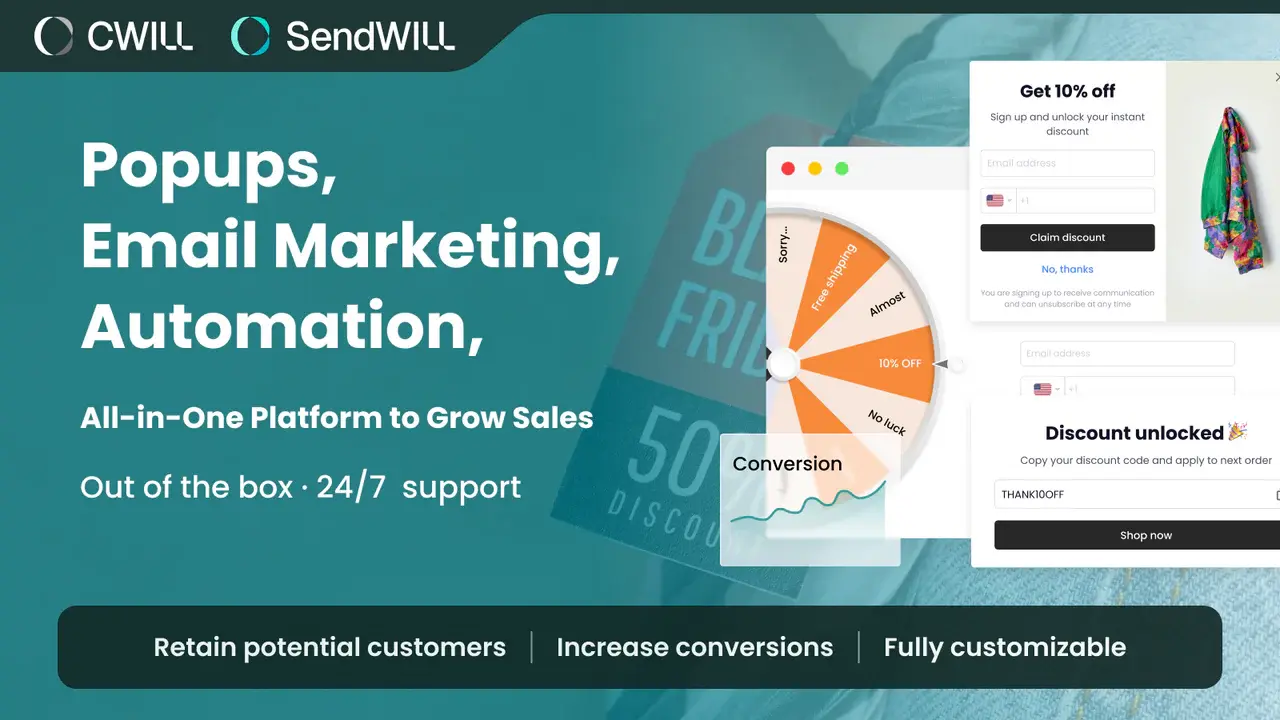
SendWILL Popup Email Marketing is a smart, comprehensive Email Marketing App designed specifically for the needs of scaling Shopify stores. It merges the best pop-up features with a robust full email marketing platform to help grow your list and convert customers from just one app. SendWILL allows you to gather subscribers with beautiful popups and then automatically send them the right email at the right time. Beginner-friendly yet feature-rich.
No matter if you want to decrease cart abandonment, dispatch promotional emails, or create an automated welcome series, SendWILL takes care of everything. Thanks to its elegant interface and internal statistics, it is the best choice for a store owner who needs results without freak out.
Key Features
- Popup builder to capture emails and grow your subscriber list fast.
- Pre-built automation flows: welcome series, cart abandonment, and post-purchase.
- Drag-and-drop email editor with mobile-optimized templates.
- Deep Shopify integration syncs products, orders, and customer data automatically.
- A/B testing for subject lines and email content.
Pros
- Combines pop-ups and email in a single platform, no need for two separate apps
- Very beginner-friendly with a gentle learning curve
- Strong automation features even on lower-tier plans
Cons
- Newer app fewer third-party integrations compared to older tools
- Advanced reporting is limited on the free plan
Pricing
- Free App.
Best For: New and growing Shopify stores that want a powerful pop-up+ email combo without juggling multiple tools.
2. Omnisend Email Marketing & SMS
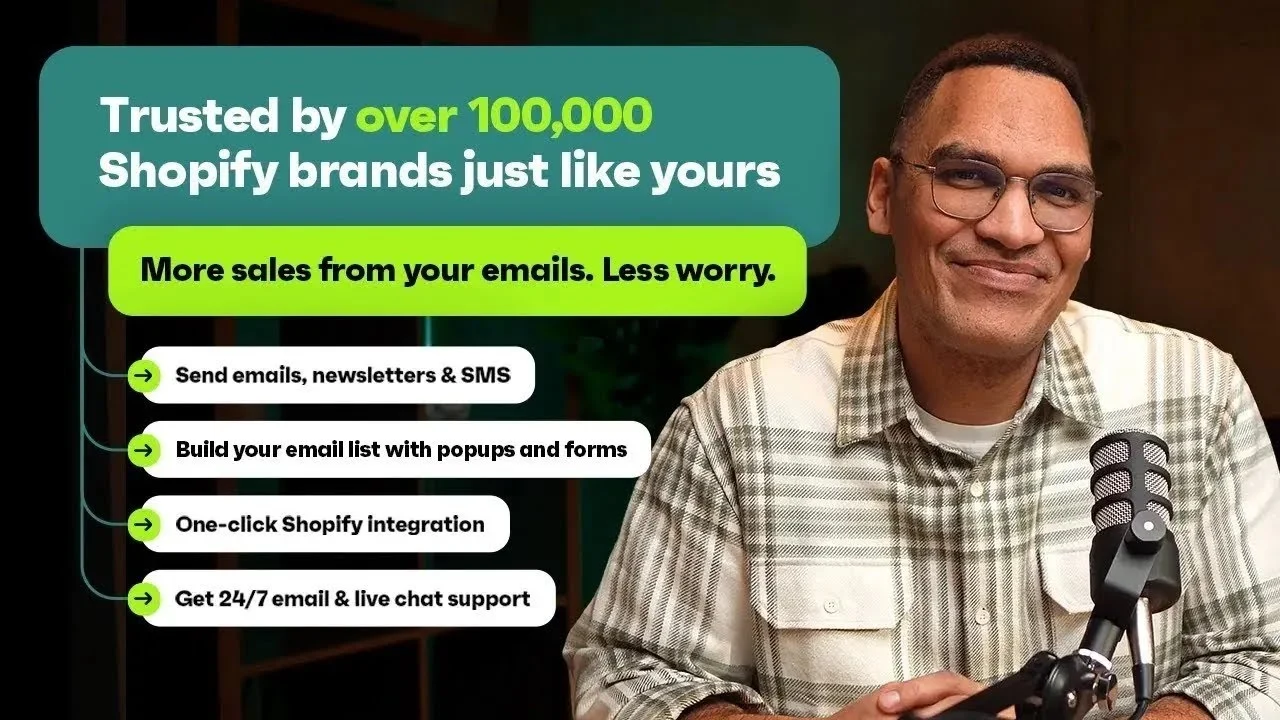
Omnisend is one of the most widely used multi-channel Email Marketing Apps for Shopify stores. Combining SMS, push notifications, and email in one place, it is perfect for Brands looking to communicate with customers across multiple channels. Omnisend is also recognised for its robust automation builder, allowing you to build sophisticated multi-step workflows easily.
Create gorgeous on-brand emails with our drag-and-drop editor. Use segmentation & personalization rules to send the right message to the right customer at the right time. Omnisend syncs directly with your Shopify store and pulls in product & order data for easy personalization.
Key Features
- Multi-channel marketing: email, SMS, and web push notifications in one tool
- Visual automation workflow builder with pre-built templates
- Smart segmentation based on shopping behavior, purchase history, and more
- Product picker tool to add Shopify products directly into emails
- A/B testing for campaigns and automation
Pros
- Excellent multi-channel capability, email + SMS in one dashboard
- Easy to set up automation without technical skills
- Great free plan for small stores
Cons
- Pricing can get expensive as your list grows beyond 500 subscribers
- SMS credits are separate from email credits
Pricing
- Free plan available.
- Paid plans start from $16/month.
Best For: Shopify stores are ready to move beyond email and explore multi-channel marketing with SMS and push notifications.
3. Klaviyo: Email Marketing & SMS
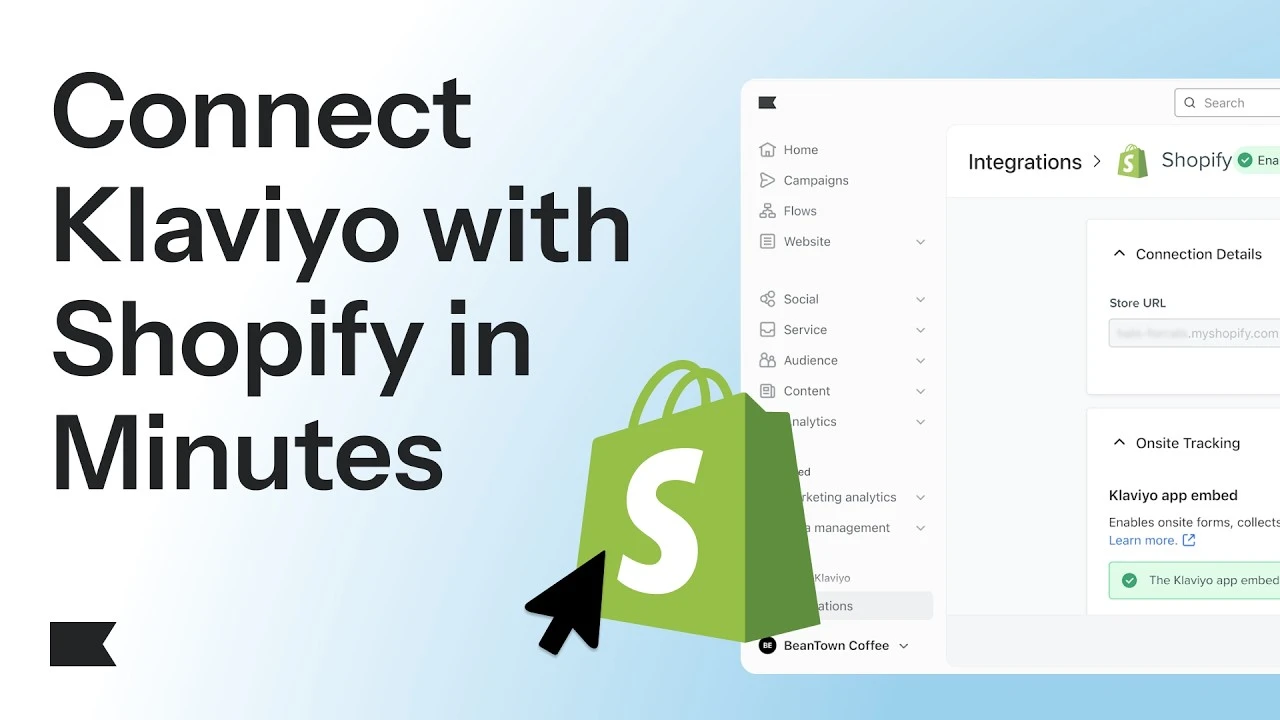
Klaviyo is the benchmark for data-driven email marketing in eCommerce. It is one of the most comprehensive Email Marketing Apps in the Shopify App Store and is trusted by over 150,000 businesses worldwide. Klaviyo leverages customer data tracking every browse, click, purchase, and interaction to build some of the most comprehensive customer profiles:
It runs its sophisticated segmentation engine, enabling the creation of hyper-customised email and SMS campaigns that are relevant for every subscriber. Not the simplest tool to get to grips with, yet for mature brands looking to extract every dollar from their email database, they don’t come better than Klaviyo. Its predictive analytics can even tell you what a customer is likely to buy next.
Key Features
- Advanced customer segmentation using real-time behavioral data
- Predictive analytics: CLV, churn risk, and next purchase date predictions
- Powerful flow builder with hundreds of pre-built automation templates
- Deep Shopify integration with real-time data sync
- Email and SMS marketing in one platform
Pros
- Industry-leading segmentation and personalization capabilities
- Extremely powerful automation and analytics tools
- A large community and a rich resource library for learning
- Scales effortlessly with large, fast-growing stores
Cons
- A steeper learning curve not ideal for beginners
- Can be expensive for stores with large lists
Pricing
- Free plan available.
- Paid plans start from $15/month
Best For: Established Shopify brands and data-driven marketers who want maximum control, deep analytics, and advanced personalization.
4. Mailchimp Email SMS Marketing
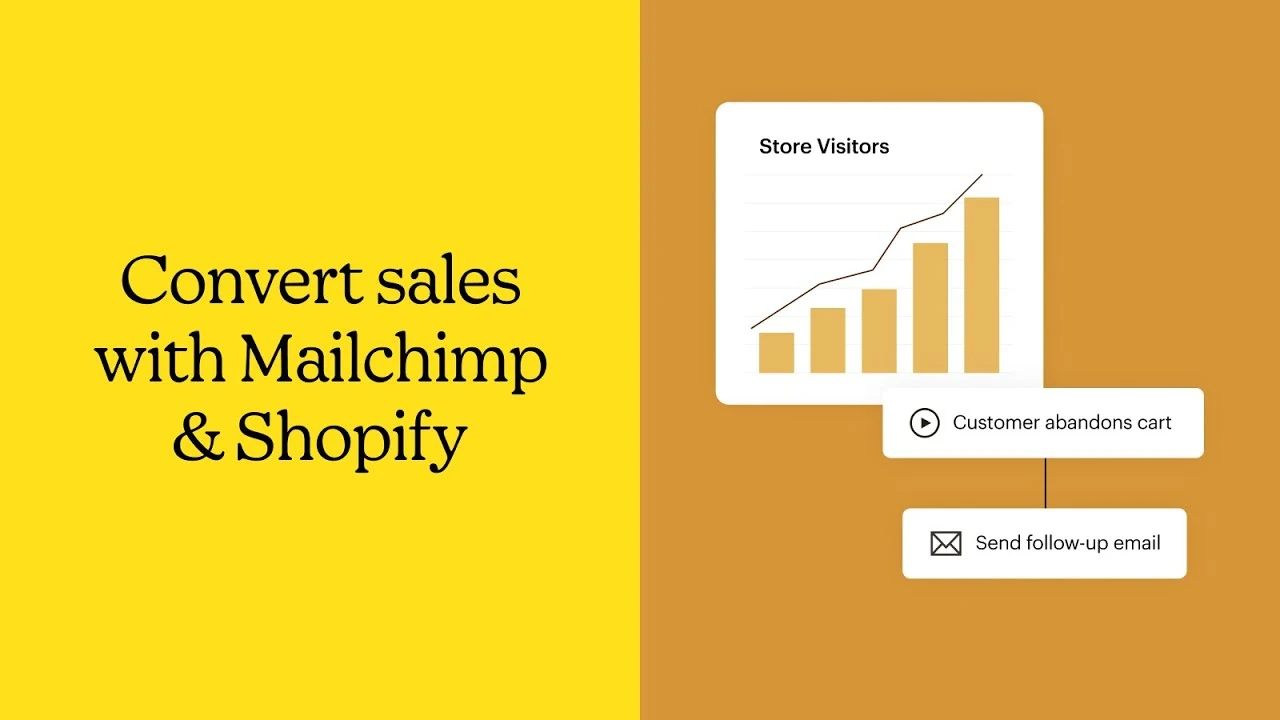
Mailchimp itself is one of the best-known names in email marketing. The integration of Mailchimp into Shopify brings this ease of use and knowledge that users have into the Shopify community.
Mailchimp is best known for its drag-and-drop email builder, which allows you to make stunning emails in minutes, without the headache. It has a very generous free plan that is suitable for new business owners with some basic automation, landing pages, and signup forms. While Mailchimp isn’t as eCommerce-focused as some other options on the list, it is extremely easy to use and familiar to the majority of users, which makes it a good option for those who want recognisable branding and a simple-to-use platform. Recently, Mailchimp has added SMS marketing to appeal to growing stores.
Key Features
- Intuitive drag-and-drop email builder with hundreds of templates
- Basic automation flows: welcome emails, abandoned cart, re-engagement
- SMS marketing integration for sending text campaigns
- Customer journey builder for multi-step automation workflows
- Built-in landing page and signup form builder
Pros
- Very beginner-friendly, most people already know Mailchimp
- Strong template library with on-brand, professional designs
- Solid free plan for stores just getting started
Cons
- Shopify integration is less native than competitors like Klaviyo or Seguno
- eCommerce-specific features are not as deep as purpose-built tools
Pricing
- Free plan available.
- Paid plans start from $13/month
Best For: Beginners and small Shopify stores that want a familiar, easy-to-use email platform without a steep learning curve.
5. Seguno Email Marketing
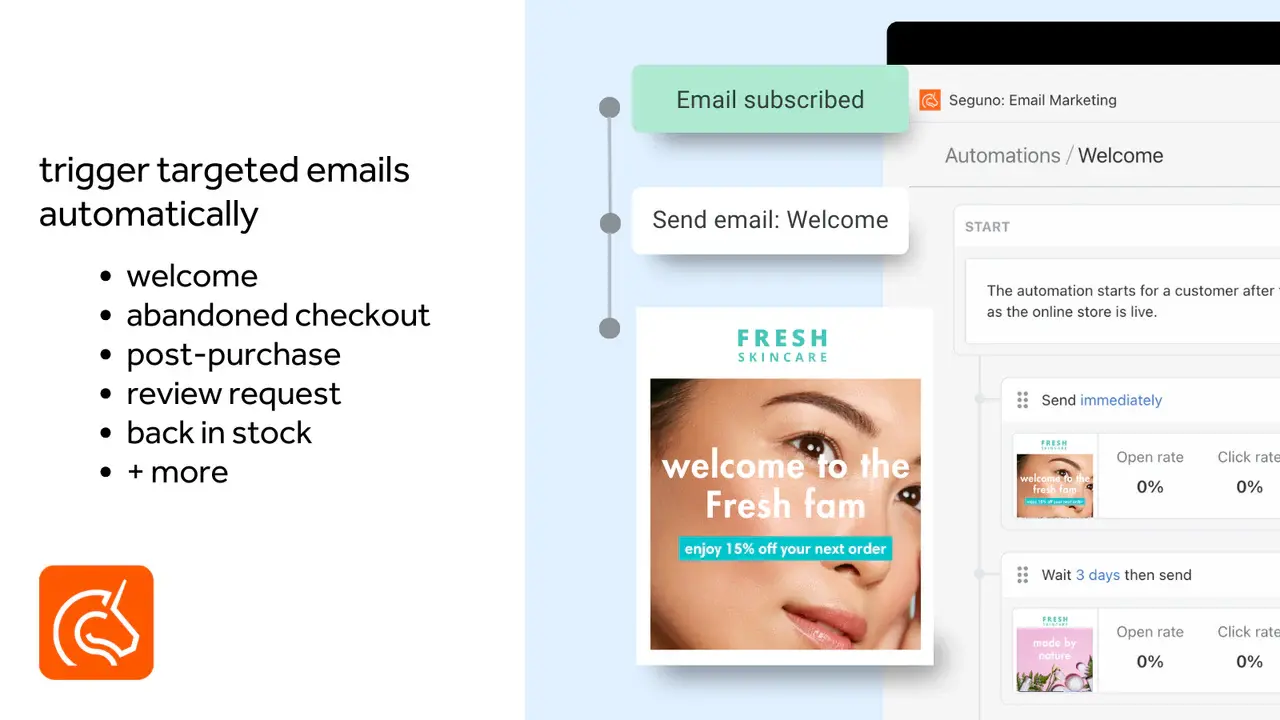
Seguno Email Marketing has been created exclusively for Shopify. Unlike any other email platform that’s also compatible with several other platforms, Seguno was built from day one to operate in your Shopify admin. Setting it up takes no time at all, no complicated integrations to fuss with. And it’s built to operate seamlessly within Shopify so that your product data, customer segments, and discount codes are all sent over from your Shopify store automatically. It features a crisp, simple email editor and a selection of intelligent automation templates geared toward an eCommerce audience.
Seguno, a favorite among small to mid-sized Shopify stores, is a great option for marketers who want something that is native to and built specifically for Shopify. Its use of the Shopify platform keeps bugs down, updates rolling in faster, and the user experience even more native to the platform.
Key Features
- 100% Shopify-native lives inside your Shopify admin, no separate dashboard
- Automated flows: welcome, abandoned cart, back-in-stock, and post-purchase
- Dynamic discount code generation and insertion directly from Shopify
- Easy-to-use email editor with Shopify product integration
- Segment customers using Shopify’s native customer data and tags
Pros
- The fastest setup of any app on this list works inside Shopify from day one
- Seamless, glitch-free Shopify data sync
- Great for stores that want simplicity without sacrificing core features
Cons
- Only works with Shopify, not suitable if you plan to migrate platforms
- Fewer advanced features than Klaviyo or Omnisend for complex marketers
Pricing
- Free plan available.
- Paid plans start from $35/month
Best For: Shopify-focused store owners who want the fastest setup, deepest Shopify integration, and a tool that feels like a natural part of their store.
Tips to Get the Most Out of Your Email Marketing App
Choosing the right app is just step one. Here is how to make it work hard for your store:
1. Segment Your Audience
They all differ from each other. Separate your subscribers into groups based on your interactions with them, for example, new customers, loyal customers, dormant users, big spenders, and make sure you’re only targeting them with messages that matter. Segmented campaigns generate 760% more revenue than non-targeted blasts.
2. Use Automation Workflows
Establish at least three critical automations immediately: a course delivery series targeted at all new subscribers, a cart abandonment sequence, and a post-purchase follow-up. These three sequences alone will recover 5–15% of otherwise lost revenue with no ongoing effort.
3. Personalize Your Emails
Personalize your emails with the customer’s first name. Personalized recommendations show them the product only available to them. Send a birthday gift with a “Happy Birthday” message with a small discount. Personalization is a must! If using a personalized subject line, the open rate is 26% higher.
4. Optimize for Mobile
More than 60% of emails are being opened on a mobile device! Always test on a phone before pressing Send. Use concise subject lines, large buttons, and single-column designs that render well on a tiny screen.
5. Test and Improve
Run A/B tests all the time. Two different subject lines. Two different send times. Plain-text against designed. Your test data will show you what your audience wants, and enable you to grow faster.
Conclusion
Email marketing is not going anywhere, and it’s probably better and more effective than it has ever been. As paid advertising gets more expensive and saturated, email remains the most effective and highest ROI channel for Shopify owners.
Not all Email Marketing Apps for Shopify are the same, either. The right application for your store will really depend upon your size, your goals, your budget, and how technical you want to be.
Here is a quick recap to guide your decision:
- Choose SendWILL if you want a powerful pop-up + email combo in one easy-to-use tool
- Choose Omnisend if you are ready to go multi-channel with email + SMS
- Choose Klaviyo if you want enterprise-grade data and deep personalization
- Choose Mailchimp if you are a beginner who values simplicity and familiarity
- Choose Seguno if you want the deepest Shopify integration with the fastest setup
Whichever app you choose, and no matter how many subscribers you have, the key is just to begin. Get your first automation up and running. Grow your subscriber list and send your first campaign. Mail marketing pays off; even a simple, consistent email schedule can boost your Shopify sales considerably.
Frequently Asked Questions (FAQs)
1. What is the best Email Marketing App for a new Shopify store?
If these are for a new store, SendWILL or Mailchimp are perfect tools to get started. They are both free plans available up to date with basic automation enabled with a user-friendly interface that’s not intimidating to a first timer.
2. How does an Email Marketing App help increase Shopify sales?
Digital apps and other tools precisely deliver the most important touchpoints, cart abandonment, welcome series, and post-purchase follow-up that are automatically triggered. These targeted emails work to re-engage your customers and make immediate, impactful sales.
3. Is email marketing still effective for Shopify stores in 2026?
Yes. Email marketing has the highest ROI of all the digital channels, averaging $42 for each $1 spent. For most Shopify stores, it is one of the most successful channels in generating sales and increasing repeat business.
4. What is the difference between Klaviyo and Omnisend for Shopify?
Klaviyo is a deep-data, avant-garde segmentation and predictive analytics tool and is much more suited to bigger, more stable brands. Omnisend is more intuitive and is ideal for multi-channel marketing through email and SMS, so it is best for growing mid-size stores.
5. Do I need a big email list to start using a Shopify Email Marketing App?
No way! 90 % of the top apps are free for a small list. Simple stick to it, build a list through a pop-up, signup form, and only buy an upgraded plan when you have a certain volume of subscribers.
6. Can I use multiple email marketing apps on my Shopify store?
Yes, technically, but no. One app may successfully send 2 emails at a time, but it can and may interfere with automations and even throw off the numbers in your database. Choose the one that works best, get it properly configured, and get everything you can out of that application.

Shopify Expert
Dipen Panchal, Shopify Tech Lead at Setubridge Technolabs, brings over a decade of expertise as a Shopify Expert. Passionate about e-commerce growth, he specializes in UI/UX design, crafting intuitive, engaging solutions tailored for merchants and B2B clients to enhance user experiences.