





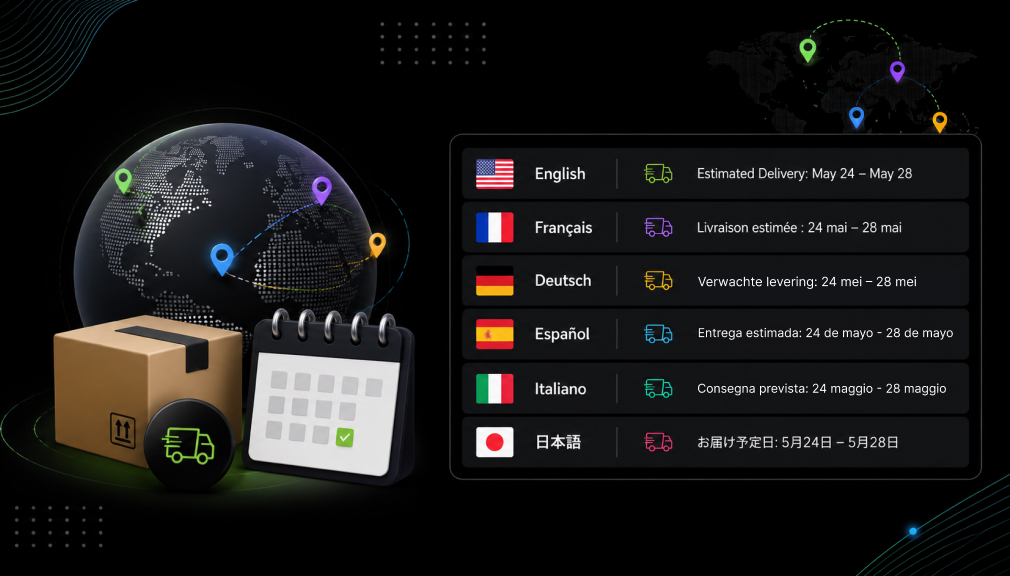
Imagine a shopper in Madrid, settling into a late-night browse of a Shopify store. They’ve chosen the item of their dreams: a pair of shoes, and are about to check out when they notice ‘Estimated delivery: 5–7 business days’ in English in the midst of otherwise Spanish text. They pause. Maybe this store isn’t for them after all?
That brief moment of uncertainty can be the difference between making the sale or not. For the international Shopify merchant, displaying multiple-language ETA is no longer merely a perk of the store; it is an essential part of shopping. When a customer sees a delivery date displayed in their language via a Shopify store, it communicates that the merchant does not just know their order; they understand them. This post looks at what is so significant about that, the complications encountered by the merchant, and two practical solutions for Hang on! Delivery dates in a customer’s language on a multilingual Shopify store:
Key Takeaways
- Multilingual for international Shopify stores builds trust and conversion when delivery information matches a customer’s language and local format.
- Most international shoppers prefer buying in their native language, and many avoid stores that don’t offer it.
- Localized delivery estimates reduce “Where is my order?” tickets, which already make up a large share of ecommerce support volume.
- Shopify’s built-in translation tools don’t automatically translate dynamic delivery date messages.
- A Shopify estimated delivery date app lets merchants add translated ETA messages for each language without coding.
- Custom code can work for very simple stores, but maintenance grows quickly as languages and shipping rules increase.
Why Multilingual ETA Matters
The checkout is probably the most emotional moment in the shopping course. Companies are asking their visitors to give their money, in the form of credit card details, but also their address and their expectations of an experience. And language can make a huge difference. 75% of international online shoppers would rather purchase in a language they feel comfortable with. Cross-border transactions account for almost 20% of all online shopping.
For Shopify merchants, the customer’s language on Shopify also applies across the board, including delivery dates. 76% of online shoppers prefer to buy products with information in their native language, and 40% will never purchase from websites in other languages; CSA Research has revealed that 60% of shopkeepers almost / never buy from English-only online shops. If the whole of the shop is translatable, but the delivery date of “Ships in 3–5 business days” remains, the mismatch is obvious and quietly unravels all of that trust.
Common Merchant Challenges
The vast majority of shops skipping the multilingual ETA is not because merchants do not value, it is because it was incredibly difficult to do right in the first place. The common difficulty points are:
- Translation apps overlook dynamic parts. Where translation engines (such as those used for translating themes and product pages) do well with static text, otherwise variable communication, such as for delivery, may be omitted completely.
- Date formats are defined by the country you are in. 03/07/2026 is April 3rd across most of Europe but March 4 th in the US, a minor difference that can sometimes seem insignificant but causes real confusion over arrival dates.
- ETA rules and language-sets are kept separately. For example, most merchants put in some well-thought-out shipping rules for every country, but there’s no good way to relate those rules to the correct language.
- Manual translation is not scalable. Writing and editing messages for five or six different languages is no longer realistic after your store grows.
Support teams take the hits. If delivery details can’t be communicated to the customer in their native tongue, the question doesn’t go away; it becomes a support ticket. Support tickets for WISMO requests have already reached 20 to 40% of ecommerce volumes and will increase during peak season.
Benefits of Localized Delivery Dates
When the delivery dates are available in a customer language over Shopify, the impact has occurred on the following sites or places,
Fewer “Where is my order?” messages. End-to-end proactive, transparent delivery communication is a major precipitator of WISMO tickets; some brands have been able to reduce these queries by up to 75% by improving delivery information communication. For instance, a German customer confronted with the message “Lieferung bis Freitag, 19. Juni” is much less prone to inquire when their order will arrive.
Higher checkout completion. A mere change in the language of “[X] business days” to show a concrete delivery date actually had a measurable impact on checkout completion.22% of shoppers said delivery times had influenced their abandoned shopping cart. Users respond positively to localized, concrete information.
Stronger trust in the brand. 73% of online consumers will not complete a purchase if they do not trust the delivery process. Localized delivery dates illustrate to a store that they have considered the international experience, not just the homepage.
Better experience for repeat shoppers. Clear shipment information has been proven to boost customer satisfaction scores of repeat customers by as much as 25% for international shipments.
How to Show Estimated Delivery Dates in Multiple Languages on Shopify
There are two options to show estimated delivery dates in multiple languages on Shopify: a Shopify estimated delivery date app or custom code. Both can work, but custom-coded solutions require more technical maintenance in the long-term. For most Shopify merchants, the best way to show delivery estimates in the customer’s language of choice is an app-based solution.
Option 1: Shopify App-Based Solution (Recommended)
The easiest way to Show Estimated Delivery Dates in Multiple Languages on Shopify is with a dedicated Shopify estimated delivery date app. Apps built for ETA management connect language settings directly to delivery rules, so the correct delivery message appears automatically based on the customer’s selected language. This ensures a localized shopping experience, improves customer trust, and helps international shoppers clearly understand when their orders are expected to arrive.
Here’s how this typically works, using SetuBridge’s Estimated Delivery Date & Time app as an example:
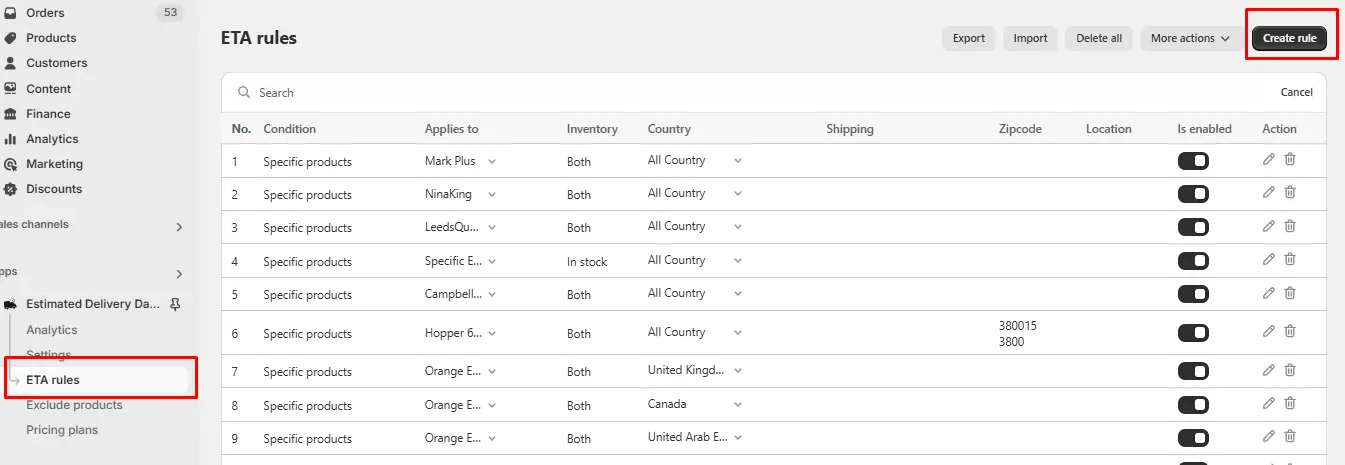
Create an ETA rule. In the app dashboard, go to ETA Rules and create a new rule for a product, collection, or shipping method.
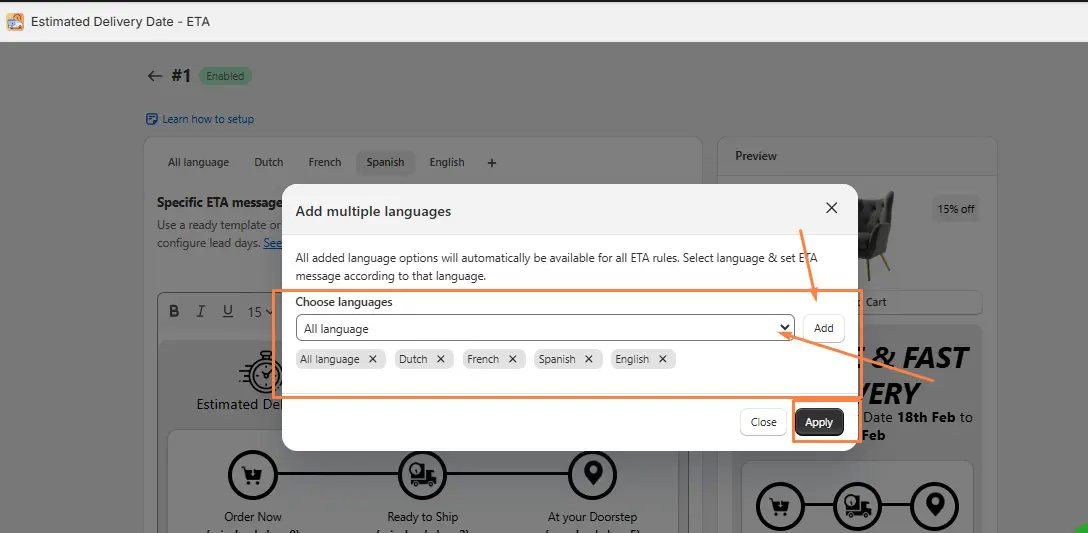
Add the languages your store supports. Within the rule, click “Add language,” select each language from the dropdown, and save the list.
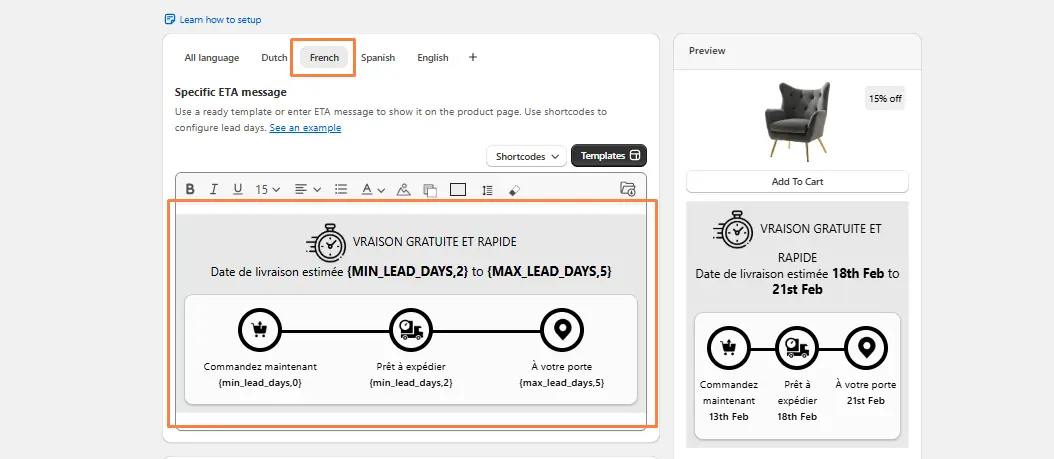
Write a translated message for each language. Enter the delivery message for every language added; for example, an English message for US customers and a separate French message for French-speaking shoppers. Lead times, icons, and text styles can be customized per language.
Save and test. Switch the storefront language to confirm that the correct message appears as a customer would see it.
For example, a store wanting a different delivery message for Spanish-speaking customers in Spain would select Spanish as the language and Spain as the country, then write the message in Spanish. From there, those shoppers see delivery information matching their language and local shipping timeline, while other customers see their own version.
Option 2: Custom Shopify Code Solution
It’s possible to build a basic version of Shopify ETA in multiple languages using Liquid and JavaScript, but this comes with real limitations.
A typical custom setup involves:
- Detecting the customer’s active language or market using Shopify’s localization object in Liquid.
- Writing conditional logic for each supported language, with separate hardcoded messages and date formats.
- Manually formatting dates in JavaScript to match local conventions (DD/MM/YYYY vs MM/DD/YYYY).
- Updating theme code whenever shipping times, cutoffs, or languages change.
This can work for a store with one or two languages and simple, store-wide shipping rules. But it becomes tricky quickly: every new language means more conditional logic, and every shipping change means editing theme code across multiple files. There’s also no built-in way to combine language-based messages with other ETA logic, like zip code-based delivery dates or product-specific lead times, without significant custom development. For most stores, the limited flexibility and maintenance burden make this a weaker long-term fit than a dedicated app.
Conclusion
For those shops that ship to customers across the US, UK, Australia, UAE and Ireland, Multilingual ETA is not a subtle feature. It is a way to earn trust with the customer before the checkout. Delivery dates in the customer’s language on Shopify instil confidence; cut back on confusing support questions.
You could technically use a custom code workaround to show delivery dates by language in Shopify, but it becomes complicated to implement and is of no use once your shipping rules start to get more complex. With a Shopify estimated delivery app, you can offer localised delivery times to every language and customer segment, all managed from one dashboard, whatever works best for you. But the aim’s still the same: “effective communication that makes every customer, in every language, aware of when their shipment will reach them.”
FAQs
1. How do I show estimated delivery dates in multiple languages on Shopify?
Use a Shopify app that lets you create ETA rules with translated delivery messages for each language your store supports. The app then displays the correct message automatically based on the customer’s selected language.
2. Can Shopify display delivery dates based on customer language?
Yes, but Shopify’s native translation tools handle static theme text and don’t automatically translate dynamic delivery date messages. A dedicated ETA app is needed to connect delivery dates to language settings.
3. What is the best Shopify app for multilingual delivery dates?
Look for an estimated delivery date app that supports adding multiple languages directly within ETA rules, alongside country-based and product-based settings. This lets you manage language and shipping logic together in one place.
4. Does Shopify support delivery date translation natively?
No, Shopify doesn’t natively translate dynamic delivery date text as part of its core platform or standard translation tools. Merchants need an app or custom code to display delivery dates in multiple languages.

Shopify Expert
Dipen Panchal, Shopify Tech Lead at Setubridge Technolabs, brings over a decade of expertise as a Shopify Expert. Passionate about e-commerce growth, he specializes in UI/UX design, crafting intuitive, engaging solutions tailored for merchants and B2B clients to enhance user experiences.