





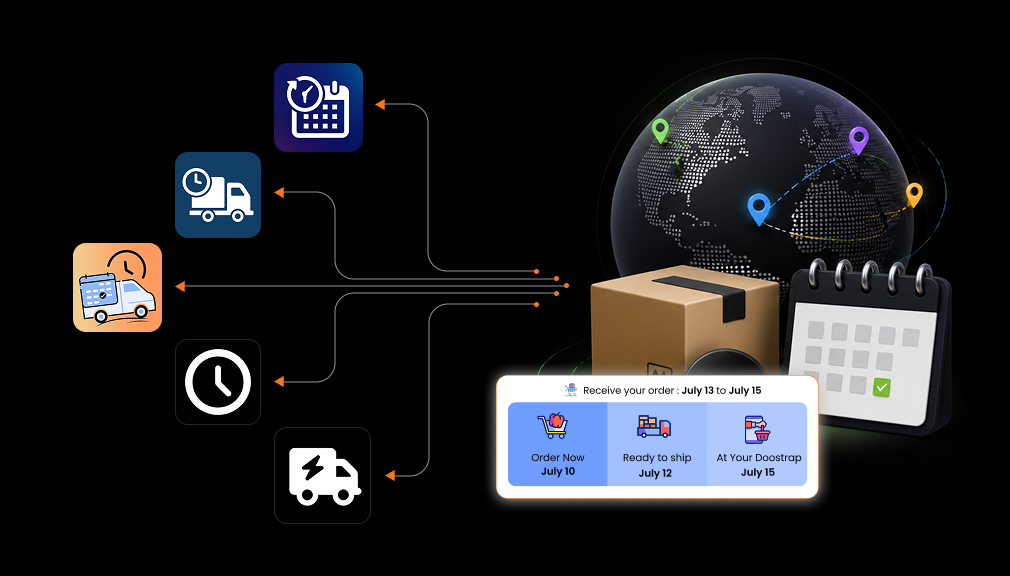
Shoppers no longer accept vague shipping promises. A line saying “ships in 5 to 10 business days” invites doubt, not confidence. People want a real date they can plan around. When your product page cannot give one, they leave and check a competitor.
The data backs this up. Baymard Institute’s analysis of 50 documented studies found that the average shopping cart abandonment rate is 70.22%, meaning roughly 7 out of 10 shoppers leave without completing their purchase after adding items to their cart. Remove the shoppers who were only browsing, and the fixable reasons come into focus. High extra costs lead at 39%. Slow delivery follows at roughly 21% to 23%.
That second number is the one merchants keep ignoring. Many stores ship quickly but never say so on the page. The shopper assumes the worst and abandons a cart you could have won. A clear estimated delivery date fixes an expectation problem, not a logistics problem.
There is a support cost too. “Where is my order?” tickets, shortened to WISMO, are the largest single category of ecommerce support requests. Industry estimates place them between 20% and 50% of all tickets. Each one costs staff time and returns nothing.
A good estimated delivery date app attacks both problems at once. It lifts conversions at the product page and cuts tickets after checkout.
Key Takeaways
- Vague shipping promises like “ships in 5–10 days” create doubt at the exact moment shoppers decide to buy. Slow or unclear delivery is a top-three fixable reason people abandon carts, and it also fuels a flood of “where is my order?” support tickets.
- An estimated delivery date app shows customers a real, realistic arrival date across the product page, cart, checkout, and confirmation emails turning an expectation gap into buyer confidence.
- Clearer delivery dates lift product-page conversions, reduce delivery-related cart abandonment, and cut post-purchase support volume, so the app effectively pays for itself.
- Match the app to your fulfillment complexity, not just its feature list; weigh multi-warehouse and pickup rules, geo/ZIP-based dates, timezone accuracy, checkout ETA support, date-calculation reliability, and whether the delivery text renders as real, machine-readable page content for AI shopping agents.
- Start on a free plan where one exists, install only one delivery date app at a time, and test it with real orders across different locations, shipping methods, and processing times before you rely on it.
Comparison of top Shopify Estimated Delivery Date Apps
| App | Rating (reviews) | Free plan | Best for |
| Estimated Delivery Date ‑ ETA by Setubridge | 4.9 (493+) | Yes | Powerful rule engine, warehouses, pickup |
| S Estimated Delivery Date ETA by Synctrack | 4.9 (440+) | Yes | Shopify Plus checkout, 24/7 chat |
| Essent Estimated Delivery Date by Essential Apps | 5.0 (972+) | Yes | Simple stores on zero budget |
| C‑EDD: Estimated Delivery Date by Coder | 4.9 (384+) | Yes | Cheapest unlimited product rules |
| NS Estimated Delivery Date by NestScale | 4.8 (92+) | Yes | Best value for geo-based ETA |
5 Best Estimated Delivery Date Apps for Shopify
“All apps personally tested by our Shopify Team”
1. Estimated Delivery Date by SetuBridge
4.9 stars (461+ reviews) · Built for Shopify · Free to install · Launched 2020
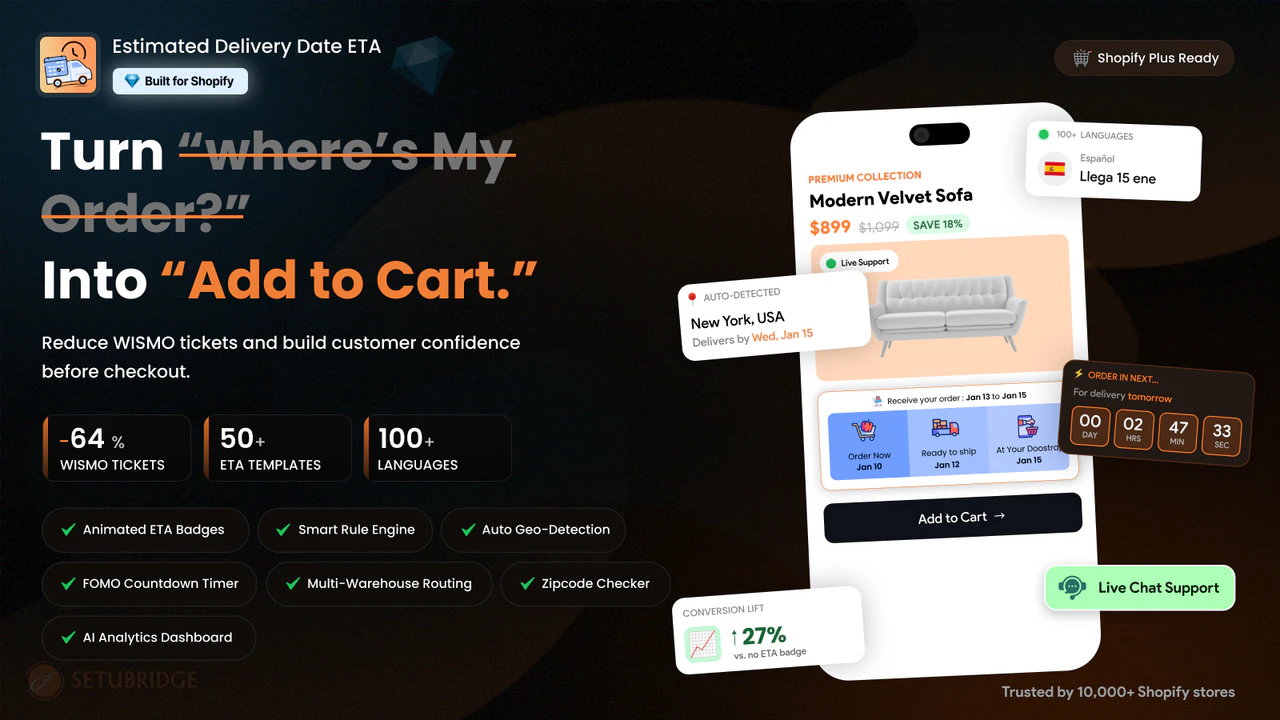
Estimated Delivery Date – ETA by SetuBridge: Best overall for its powerful rule engine. It handles complex delivery scenarios that the other four apps don’t address. If your fulfillment process is complicated, this is the strongest option on the list.
Most estimated delivery date apps set rules by product, collection, or country. This one goes further. You can set rules by vendor, tag, inventory status, and warehouse location. You can also run ETA by pincode or ZIP code with a built-in checker for shoppers.
The multi-item cart problem it solves
Here is a scenario every growing store hits. A customer adds three items with different lead times to one cart. Which delivery date do you show at checkout?
Show the earliest, and you break a promise. Show nothing and the shopper worries. This app displays the longest estimated delivery date at checkout, which is the honest answer. That feature needs Shopify Plus, but no other app compared here offers it.
What else stands out
Delivery dates display across product pages, collection pages, cart, checkout, order status pages, and emails. Featured products on your home page are covered too. That is unusually wide coverage.
There are more than 50 animated templates with live preview while you edit. Date calculation handles processing time, cut-off times, holidays, off days, and scheduled vacations. In-store pickup locations can show their own separate ETA.
Merchants consistently praise the support team for responsive setup help. The Premium plan adds a dedicated account manager and one-to-one onboarding.
Pricing: Free plan available; paid plan starts from $6.99/month.
Pros:
- Deepest rule engine of any app compared here.
- Warehouse-based and inventory-based ETA rules.
- Longest ETA at checkout for multi-item carts (Shopify Plus).
- In-store pickup locations with their own delivery estimate.
- 50+ animated templates with real-time preview.
- Six years in market with a mature feature set.
- Frequently updated changelog every month.
- Shows ETA views in Analytics as an advanced feature.
Cons:
- The best features sit on the $19.99 Premium tier, which is the highest entry point for full functionality here.
Choose it as well if: you ship from multiple locations, offer store pickup, sell across many regions, or run carts with mixed lead times.
2. S Estimated Delivery Date Plus by Synctrack
4.9 stars (400+ reviews) · Built for Shopify · Free plan available · Launched 2018

S Estimated Delivery Date Plus by Synctrack, formerly Omega, is the longest-running app in this comparison. Its Plus tier delivers a genuinely dynamic checkout extension. You can drive checkout ETA by variant, product, vendor, tag, SKU, country, city, or ZIP code. It also places an ETA banner on the thank-you page and order status page.
Two features here are unique in this group. First, you can drive delivery dates from product or variant metafields. That is powerful if you already store lead times in Shopify metafields. Second, the app bundles shipping protection, which sits outside pure EDD but saves installing another app.
Support is the other strong point. The team offers 24/7 live chat on every tier, including the free plan. Reviews repeatedly name individual agents who solved problems at weekends.
Pricing: Free plan available; paid plan starts from $4.99/month.
Pros
- Best checkout extension for Shopify Plus merchants.
- Metafield-driven delivery dates.
- Shipping protection bundled in.
- Works with customer accounts and Shiprocket.
- A frequently updated changelog every month.
Cons
- The free plan allows only one rule, which is restrictive.
- The trial runs three days, shorter than the seven-day standard.
Choose it if: you run Shopify Plus and want ETA logic inside checkout, or you value round-the-clock chat support.
3. Essent Estimated Delivery Date by Essential Apps
5.0 stars (849+ reviews) · Built for Shopify · Completely free · Launched 2025

Essent Estimated Delivery Date by Essential Apps has the highest rating and the most reviews of any app in this comparison. It is also completely free, with no paid tier at all. For simple stores, that combination is hard to beat.
It covers the fundamentals well. You get estimated delivery dates, processing times, cut-off hours, holidays, and countdown timers. The widget editor is genuinely easy, and reviewers repeatedly finish setup within an hour.
One reviewer captured its appeal well. They installed it, customised it, built separate widgets for different products, and left a five-star review the same hour. That is the experience this app is built for.
Be clear about the trade-off, though. Its feature depth is narrow compared to the top two. Shopify’s own listing tags show delivery options limited to blocked dates and countdown timers. There is no warehouse logic, no pickup ETA, and no ZIP code checker.
It also launched in June 2025, making it the newest app here. The rating is excellent, but the long-term track record is still short.
Pricing: Totally free to use.
Pros
- Genuinely free with no upsell tier.
- Highest rating and review count in this comparison.
- Very fast setup, often under an hour.
- Multiple widgets for different products or markets.
- Built for Shopify badge.
Cons
- No warehouse, pickup, or multi-location logic.
- Focused mainly on product pages.
- No widget duplication yet, which merchants have requested.
Choose it if: you have one warehouse, straightforward shipping, and want a clean delivery date live today at zero cost.
4. C‑EDD: Estimated Delivery Date by Coder
4.8 stars (333+ reviews) · Free plan available · Launched 2022

C-EDD: Estimated Delivery Date by Coder keeps things simple and affordable. Its Pro plan costs $8.98 per month and removes all quotas, giving you unlimited products, categories, countries, languages, and holidays.
One nice touch: the app displays estimated delivery dates in the visitor’s local time zone. That is a small detail with real impact for international stores. If you have a large catalogue and need per-product delivery dates, this is the lowest-cost route.
Two caveats matter here. This is the only app in this list without the Built for Shopify badge. That badge signals Shopify’s performance and integration standards, so its absence is worth weighing.
More importantly, one merchant in Chile reported inconsistent business-day calculations over a year of use. They said weekends were sometimes counted despite being excluded. Date maths is the core job of this app, so test yours carefully before launch.
Pricing: Free plan available; paid plan starts from $4.98/month.
Pros
- Cheapest unlimited plan in this comparison.
- Local time zone display for international shoppers.
- Simple, quick setup with low learning curve.
- Support team reviewed as fast and helpful.
Cons
- A documented merchant report of business-day calculation errors.
- Mostly product-page focused.
- No ZIP code checker or warehouse logic.
Choose it if: you need per-product delivery dates across a big catalogue at the lowest possible price, and you will test date accuracy properly first.
5. NS Estimated Delivery Date by NestScale
4.8 stars (80+ reviews) · Built for Shopify · Free plan available · Launched 2024
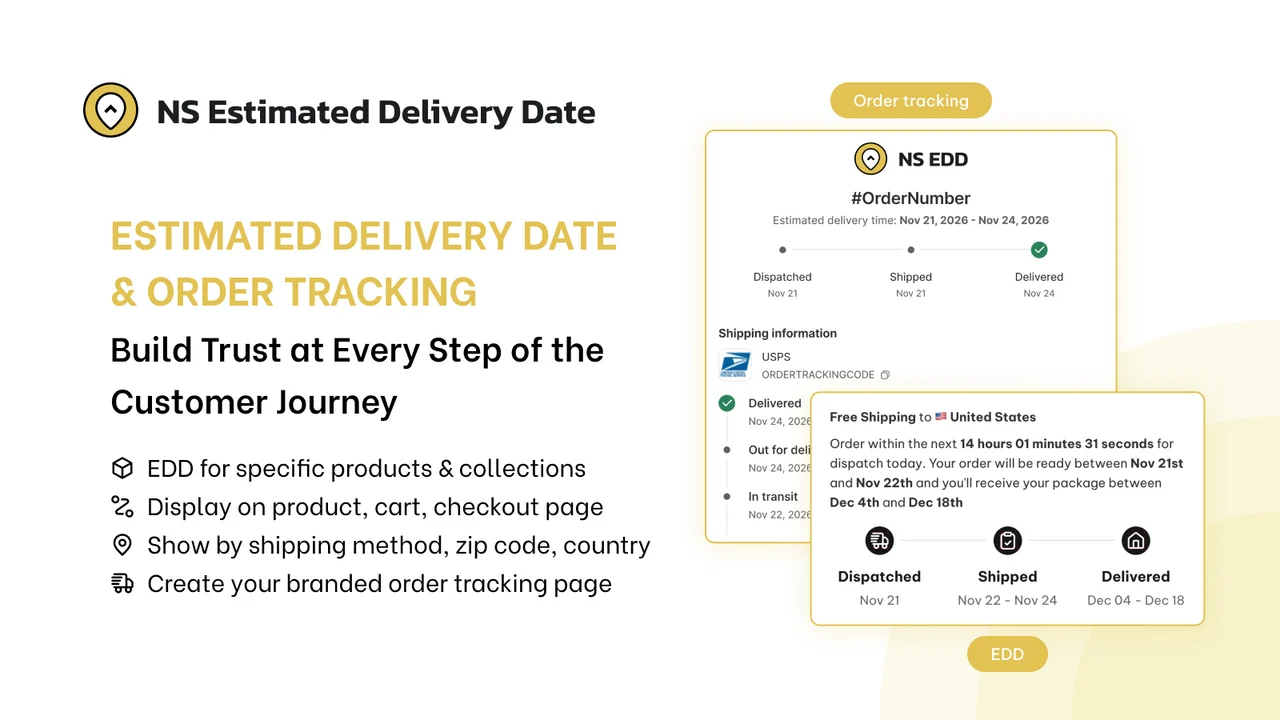
NS Estimated Delivery Date by NestScale shows clear delivery dates throughout the buyer journey. The app displays EDD and ETA on product, cart, and checkout pages.
Shoppers see an estimated delivery date the moment they view a product. This builds trust, reduces cart abandonment, and lifts your store conversions. You set delivery rules by product, ZIP code, or shipping method. Automatic timezone conversion shows each visitor an accurate local arrival date.
The free plan supports up to 100 products, which suits small stores. Global rules and product rules give you flexible control over delivery dates. Cut-off times, working days, and holidays keep every estimate realistic. A branded order-tracking page shows real-time shipping progress to buyers.
Pricing: Free plan available; paid plan starts from $7.99/month.
Pros
- Built for Shopify quality with a high 4.9-star rating.
- Free plan covers up to 100 products for small stores.
- Flexible global and product rules for accurate delivery dates.
- Responsive support praised across many recent reviews.
Cons
- The free plan shows a “powered by” logo on the widget.
- The 100-product cap may not fit larger catalogs.
Choose it if: you sell internationally, need country or ZIP code delivery dates, and want the strongest price-to-feature ratio.
The new reason this matters: AI shoppers read your delivery info
Something changed in 2026 that most merchants have not adjusted for. AI assistants now send real buying traffic to stores. Adobe Analytics reported that AI-referred traffic to U.S. retail websites increased by 393% year over year in Q1 2026. Even more importantly, AI-referred visitors converted 42% better than traditional traffic, spent 48% more time on-site, and viewed 13% more pages per visit.
That traffic converts well. Adobe found AI-referred visitors converted about 42% better than other channels by March 2026. Orders from AI-powered search on Shopify carried around 14% higher average order values.
Here is the catch. Adobe also scored the average US product page at just 66% machine-readable. Roughly a third of the page cannot be parsed by an AI agent. If your delivery promise sits in an image or an unreadable script, it does not exist to that shopper.
So pick an app that renders delivery text as real page content. Ask any vendor how their widget outputs its date. Good developers will answer that directly.
How to choose the right estimated delivery date app
Work down this list. Stop at the first line that describes your store.
- You ship from multiple warehouses, offer pickup, or run mixed lead times. Choose SetuBridge Estimated Delivery Date ‑ ETA.
- You have one warehouse, one country, and one shipping speed. Install Essent Estimated Delivery Date. It is free and takes under an hour.
- You need geo-based dates across many countries on a tight budget. Choose CodeRagon.
- You have a huge catalogue and need per-product dates cheaply. Choose C-EDD, and test date accuracy for two weeks first.
- You run a Shopify Plus store and want to display ETAs in the checkout. Choose Synctrack.
Two more rules worth following. Never install two EDD apps at once, because conflicting widgets confuse shoppers and slow your pages. And always start on a free plan where one exists.
Final thoughts
Estimated delivery date apps can make a meaningful difference to the Shopify shopping experience. By giving customers clear and realistic delivery expectations, they can reduce uncertainty, improve confidence, and help lower delivery-related support queries.
The best app for your store depends on factors such as fulfillment complexity, shipping regions, customization needs, and budget. Before making a decision, consider the features that align with your actual delivery workflow rather than simply choosing the app with the longest feature list. Most importantly, test your chosen solution with real orders, different locations, shipping methods, and varying processing times.
A reliable delivery date experience should remain accurate across different scenarios and provide customers with confidence from product discovery through checkout.
Frequently Asked Questions
1. Do estimated delivery date apps increase conversions?
Clear delivery dates reduce uncertainty around shipping times, helping address delivery-related cart abandonment and improve customer confidence.
2. Can I show estimated delivery dates at Shopify checkout?
Yes, checkout ETA features are generally available on Shopify Plus, with options varying by app and plan.
3. Will an estimated delivery date app slow down my store?
Storefront scripts may add some weight. Four apps have the Built for Shopify badge, but always test Core Web Vitals.
4. How do I show different delivery dates for different countries?
Choose an app with flexible geolocation rules to provide accurate delivery estimates across different countries, regions, and shipping scenarios.
5. Can Shopify show delivery dates without an app?
Shopify supports static shipping text, while dynamic delivery dates require an estimated delivery date app.
6. How do delivery date apps reduce support tickets?
Clear delivery dates before purchase and in confirmation emails can reduce “Where is my order?” support questions.

Shopify Expert
Dipen Panchal, Shopify Tech Lead at Setubridge Technolabs, brings over a decade of expertise as a Shopify Expert. Passionate about e-commerce growth, he specializes in UI/UX design, crafting intuitive, engaging solutions tailored for merchants and B2B clients to enhance user experiences.