





It is 11 p.m. on a Sunday. You open your Shopify admin to check your bestseller before tomorrow’s ad push. The stock count says zero. Your heart sinks because that ad budget is already committed.
Every Shopify merchant knows this feeling. You either run out of your winners or sit on boxes of products nobody wants. Both problems drain the same thing: your cash.
The scale of this pain is hard to ignore. According to the IHL Group’s 2026 Inventory Distortion Study, stockouts and overstocks cost retailers about $1.7 trillion worldwide each year. Out-of-stocks alone account for roughly $1.2 trillion of that loss.
The good news? The right Shopify inventory management app can shrink this problem for your store. Below are five apps that solve real merchant pain points, starting with the details you actually need.
Key Takeaways
- Stockouts and overstocks cost retailers about $1.7 trillion a year, per the IHL Group study.
- Stockie is the smoothest path for retail teams replacing Stocky, with a Built for Shopify badge.
- Prediko suits scaling D2C brands that want AI forecasting, raw materials tracking, and an AI agent.
- Assisty wins on reporting depth and plan-based pricing, including a useful free plan.
- Sumtracker shines for bundles and syncing Amazon, eBay, Etsy, and Walmart with Shopify.
- EasyEcom fits high-volume operations with its WMS, packing video proof, and pay-per-order pricing.
Comparison Table: Details You Will Not Find at a Glance
This table focuses on inside details from deep research, pricing pages, and merchant reviews, not just feature checklists.
| App | Standout inside detail | Pricing model | Best fit |
|---|---|---|---|
| Stockie Inventory Management by Plutonian | Stocktakes run without closing the store; founders ship review-requested features within days | Feature tiers, $4.99–$59.99/mo, unlimited locations on all plans | Retail teams replacing Stocky |
| Prediko Inventory Management by Prediko | PIA AI agent plus an MCP connector to query stock inside ChatGPT or Claude; auto-migrates Stocky data | Revenue tiers, $49–$199/mo; enterprise free to install | Scaling D2C brands with raw materials |
| Inventory Management ‑ Assisty by Assisty | Pricing tied to your Shopify plan, not revenue; 300+ report library with a custom builder | $19/$59/$199 by Shopify plan; free plan with 6 months history | Data-driven multi-location stores |
| Sumtracker Inventory Manager by Sumtracker | Bundle components feed many bundles at once; landed costs flow into COGS and valuation reports | Order-volume tiers, $59/$119/mo; ~15% off annually | Multichannel sellers with bundles |
| EasyEcom Inventory Management by Edgewise Technologies | EasyVMS tags packing video to order IDs for return disputes; auto payment reconciliation catches overcharges | Pay-per-order, $0.49/order, no monthly fee | High-volume omnichannel with a warehouse |
The 5 Best Shopify Inventory Management Apps
1. Stockie Inventory Management — Best for Retail Teams Replacing Stocky
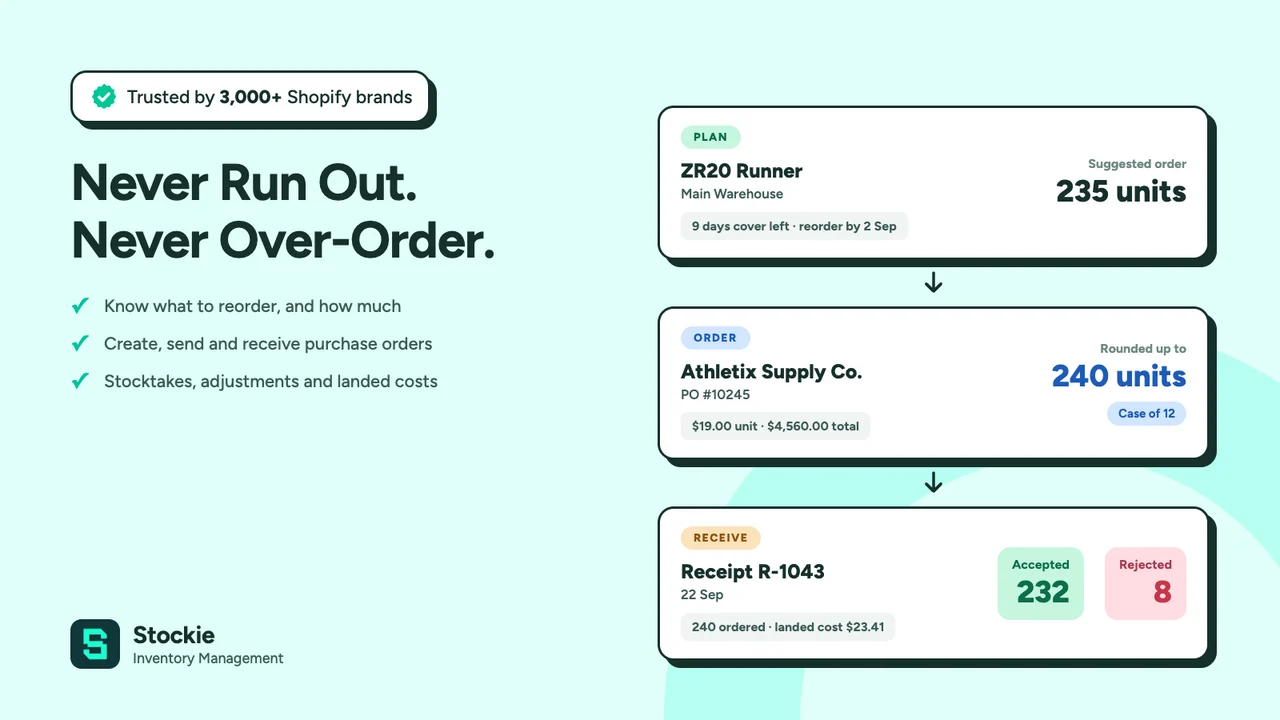
Stockie Inventory Management by Plutonian is a Built for Shopify app, which means it meets Shopify’s highest performance and design standards. It has a 4.9-star rating, and many merchants who are moving away from Stocky frequently mention it in their reviews.
The pain point it solves: When Shopify sunset Stocky, thousands of retail stores lost their purchase order workflow overnight. Merchants tried several tools and felt lost mid-season. Stockie rebuilt that workflow, then added forecasting on top.
Here is what makes it different in daily use. Forecasts come from your real sales history, so predicted reorder dates update as sales velocity changes. Purchase orders build themselves from those forecasts, and received stock syncs back to Shopify automatically. You can also run stocktakes without closing the store, which retail teams love.
Insider detail: the co-founder, Jake, personally answers review feedback and ships requested features fast. Several merchants report asking for a feature and seeing it live within days. Low stock alerts arrive by email or Slack, so your team sees them where they already work.
Pricing starts at $4.99 per month, with forecasting at $29.99 and full purchase orders at $59.99. Every plan includes a 14-day free trial and unlimited locations.
Key Features
- Receive stock fast by scanning product barcodes during purchase order receiving.
- Suggests smart reorder quantities through demand forecasting to prevent stockouts and overstock.
- Shows ABC ratings and clear inventory health visuals for instant stock insight.
- Syncs average product costs automatically with Shopify for accurate profit reporting.
- Moves your Stocky data across smoothly with hands-on setup and migration help.
- Offers an intuitive interface that integrates seamlessly with your Shopify store.
- Reviewers repeatedly praise quick, real-person support that solves issues fast.
2. Prediko Inventory Management — Best for D2C Brands That Want AI Planning
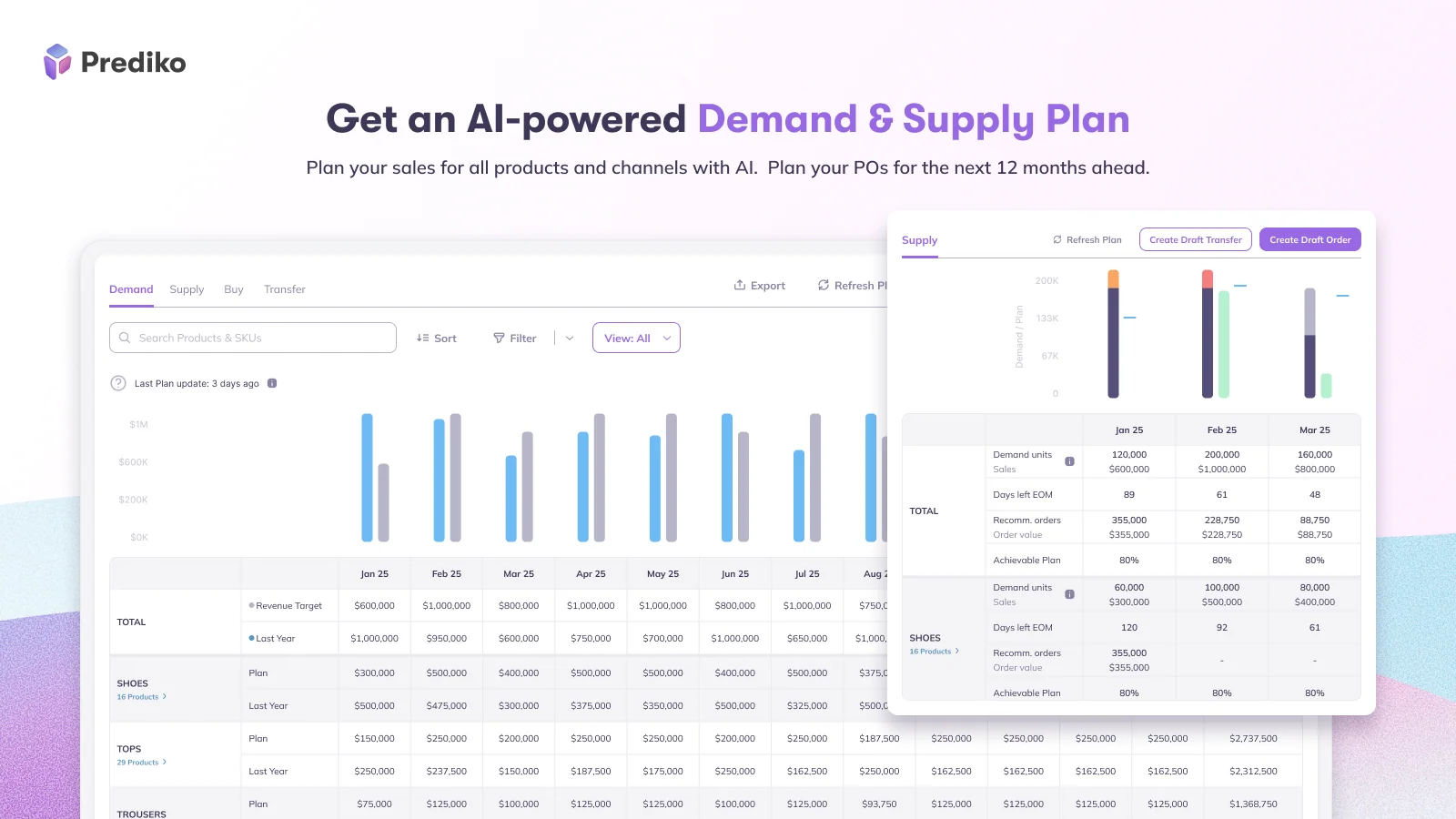
Prediko Inventory Management by Prediko has a 4.9 rating from 249 reviews and focuses on AI demand planning for growing D2C brands. Shopify has also featured it as a top inventory management app.
The pain point it solves: You know your total sales, but planning by SKU, size, and season feels impossible. One color sells out while another gathers dust, and guessing quantities burns cash.
Prediko’s AI forecasts demand per product, SKU, and season, then feeds a dynamic buying table like an ERP. It tracks raw materials with a bill of materials, which is rare in Shopify apps. Brands that manufacture their own products can forecast fabric or ingredient needs, not just finished goods.
Insider detail: Prediko built an AI inventory agent called PIA, trained only on inventory workflows. It also offers an MCP connector, so you can ask questions about your stock inside ChatGPT or Claude. If you are leaving Stocky, your suppliers and purchase order history migrate automatically.
Pricing maps to store revenue: $49 for stores up to $100K, $119 up to $500K, and $199 up to $2M. Larger stores get enterprise onboarding with a dedicated success manager and Slack channel.
Key Features
- Suggests smart order and replenishment recommendations to prevent overstock and stockouts.
- Builds and manages purchase orders through a fast, practical buying-table workflow.
- Tracks stock coverage and adjusts quantities for seasonality and promotions easily.
- Surfaces many useful inventory metrics that reduce reliance on manual spreadsheets.
- Handles large catalogs with thousands of products and dozens of vendors smoothly.
- Integrates well with Shopify and connected systems like ShipHero for inventory data.
- Offers a user-friendly, customizable interface that starts working quickly after installation.
- Makes onboarding seamless with hands-on setup, supplier and purchase-order history imports.
- Reviewers repeatedly praise fast, real-person support that often solves issues same-day.
3. Inventory Management ‑ Assisty — Best for Data-Driven, Multi-Location Stores
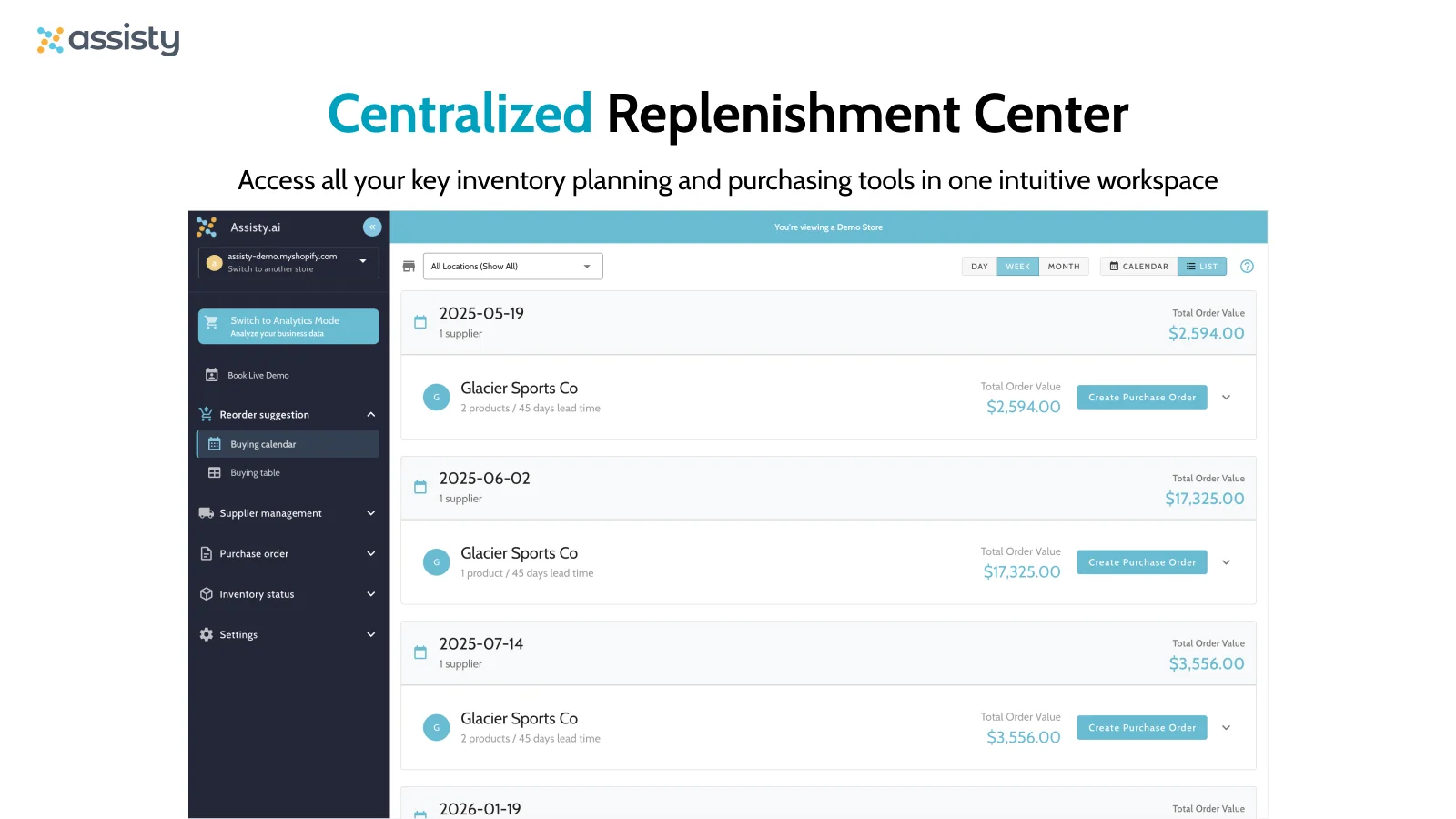
Inventory Management ‑ Assisty by Assisty carries a 4.8 rating across 358 reviews and leans heavily into reporting depth. Its library includes more than 300 inventory and sales reports, plus a custom report builder.
The pain point it solves: You have stock spread across locations, but no clear answer to “what do I reorder, where, and when?” Transferring stock between stores becomes guesswork, and dead stock hides in the numbers.
Assisty calculates reorder points per location and flags suggestions by urgency. Weekly reports surface dead stock and reorder needs before they become emergencies. A buying calendar and advanced buying table help you plan purchases around lead times and seasonality.
Insider detail: pricing follows your Shopify plan, not your revenue. Basic Shopify stores pay $19, Advanced stores pay $59, and stores pay $199. There is also a genuinely free plan with six months of sales history, which works well for testing. Merchants frequently praise the onboarding sessions with the support team by name.
Key Features
- Generates precise replenishment forecasts and reorder points that help prevent stockouts.
- Recommends AI-driven stock transfers between stores for smarter multi-location inventory decisions.
- Automates purchase orders and reorder planning from a clear buying table.
- Offers 300+ inventory reports covering sell-through, inventory ROI, and performance views.
- Lets you customize and schedule report exports to share data directly with suppliers.
- Provides safety stock controls with global and item-level configuration options.
- Fills reporting gaps that native Shopify analytics leaves for inventory tracking.
- Handles very large catalogs with tens of thousands of SKUs and vendors.
- Offers hands-on onboarding through live demos that tailor setup to your business.
- Reviewers repeatedly praise responsive, knowledgeable support available across time zones.
4. Sumtracker Inventory Manager — Best for Bundles and Multichannel Sellers
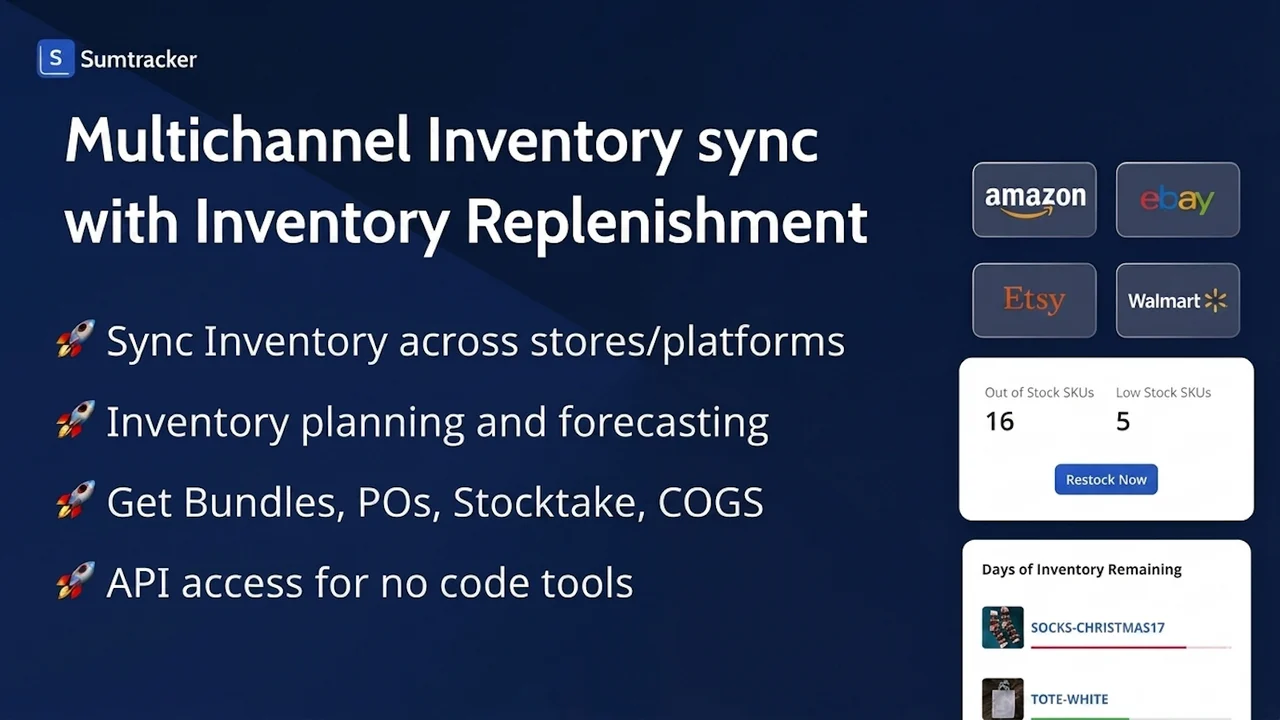
Sumtracker Inventory Manager by Sumtracker holds a 4.8 rating and has been solving multichannel sync since 2020. It connects Shopify with Amazon, eBay, Etsy, and Walmart in one shared inventory pool.
The pain point it solves: Selling the same SKU on four channels means one sale must update everywhere instantly. When sync lags, you oversell, refund, and apologize. Bundles make this worse because one bundle sale should reduce several component counts.
Sumtracker’s bundle engine is its quiet superpower. Bundle stock auto-updates based on component availability, and components can feed many bundles at once. Merchants selling customized or kitted products call it the only tool that handles their many-to-one product structures cleanly.
Insider detail: it tracks landed costs on purchase orders, so your COGS and stock valuation reports reflect true product cost, including freight. Pricing follows order volume rather than features alone: Manage starts at $59 per month and Replenish, with forecasting and automated reorder suggestions, starts at $119. Annual billing saves around 15 percent.
Key Features
- Syncs stock in real time across Shopify, Etsy, Amazon, and multiple stores.
- Handles product bundles and BOM lists so component stock stays correct automatically.
- Tracks raw materials, packaging, and components alongside finished goods for full visibility.
- Creates and manages purchase orders, including sending POs to subcontractors and suppliers.
- Calculates average product costs and supports receiving purchase orders in one place.
- Offers automated reorder suggestions and inventory planning to keep stock replenished on time.
- Provides a fast, intuitive interface that gets merchants set up within days.
- Supports barcode scanning on the inventory screen for quicker stock management.
- Serves as a reliable Stocky replacement, with missing features often built within days.
- Reviewers repeatedly praise responsive support that hops on calls and ships fixes fast.
5. EasyEcom Inventory Management — Best for High-Volume Omnichannel Operations
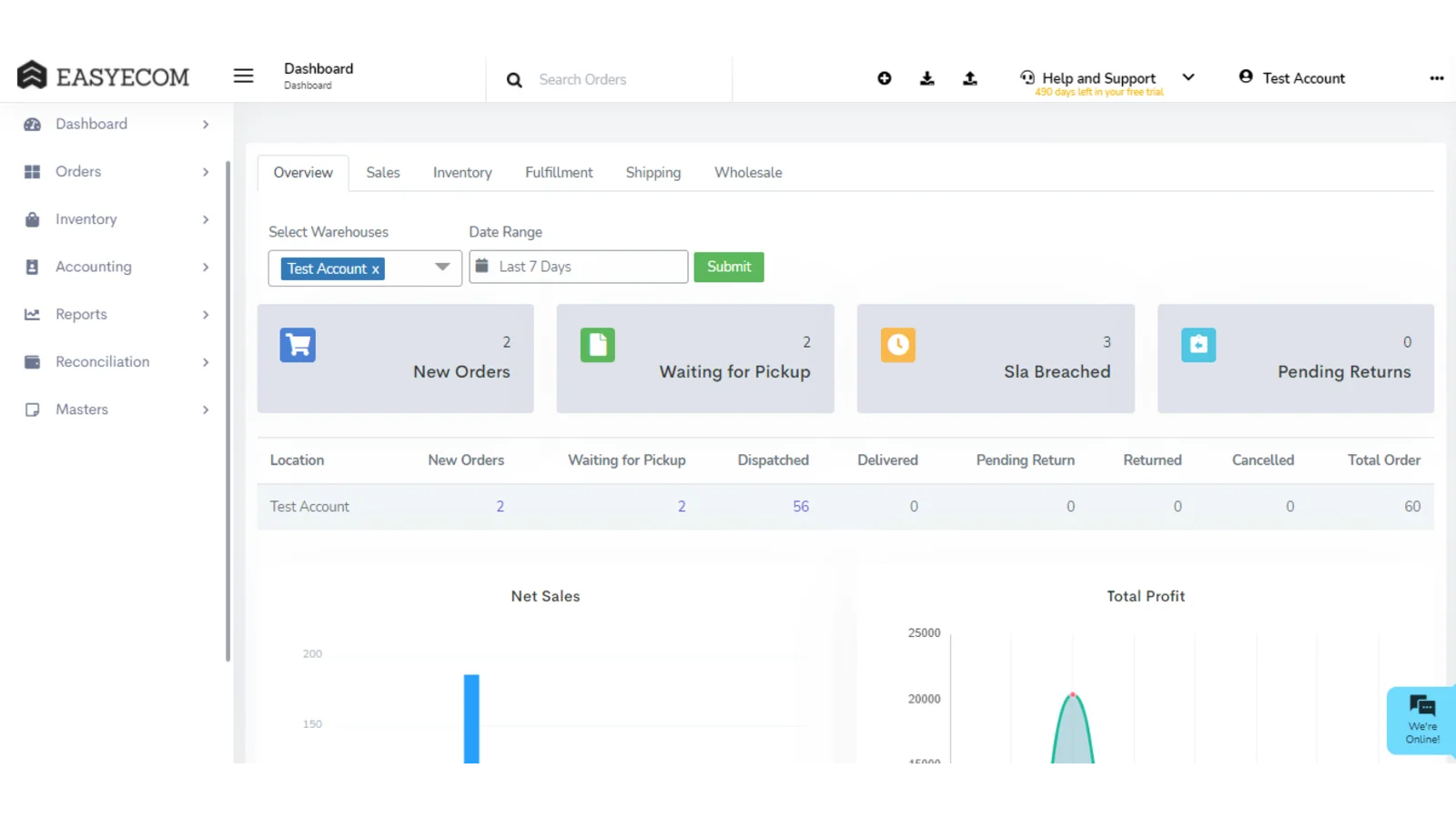
EasyEcom Inventory Management by Edgewise Technologies holds a perfect 5.0 rating and behaves more like a full operations platform than a simple app. It combines inventory sync, order management, and a warehouse management system (WMS).
The pain point it solves: Once you ship hundreds of orders daily across marketplaces, spreadsheet-level tools collapse. Picking errors rise, returns disputes drag on, and marketplace payouts become hard to verify.
EasyEcom syncs real-time inventory across channels to prevent overselling. Its WMS adds shelf management and handheld scanning, so pickers walk optimized routes instead of hunting products.
Insider detail: it includes EasyVMS, a video system that tags packing footage to each order ID. When a customer claims a wrong or missing item, you have visual proof for the dispute. It also runs automated payment reconciliation, catching marketplace overcharges and unpaid dues that quietly eat margins. Pricing is pay-as-you-go at $0.49 per order with no monthly fee, and bulk discounts are available.
Key Features
- Syncs real-time inventory across Shopify and marketplaces to prevent overselling and discrepancies.
- Pulls and processes orders from multiple stores and channels for faster fulfillment.
- Runs as a full WMS with shelf management and organized warehouse operations.
- Handles kit and virtual bundle management, with easy product mapping and unmapping.
- Provides predictive stock replenishment reports to plan purchase orders and avoid dead stock.
- Supports both B2B and B2C order processing from a single scalable platform.
- Integrates with external systems like Tally ERP alongside Shopify for accounting sync.
- Offers a robust analytics dashboard giving clear visibility across daily operations.
- Tailors the platform to each brand’s workflow, adding requested features over time.
- Reviewers repeatedly praise proactive, responsive support with dedicated account managers.
What Is Shopify Inventory Management?
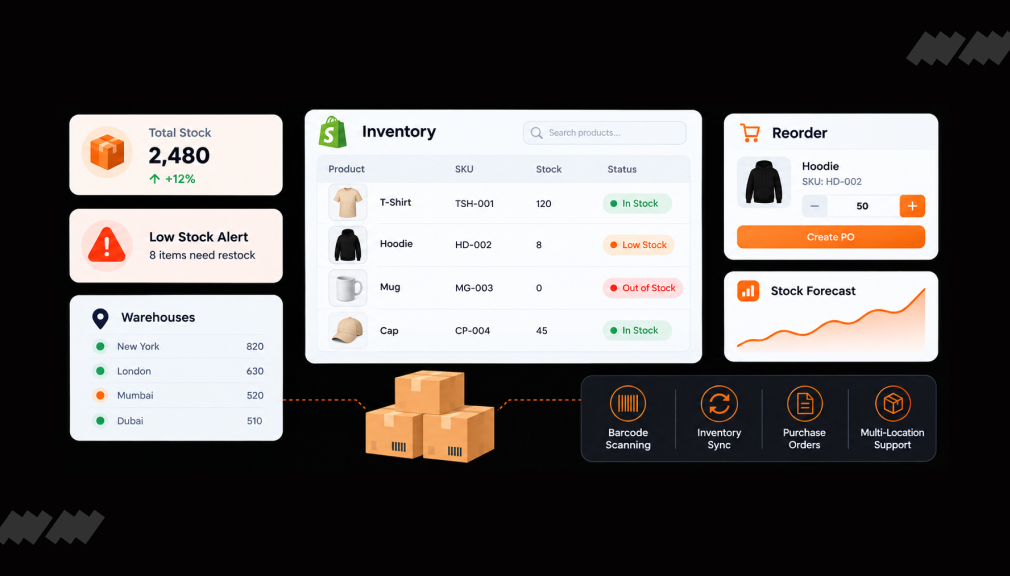
Shopify inventory management is the process of tracking, forecasting, and replenishing stock across your store and sales channels. Shopify’s admin counts units, but it does not tell you when to reorder or how much. Inventory management apps fill that gap with demand forecasting, purchase orders, low stock alerts, and multi-location transfers.
Why Do Stockouts and Overstock Keep Happening?
The mechanism is simple and very human. Spreadsheets show static numbers, and people stop noticing numbers that never move or shout. A reorder deadline hides quietly in a cell until the product is already gone.
Lead times make it worse. If your supplier needs 30 days, the reorder decision must happen a month before the shelf looks empty. Without forecasting, most merchants react to empty shelves instead of predicting them. Overstock is the mirror image: fear of running out leads to ordering too much, which ties up cash in slow movers.
Where Do These Apps Fit in Your Workflow?
Think of them as a layer between your sales data and your suppliers. The app reads your Shopify sales history, calculates velocity, and predicts when each SKU runs out. It then alerts you, suggests quantities, and turns approved suggestions into purchase orders. When stock arrives, it updates Shopify automatically, closing the loop without manual edits.
When Should You Move Off Spreadsheets?
Watch for three signals. First, you have missed a reorder on a bestseller more than once. Second, you sell in more than one location or channel and counts drift apart. Third, you spend hours each week updating stock numbers by hand. Any one of these means an app will likely pay for itself quickly.
How to Choose the Right Inventory App for Your Store
- Match the app to your pain, not the longest feature list. Stockout pain points to forecasting; multichannel pain points to sync.
- Check the pricing model against your growth. Revenue tiers, plan tiers, order-based fees, and feature tiers each suit different stores.
- Use the free trial with real data. Import your catalog, set supplier lead times, and judge the first forecast honestly.
One honest guardrail: no forecast fixes bad inputs. If your lead times and costs are wrong in the app, suggestions will be wrong too. Spend your first week on clean setup before trusting automated reorder quantities.
Final Thoughts
Inventory problems rarely announce themselves. They show up as a quiet zero on a bestseller or a shelf of markdowns in January. The right Shopify inventory management app catches those moments weeks earlier, when they are still cheap to fix.
Start with the app that matches your sharpest pain today. Run the free trial with real numbers, set honest lead times, and let the forecasts prove themselves. Your future self, checking stock at 11 p.m., will thank you.
FAQs
Which Shopify inventory management app is best after Stocky shut down?
Stockie, Prediko, and Assisty all rebuilt Stocky’s core purchase order workflow. Prediko and Assisty even migrate your Stocky suppliers and purchase orders automatically. Pick based on whether you want simplicity, AI planning, or reporting depth.
Do these apps work with multiple locations?
Yes, all five support multi-location inventory. Stockie includes unlimited locations on every plan, while Assisty and Prediko add per-location reorder points and stock transfers.
Can I sync Shopify inventory with Amazon, Etsy, and eBay?
Sumtracker specializes in this, syncing Shopify with Amazon, eBay, Etsy, and Walmart. EasyEcom also syncs marketplaces and adds order routing and reconciliation on top.
How much does a Shopify inventory management app cost?
Entry points range widely: Stockie starts at $4.99 monthly, and EasyEcom charges $0.49 per order. Assisty offers a free plan, while Prediko and Sumtracker start at $49 and $59.
Will demand forecasting work for a new store with little sales history?
Forecasts improve with data, so brand-new stores get rougher predictions at first. Start with low stock alerts and manual thresholds, then lean on forecasts as history builds. Most of these apps let you adjust safety stock while you wait.
Do I still need spreadsheets after installing one of these apps?
For daily reordering, no. The app becomes your source of truth for velocity, reorder dates, and purchase orders. Many merchants keep a simple export for accounting, and every app here supports data export.

Shopify Expert
Dipen Panchal, Shopify Tech Lead at Setubridge Technolabs, brings over a decade of expertise as a Shopify Expert. Passionate about e-commerce growth, he specializes in UI/UX design, crafting intuitive, engaging solutions tailored for merchants and B2B clients to enhance user experiences.