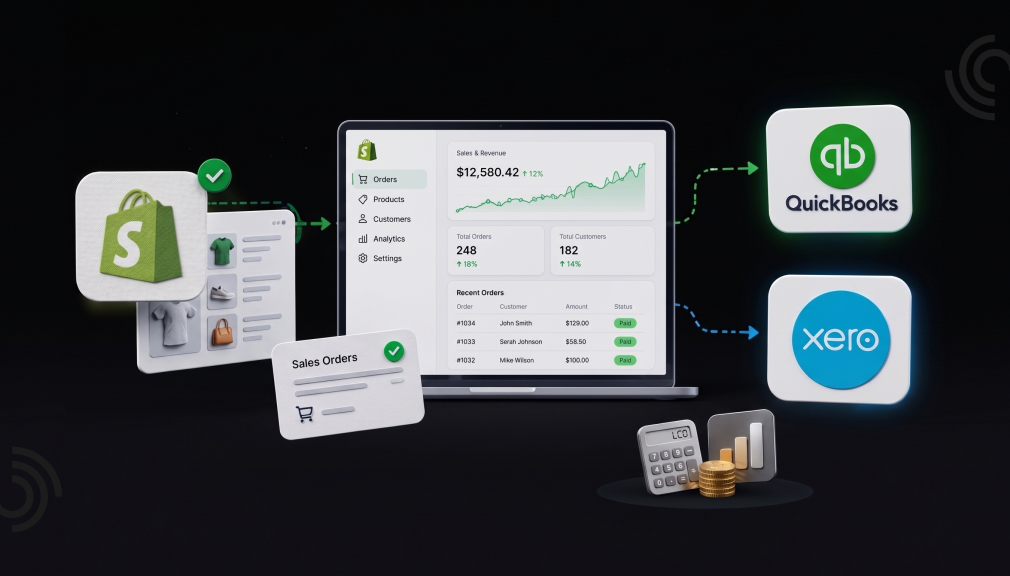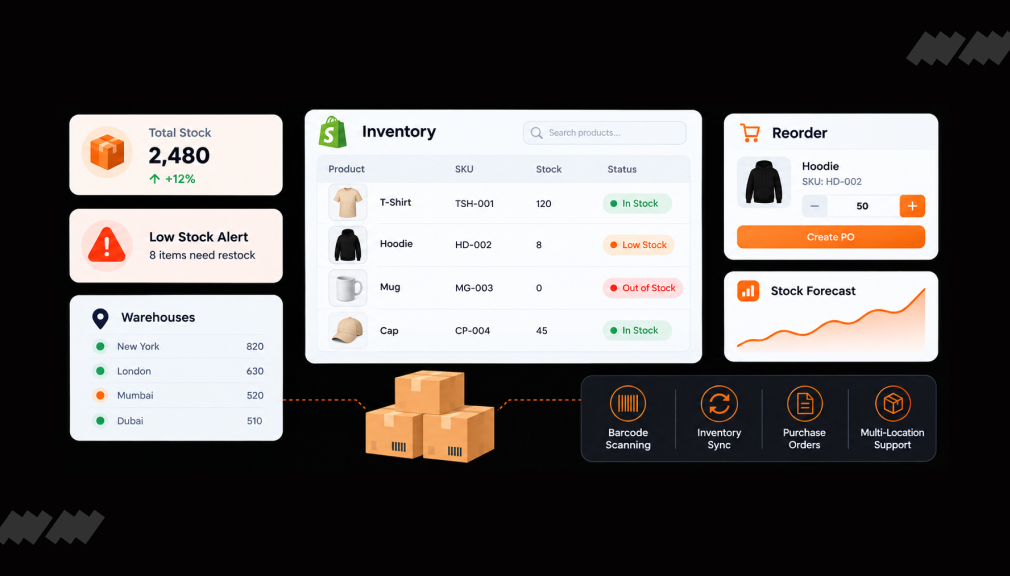







Shopify has no built-in warranty system. There is no native way to register products, track claims, validate serial numbers, or manage repairs inside the platform. Every Shopify brand selling physical products with a warranty period needs a separate tool to handle the post-purchase workflow.
The problem breaks into three parts. First, capturing who owns the product and when they bought it, especially when customers buy through retail stores, Amazon, or distributors where Shopify order data simply does not exist.
Then, processing warranty claims in a structured way so the support team can validate coverage, collect evidence, and resolve cases without turning every claim into a multi-email thread. Lastly, turning the warranty touchpoint into revenue through extended protection plans, upsells during registration, or first-party data that fuels retention marketing.
This guide ranks 7 Shopify warranty apps by the features that actually matter for registration, claims management, service workflows, and revenue generation in 2026. Each app is evaluated on what it does today, what it costs, and which type of Shopify store gets the most value from it.
TL, DR
- Dyrect is the most feature-complete Shopify warranty app in 2026, covering registration, claims, repairs, replacements, serial tracking, analytics, and six helpdesk/CRM integrations from a single dashboard.
- Propel and My Product Registration work well for smaller stores focused on registration and basic claims.
- Resolvi stands out for product fault intelligence. Warranly and Warranty Upsell handle warranty upsells at checkout. Warranto solves EU warranty label compliance.
Why Shopify Brands Need a Warranty Management App

Warranty support at low volume is manageable. An email here, a Shopify order lookup there, a quick replacement shipped out. The process feels simple enough that building a system around it seems unnecessary.
The math changes quickly. Each manually processed warranty claim takes 25 to 45 minutes when you add up verification, eligibility checks, photo requests, internal routing, customer updates, and resolution. At 100 claims per month, that adds up to 40 to 75 hours of staff time, roughly equivalent to a full-time employee doing warranty administration and nothing else.
The average warranty administrator in the US earns between $22.96 and $26 per hour depending on the source, which means the labor cost alone for manual warranty processing can reach $1,500 to $1,950 per month before you even count the software subscriptions for Shopify, the helpdesk, the spreadsheet tool, and the email platform.
Self-service warranty portals consistently reduce inbound support volume by 30 to 50 percent because customers can check coverage, file claims, and track status on their own. Automated warranty workflows close claims in 2 to 3 days compared to 7 to 14 days for manual processes.
And structured warranty data reveals which products fail most often, which defects are recurring, and which suppliers need accountability- insights that stay invisible when claims are scattered across inboxes and spreadsheets.
In-House Warranty Management vs. a Dedicated Shopify App
Running warranty management in-house means stitching together Shopify order lookups, a shared inbox, a spreadsheet for tracking, and maybe some Zapier automations to connect them. The brand owns the logic and the data, but the maintenance burden grows with every new edge case, and there is zero built-in analytics, customer portal, or helpdesk integration.
Here is what the cost comparison actually looks like:
| In-House (Manual) | Dedicated Warranty App | |
| Monthly tool cost | $140 to $790 (Shopify + helpdesk + spreadsheet + Zapier) | $0 to $149 (depending on plan) |
| Labor cost at 100 claims/month | $1,500 to $1,950/month | Reduced by 50 to 84% with automation |
| Claim resolution time | 7 to 14 days | 2 to 3 days |
| Customer self-service | Requires custom build | Built-in portal |
| Product defect analytics | Manual tracking in spreadsheets | Automated dashboards |
| Setup time | Weeks to months | 20 minutes to 1 day |
| Helpdesk/CRM integration | Custom Zapier workflows | Native connections (Klaviyo, Gorgias, Zendesk, HubSpot) |
For stores processing fewer than 20 claims per month, in-house can work. Beyond that threshold, the time savings from automated validation, customer self-service, and structured routing make a dedicated app the more efficient and cost-effective path.
What to Look for in a Shopify Warranty App

Product Registration: The foundation of any warranty system. Look for apps that let customers register products through QR codes, online forms, or at checkout, with the registration syncing directly to Shopify order data. Omnichannel registration, the ability to capture customers who bought through retail, marketplaces, or distributors, matters significantly for brands selling beyond Shopify checkout.
Claims Workflow: Collecting a claim is step one. The real value comes from structured review, automated eligibility checks, team routing, and one-click resolutions (replacement orders, refunds, store credit) that execute directly in Shopify.
Service Workflows (Repair, Replacement, Return Tracking): For brands selling durable goods like electronics, appliances, or outdoor gear, the warranty journey often includes coordinating repairs, shipping replacement units, managing RMAs, and tracking the entire service cycle. Few apps handle this end-to-end.
Serial Number Validation: Verifying that a product is genuine, that the serial number matches the registered unit, and that coverage has not expired. This prevents duplicate claims and flags fraud early.
Customer Self-Serve Portal: Lets customers register products, submit claims, upload evidence, and track claim status without contacting support. Directly reduces support ticket volume.
Analytics: Which products generate the most claims? What fault types are trending? How fast is the team resolving cases? Warranty data should connect to product quality decisions and operational improvements.
Integrations: Warranty data should flow into the tools the team already uses. Helpdesk integrations (Gorgias, Zendesk) mean claims appear as tickets. CRM integrations (HubSpot) mean ownership records enrich contact databases. Email integrations (Klaviyo, Mailchimp) mean registration events trigger post-purchase sequences.
Shopify Warranty App Comparison: Feature-by-Feature Matrix
Before diving into individual reviews, here is the full feature breakdown across all seven apps. This is the fastest way to see which tools cover which capabilities.
| Feature | Dyrect | Resolvi | My Product Reg. | Propel | Warranly | Warranty Upsell | Warranto |
| Product Registration | ✅ | ❌ | ✅ | ✅ | ❌ | ❌ | ❌ |
| QR Code Registration | ✅ | ❌ | ✅ | ❌ | ❌ | ❌ | ❌ |
| Claims Management | ✅ | ✅ | ✅ | ✅ | ❌ | ❌ | ❌ |
| Serial Number Validation | ✅ | ❌ | ✅ | ✅ | ❌ | ❌ | ❌ |
| Customer Self-Serve Portal | ✅ | ✅ | ❌ | ❌ | ❌ | ❌ | ❌ |
| Repair/Replacement Workflows | ✅ | ✅ | ❌ | ❌ | ❌ | ❌ | ❌ |
| Product Fault Analytics | ✅ | ✅ | ❌ | ❌ | ❌ | ❌ | ❌ |
| Omnichannel Registration (Offline/Retail) | ✅ | ❌ | ❌ | ❌ | ❌ | ❌ | ❌ |
| Helpdesk Integrations | ✅ | ❌ | ❌ | ❌ | ❌ | ❌ | ❌ |
| CRM/Email Marketing Integrations | ✅ | ❌ | ❌ | ❌ | ❌ | ❌ | ❌ |
| Extended Warranty Upsell | ✅ | ❌ | ❌ | ❌ | ✅ | ✅ | ❌ |
| Shopify Order Sync | ✅ | ✅ | ✅ | ✅ | ✅ | ✅ | ❌ |
| EU Warranty Label Compliance | ❌ | ❌ | ❌ | ❌ | ❌ | ❌ | ✅ |
| Shopify Markets Support | ✅ | ❌ | ❌ | ❌ | ✅ | ❌ | ✅ |
The matrix tells a clear story. Three Shopify apps (Dyrect, My Product Registration, Propel) handle registration. Two (Dyrect, Resolvi) handle structured claims with resolution workflows. Two (Warranly, Warranty Upsell) focus purely on selling warranty plans at checkout. And one (Warranto) solves regulatory compliance. The overlap is smaller than you would expect in a category that gets grouped under a single label.
Shopify Warranty App Pricing Comparison (2026)
| App | Free Plan | Lowest Paid Plan | Highest Plan | Pricing Model |
| Dyrect | ✅ (registrations, claims, portal, warranty cards) | $19/mo | $149/mo | Flat monthly tiers |
| Resolvi | ❌ (7-day trial) | $79/mo | $599/mo | Scales with case volume |
| My Product Registration | ❌ (5-day trial) | $15/mo | $15/mo | Single flat plan |
| Propel | ✅ (1 form, serial validation) | $9.95/mo | $9.95/mo | Single paid tier |
| Warranly | ✅ (3 plans, 30 sales/mo) | $29/mo | $199/mo | Tiers + per-sale overage |
| Warranty Upsell | ✅ (3 products) | $9.99/mo | $19.99/mo | Flat monthly tiers |
| Warranto | ✅ (free until Sept 2026) | TBD | TBD | Post-mandate pricing pending |
7 Best Warranty Apps for Shopify Stores (Ranked)
1. Warranty Registration & Claims
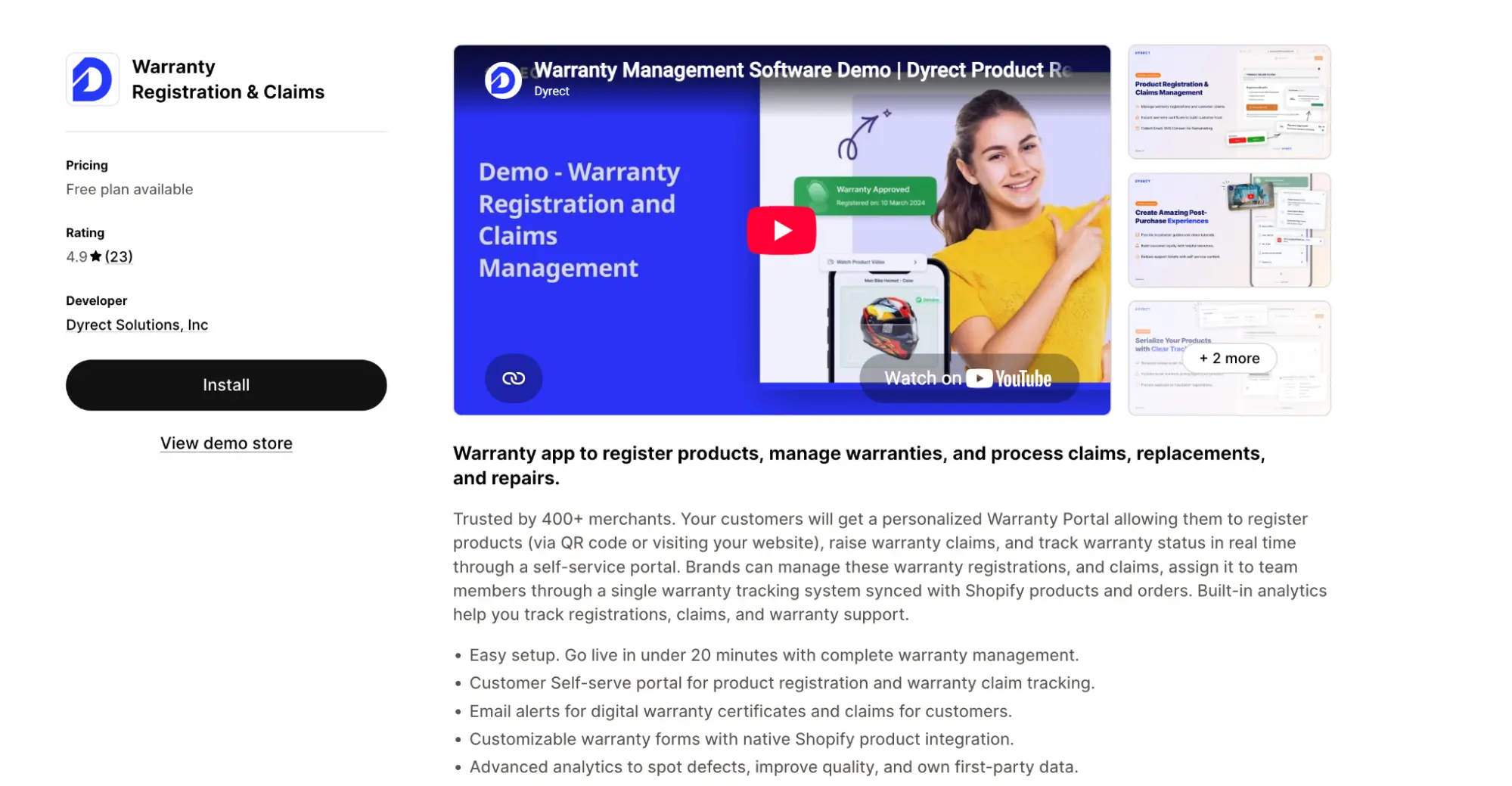
Warranty Registration & Claims by Dyrect covers the full warranty lifecycle from a single dashboard. Customers can register products using QR codes on packaging or branded web forms, receive digital warranty certificates, and submit claims through a self-service portal with photos and defect details. The team reviews claims with full context, including customer history, purchase channel, serial number, and coverage status, then resolves with actions that execute directly in Shopify.
Where Dyrect becomes especially relevant is for brands selling beyond their Shopify storefront. Shopify order data covers direct online purchases, but customers who buy through a retail partner, Amazon, or a distributor exist outside that data.
Dyrect’s QR-based registration and branded registration pages give those customers a path to register regardless of where the purchase happened. The registration creates a first-party ownership record that ties the product to the customer, the purchase channel, and the warranty start date.
On the claims side, the workflow goes beyond intake. Claims are routed to team members based on product type, issue category, or region. Resolution options include replacement order creation (automated in Shopify), repair coordination with dispatch-through-delivery tracking, refund processing, and store credit.
Moreover, the integration layer connects warranty data to the tools teams already work in. Registration events can trigger Klaviyo email sequences. Claims can surface inside Gorgias or Zendesk as support tickets. Customer ownership records flow into HubSpot. This means the warranty system feeds marketing, support, and CRM workflows instead of sitting in a silo that someone has to manually check.
Last but not least, analytics cover defect patterns by product line, claim resolution speed by team member, registration rates by channel, and fraud indicators. For brands selling electronics, appliances, or outdoor gear where product quality data directly shapes the next manufacturing run, this layer adds operational value beyond just managing claims.
Pricing: Free / $19/mo / $49/mo / $149/mo
Pick Dyrect if you sell across multiple channels, need registration and claims in one system, and want warranty data flowing into your helpdesk, CRM, and email tools.
2. Resolvi ‑ Warranty Management
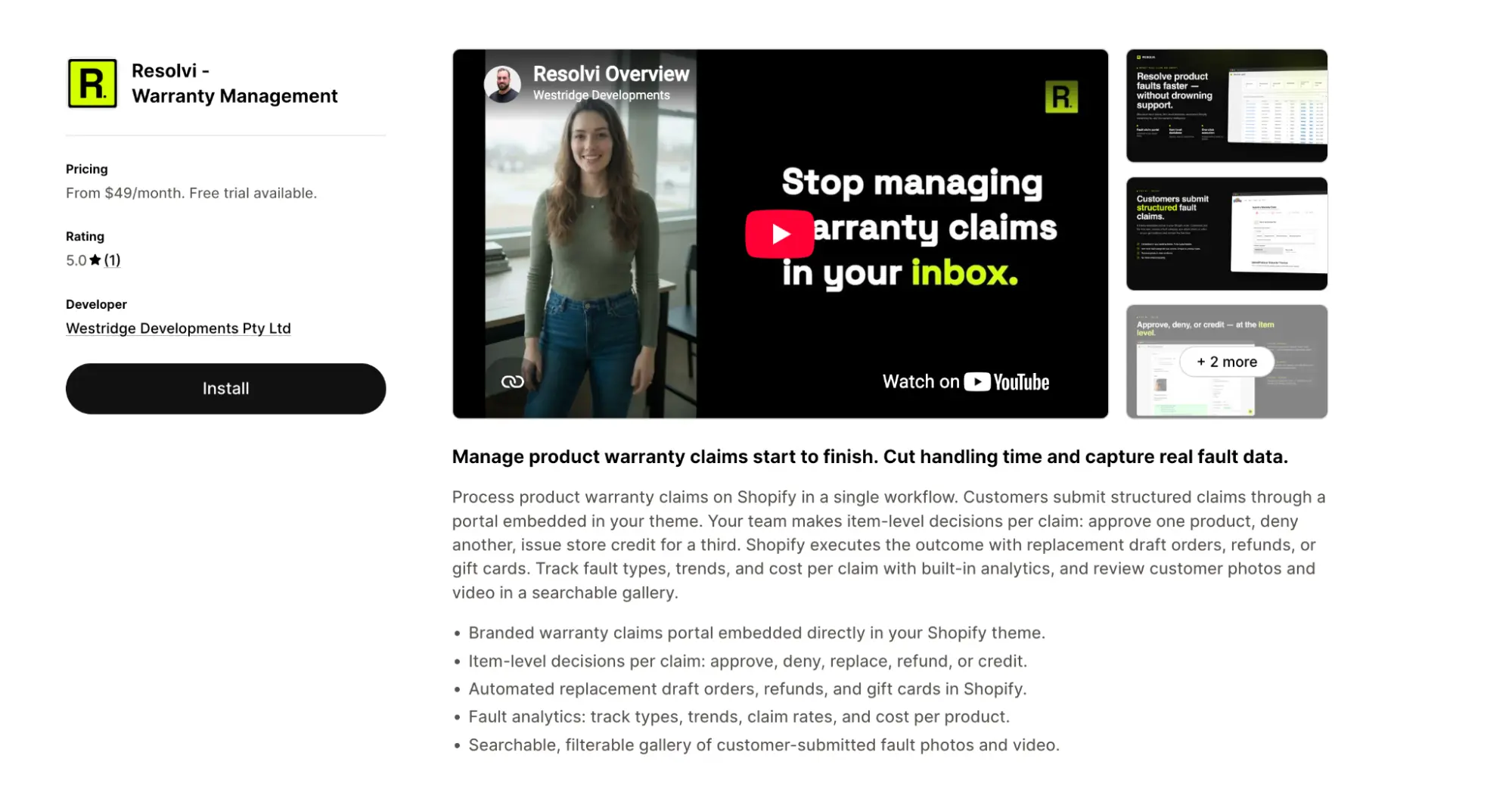
Resolvi – Warranty Management by Westridge skips product registration and focuses on the claims process. Customers can submit structured claims through a branded portal embedded in the Shopify theme. They can select the product, choose a fault category, upload photo or video evidence, and submit the claim. The agent reviews with full order context and resolves with a single click. Resolvi executes the resolution directly in Shopify, whether that is a replacement order, refund, or store credit.
The differentiator is fault-level product data. Every claim becomes a structured data point. Dashboards show which products generate the most claims, which fault types are trending, and how claim rates compare to units sold. The data can be exported as structured reports for manufacturer conversations and supplier accountability meetings. For brands that make their own products, this feedback loop between warranty claims and product development is where the app earns its price.
Resolvi fits a specific profile: brands that already handle registration through another tool (or skip it entirely) and need deep, structured claims processing with quality intelligence. It lacks registration, omnichannel capture, helpdesk integrations, and marketing tool connections. The starting price at $79/month reflects its specialization.
Pricing: $49/mo / $79/mo / $169/mo / $299/mo (7-day trial, annual billing saves 15%)
3. My Product Registration
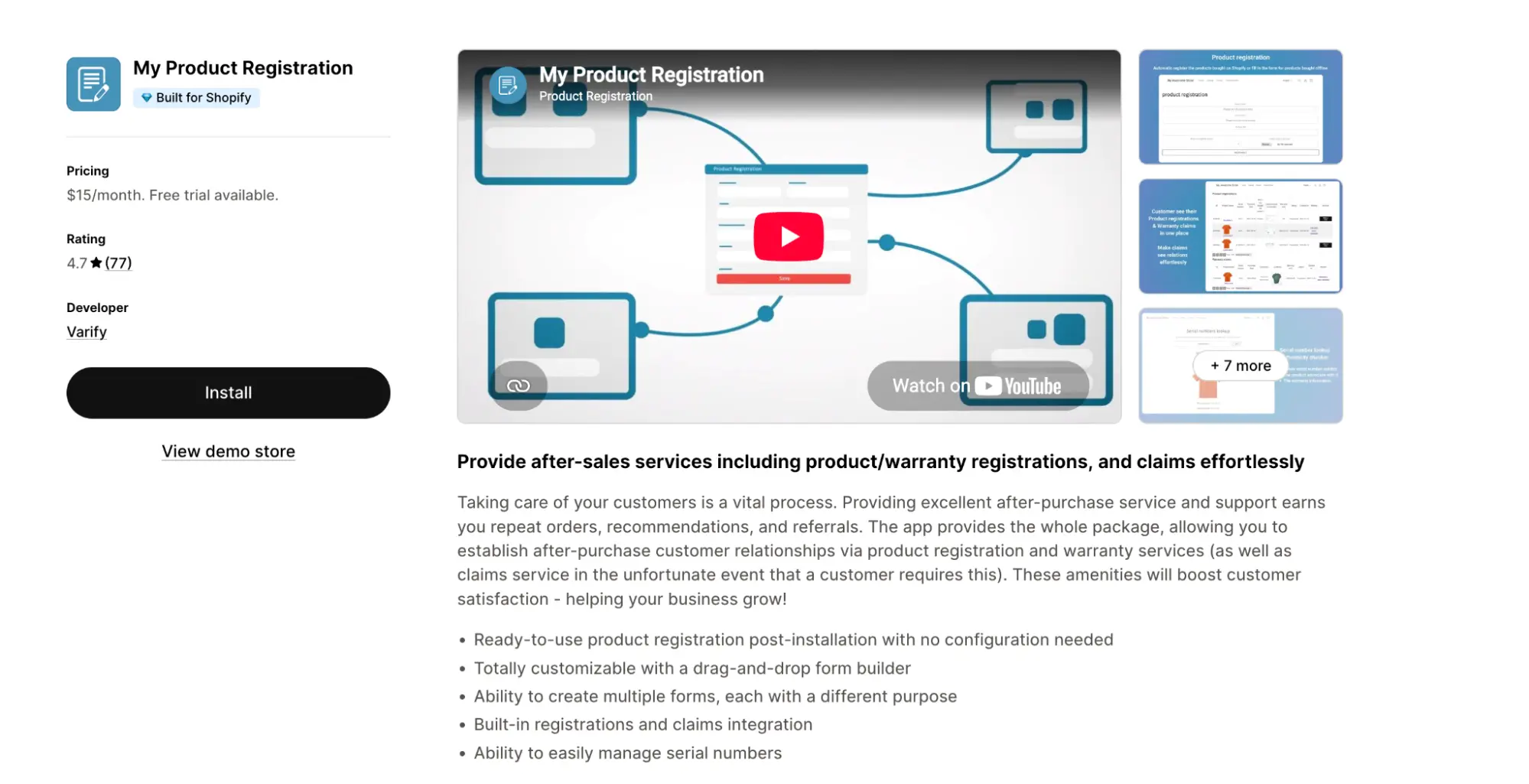
My Product Registration, a Built for Shopify app by Varify, carries Shopify’s “Built for Shopify” badge, which recognizes apps that meet Shopify’s standards for quality, performance, and integration. It also has the largest number of reviews among warranty registration apps on the Shopify App Store, giving it an established track record compared with newer tools in the category.
The app works immediately after installation with zero configuration. Registration forms are ready to go, and the drag-and-drop form builder lets merchants create multiple forms for different product lines or purposes. Serial number management is built in, with QR code support for auto-filling serial numbers during registration. Claims handling covers intake and status tracking from a central dashboard.
The pricing is one flat plan at $15/month. Everything included, nothing gated behind tiers. For brands that want registration and basic claims at a predictable cost without navigating complex pricing tables, this simplicity is the selling point.
The limits: no customer self-serve portal for real-time claim tracking, no repair or replacement automation, no helpdesk or CRM integrations, and no omnichannel registration for customers who bought outside Shopify.
Pricing: $15/mo flat (5-day trial)
4. Warranty Registration ‑ Propel
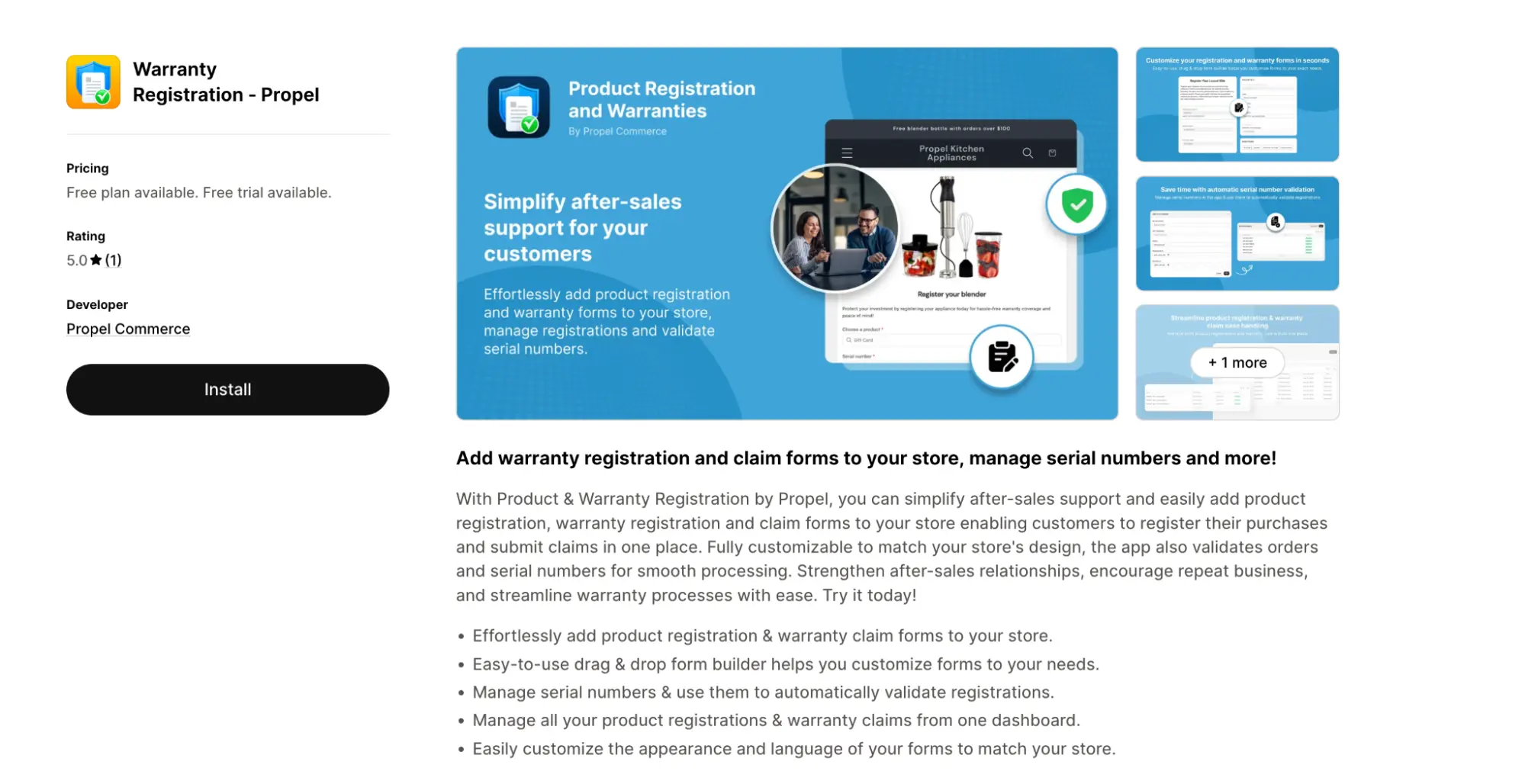
Warranty Registration – Propel by Propel gives small stores a simple way to move from email and spreadsheet-based warranty handling to a more structured system. Its free plan includes one registration form with serial number validation and priority support. The $9.95/month Pro plan unlocks unlimited registrations, unlimited forms, and warranty claims. For a brand doing its first hundred registrations and getting a handful of claims per month, Propel handles the workflow cleanly.
The drag-and-drop form builder creates custom forms with fields for serial numbers, proof of purchase, defect photos, and any other data the team needs. Serial number validation runs at submission, catching duplicates before they reach the dashboard.
The feature ceiling is low by design. No customer portal, no QR registration, no analytics beyond basic tracking, no helpdesk or CRM integrations, no repair or replacement automation. Propel is a starting point, and for small stores, it is a perfectly good one.
Pricing: Free / $9.95/mo
5. Warranly: Extended Warranty
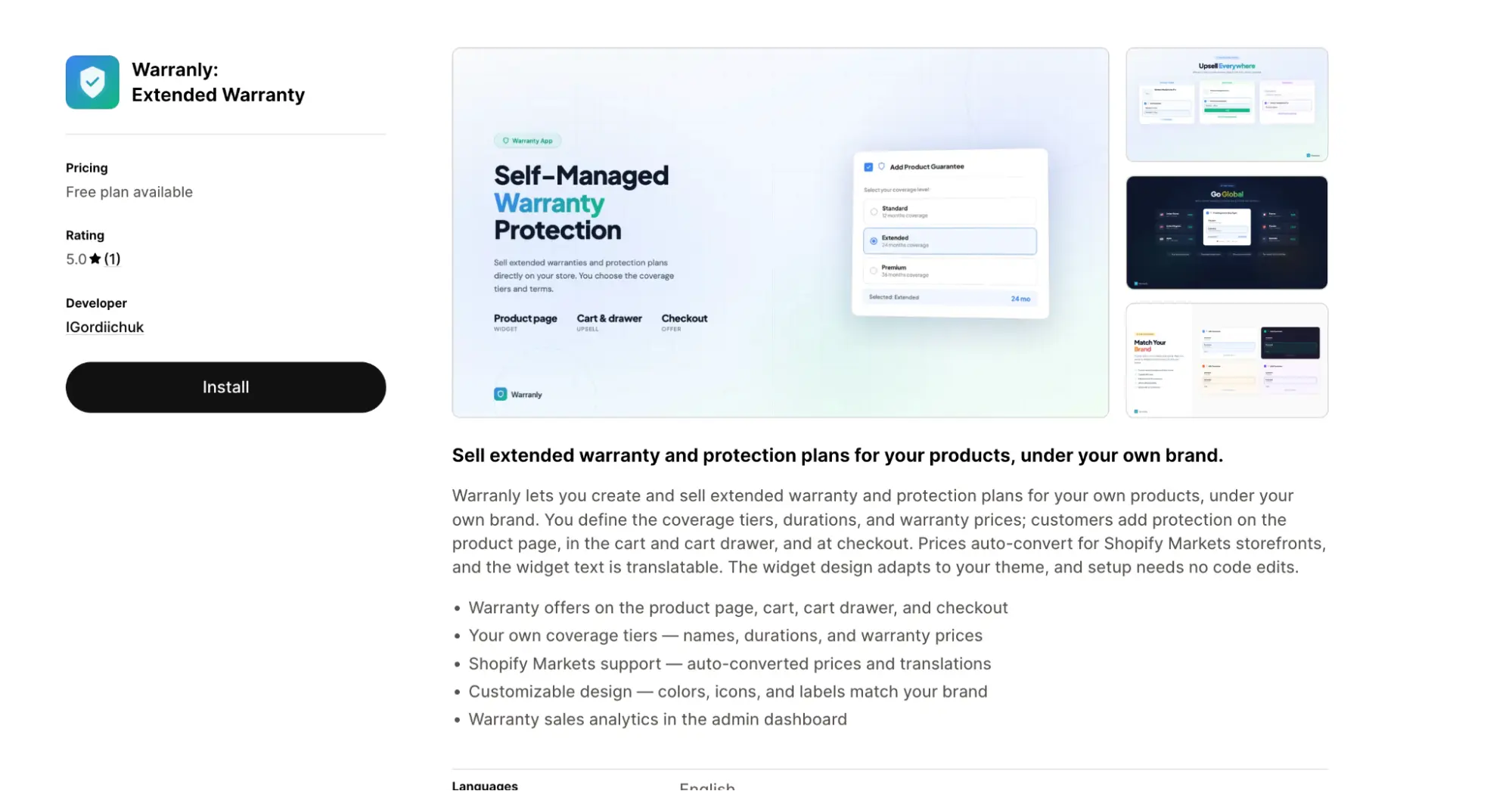
Warranly: Extended Warranty by IGordiichuk takes a different approach from the registration and claims apps above. It lets merchants create and sell extended warranty plans at checkout under their own brand while keeping 100% of the warranty revenue. Merchants can define coverage tiers, durations, and pricing, while customers can view warranty options on the product page, cart, cart drawer, and checkout.
This is a self-managed model. Compare it to platforms like Extend or SureBright where a third-party underwriter handles claims and the merchant earns a commission (typically 10 to 30%). With Warranly, the economics flip: the merchant keeps everything, but also handles all claims through their own process.
Shopify Markets support auto-converts prices for international storefronts, and widget text is translatable. The widget adapts to any theme without code.
Warranly handles warranty sales. It does not cover registration, claims workflow, serial validation, customer portals, or analytics. Think of it as a revenue tool you pair with a separate operations tool.
Pricing: Free (3 plans, 30 sales/mo) / $29/mo / $79/mo / $199/mo
6. Warranty Upsell
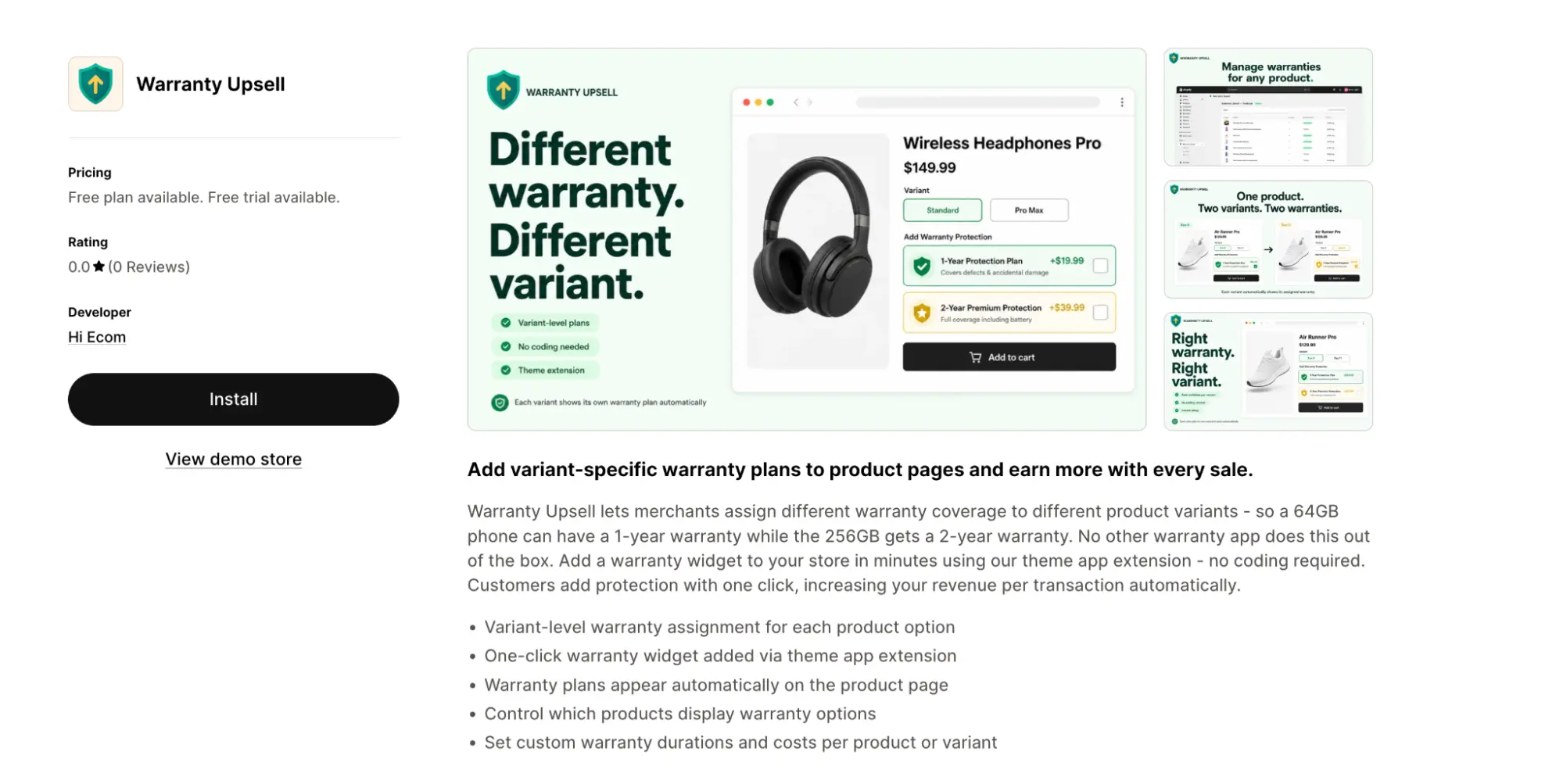
Warranty Upsell by Hi Ecom solves one specific problem: assigning warranty options at the variant level. For example, a 64GB phone can have a 1-year warranty option, while the 256GB version can offer a 2-year warranty at a different price. The app lets merchants map warranties by variant and product, then automatically displays the relevant warranty widget on the product page.
The feature is narrow but genuine. Other warranty upsell tools assign the same plan to the entire product. If you sell products with meaningfully different tiers, configurations, or price points across variants, this granularity matters.
The app launched in May 2026 and is in the early stages. It covers product page warranty upsells and conversion analytics (on the Pro plan). It does not cover registration, claims, serial numbers, customer portals, or integrations.
Pricing: Free (3 products) / $9.99/mo / $19.99/mo
7. Warranto ‑ EU Warranty Label
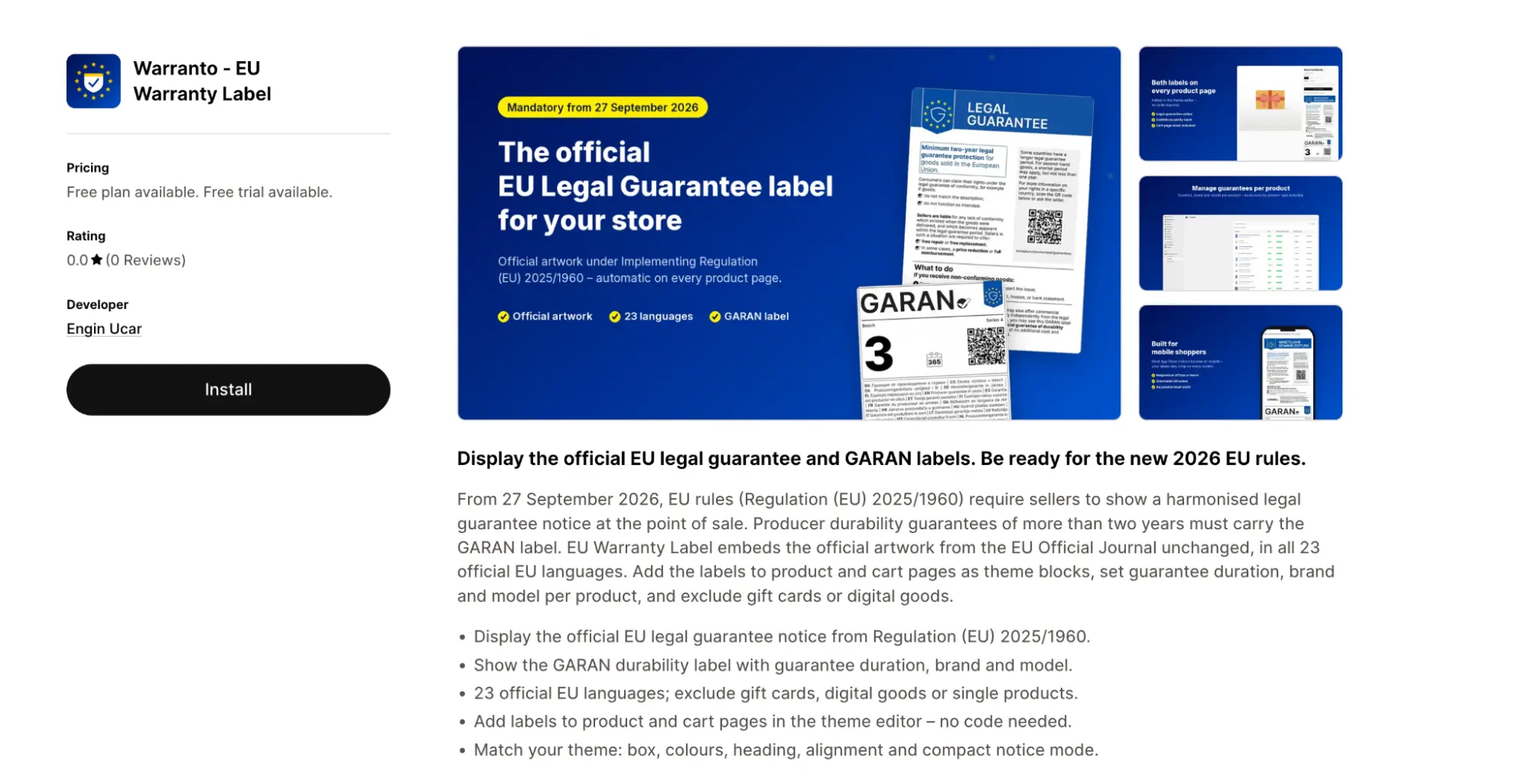
Warranto – EU Warranty Label by Engin Ucar helps Shopify stores meet a new EU regulatory requirement. Starting September 27, 2026, EU Regulation 2025/1960 requires online stores selling physical goods to EU consumers to display a standardized legal guarantee notice on product pages. For products with a producer durability guarantee exceeding 2 years, the official GARAN label must also appear. The labels must use official EU artwork in the customer’s language.
Maintaining 24 language versions of this label manually would be impractical for any store selling across multiple EU markets. Warranto adds both labels automatically to every product page, matched to the customer’s storefront language, with official QR codes. Guarantee duration, brand, and model are configured per product. Exclusions work by product type or individually. Installation happens via theme extension with zero code changes.
This app is fundamentally different from the other six. It handles compliance. It does not manage registrations, claims, upsells, or service workflows.
Pricing: Free (3 products) / $9.99/mo
How to Choose the Right Shopify Warranty App for Your Store
| Your situation | Best starting point |
| Small store, first warranty system | Propel (free) or My Product Registration ($15/mo) |
| Growing brand, multiple sales channels | Dyrect (free to $149/mo) |
| High claim volume with product quality focus | Resolvi ($79/mo+) |
| Want to sell warranty plans at checkout | Warranty (free to $199/mo) |
| Products with variant-specific warranty pricing | Warranty Upsell (free to $19.99/mo) |
| Selling physical goods to EU customers | Warranto (free until Sept 2026) |
| Full warranty stack for Shopify: registration + claims + service + analytics + integrations | Dyrect |
The warranty app category on Shopify looks like one market, but it is really three: registration and claims management tools, warranty revenue tools, and compliance tools. Understanding which problem you are solving makes the decision straightforward.
So, start with the operational need, match it to the feature matrix above, and factor in whether you will need integrations, analytics, and service workflows as claim volume grows.

Shopify Expert
Dipen Panchal, Shopify Tech Lead at Setubridge Technolabs, brings over a decade of expertise as a Shopify Expert. Passionate about e-commerce growth, he specializes in UI/UX design, crafting intuitive, engaging solutions tailored for merchants and B2B clients to enhance user experiences.