





Think of opening a lovely bricks-and-mortar shop. The shelves are full; the lighting is just right; your goods are indeed what everyone is seeking. The trouble is that no one ever comes to make a purchase.
This is precisely what is taking place right now in millions of Shopify stores.
The global average shopping cart abandonment rate is now around 70.19%–70.22%, meaning roughly 7 out of 10 online shoppers leave without completing their purchase. Research from the Baymard Institute shows cart abandonment has remained consistently high across thousands of ecommerce stores worldwide. Meanwhile, Statista reports that global cart abandonment rates crossed the 70% mark again in 2025, highlighting how much revenue ecommerce brands continue to lose during checkout.
Key Takeaways
- 69% of shoppers abandon carts; an AI shopping assistant can recover a meaningful slice of that lost revenue.
- AI shopping assistants are not chatbots. They understand context, learn over time, and actively drive sales.
- Conversational cross-selling feels helpful, not pushy, and can lift AOV by 15–30%.
- Stores using AI-powered chat report up to 3× higher conversion rates compared to no-chat stores.
- Setup takes minutes. No code, no developer, no technical degree required.
- The AI works 24 / 7 on mobile, desktop, and in every time zone simultaneously.
- Every conversation becomes a data point that makes the AI smarter and your store more profitable.
And here is the hard part: most of those shoppers had questions. Would they be able to get that product in their size? Would this pair of shoes match that skirt? Just a small push, and they would be sure of their purchase. Except there was no one there to push.
This is the empty store problem. And in 2026, there is a serious, real, affordable fix for this kind of pain: the AI shopping assistant for Shopify.
This guide will walk you through exactly how to leverage AI shopping assistants from a moment of silence to building a voice-enabled flow that turns conversations into revenue. No BS. Just a blunt insight into how to get started.
The Hidden Cost of “Silent” Shoppers
Every visitor who comes to your store who doesn’t buy costs you. They cost you ad spend, SEO effort, time building the store, and the revenue you never took (gain).
The biggest reason for this invisible departure? Questions left unanswered. Recent eCommerce customer service research shows that nearly 60% of online shoppers abandon purchases because they don’t get fast enough support responses or answers to their questions. Those are not product issues. Those are information issues.
“77% of shoppers will abandon a purchase if answers aren’t clear.” — cited in 2026 ecommerce customer experience research summary.
There is also a sneaky second problem: lost upsell and cross-sell opportunities. When you buy a camera, you are likely to also want to buy a memory card, a case, and a cleaning kit. But if the shop is quiet, with no assistant, no advice, no conversation, they have bought the camera and left without buying any of those extras. You have missed a further 3 sales in one go.
This is the hidden cost of silence. It shows up in two ways:
- Lower average order value (AOV): customers buy the minimum because nobody suggested more.
- Higher cart abandonment: customers leave because their questions go unanswered.
An intelligent e-commerce chatbot trained to engage, answer, and suggest- specifically, an AI shopping assistant Shopify attacks both problems simultaneously. It replaces silence with helpful, revenue-generating conversation.
💡 AI-powered live chat and conversational support can recover up to 35% of abandoned carts by resolving shopper hesitation in real time. — LiveChat Success Report 2025
What Exactly Is an AI Shopping Assistant?
Direct Answer: What exactly is an AI shopping assistant? An AI shopping assistant is an intelligent AI app that runs on your store, utilizing natural language processing (NLP). It engages with your customers in real time by responding to their questions, guiding shoppers through the purchase process, and recommending additional high-margin products.
Picture this: the world’s greatest salesperson. Super knowledgeable of all your products, available 24 hours, 7 days a week, always in a great mood, and able to serve all your customers at once.
But unlike a stiff, outdated chatbot, today’s AI shopping assistant doesn’t simply react to keywords. It also recognizes the context behind the customer’s question. And it can manage:
- Typos and misspellings (“do u have size 9 sneakers?”)
- Slang and casual language (“something that goes with my beach vibe”)
- Complex questions (“What’s the difference between these two products and which one is better for daily use?”)
- Intent signals (a hesitating shopper is different from a ready-to-buy shopper)
The AI considers the entire conversation, not just the last message, to provide answers that seem very useful. In 2026, in the Conversational Commerce world, this is the norm to expect from shoppers.
A great AI shopping advisor learns. It evolves by learning which product recommendations are actually bought, what the most frequently asked shopper questions are, and the types of shoppers you’re attracting. This helps it become smarter and your store more profitable over time.
Old Chatbots vs. New AI Shopping Assistants
Every chatbot is not equal. Recently revisited a free chatbot you used five years ago and were frustrated? You are not alone. But AI has evolved significantly. Here is a direct comparison of existing outdated tools versus a virtual shopping assistant built for 2026.
| Feature | Old Chatbots (Pre-2024) | AI Shopping Assistants (2026) |
| Main Goal | Answer basic support questions only | Drive sales, cross-sell & guide shoppers |
| Conversation | Sounds like a scripted robot | Sounds like a friendly, knowledgeable human |
| Understanding | Needs exact keywords to work | Understands typos, slang & natural language |
| Cross-Selling | Cannot suggest products | Naturally recommends items that go together |
| Data Learning | Static scripts never improve | Learns from each interaction over time |
| Cart Recovery | No impact on abandonment | Actively recovers abandoned shoppers |
| AOV Impact | Zero impact on average order value | Proven to lift AOV by 15–30% |
| Setup Time | Weeks of developer work | Minutes with a no-code Shopify install |
The difference is not cosmetic. Old chatbots are cost centers. AI shopping assistants are revenue centers. The entire philosophy has flipped.
The Magic Trick: Turning Chats Into Cross-Sell Revenue
Next, let’s move on to how to make money. The process is known as conversational cross-selling, and it is the single most important revenue tool that most SHOPIFY store owners are not currently using.
Most conventional product recommendation widgets (common examples are “Frequently Bought Together ” that appear at the bottom of a product page) are passive. It just sits there and hopes that the customer scrolls down far enough to notice it. Only less than 8% of shoppers click on those widgets.
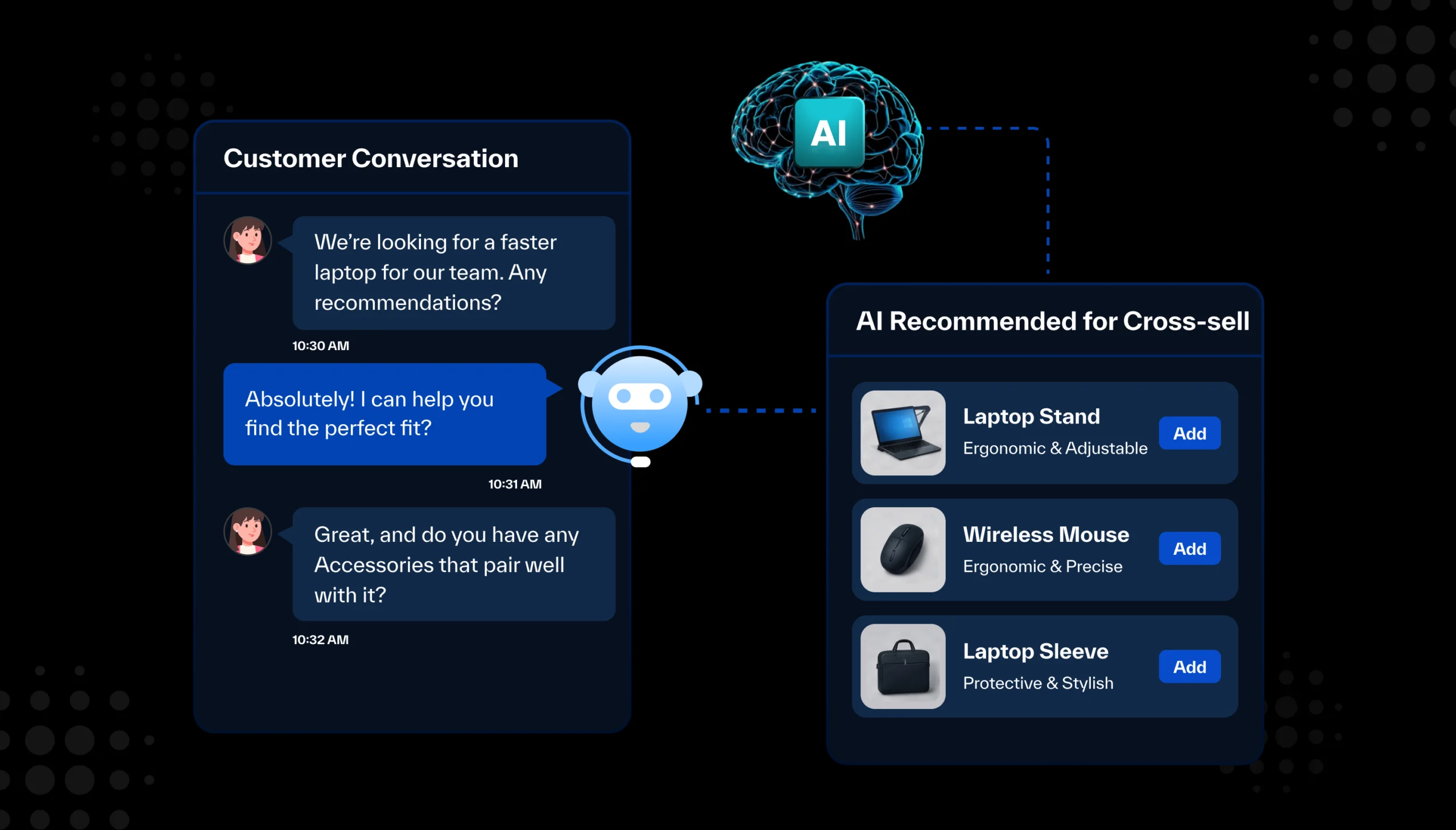
There is an AI shopping assistant. It integrates pertinent product recommendations seamlessly into a natural flow of conversation. It is not seen as an advertisement, but rather appreciated as sincere guidance offered by an authority figure.
Here are three specific ways the AI turns a chat into cross-sell revenue:
Strategy 1: The “Perfect Match” Suggestion
If a shopper says, “Is this leather jacket available in brown?” The AI responds to his/her query and follows up with: “It has the perfect appearance when paired with our Slim Fit Chinos in khaki, a recent favorite. Would you like me to show you the pair?”
That one sentence you say at the precise second can instantly put a second item in your cart. It’s all in the timing and the context. The AI is not just throwing phrases randomly. It knows what goes together because it has studied more shopping cart orders than us.
Strategy 2: The “Complete the Look” Upsell
The customer is viewing a sofa. Instead of merely saying whether the item is available, the AI might respond: ‘Great choice, most customers who bought this sofa also added the matching throw pillows and side table for a complete living room look. Would you like me to bundle the items into a package?’
This is the digital counterpart to a professional showroom consultant. It creates a higher average order value (AOV) naturally with no arm-twisting. McKinsey research indicates that the principle of cross-sell/upsell means that these activities account for as much as 35% of Amazon’s gross revenue, and the same effect exists for independent Shopify stores.
Strategy 3: The “Free Shipping” Nudge
A customer has a $47 cart. Your free shipping threshold is $50. The AI swoops in to save the day: “Just $3 more to qualify for free shipping! Our top-selling lip balms are just $5, and customers rave about them. Would you like to add one?”
The free shipping nudge by itself has demonstrated an ability to increase average order value by 12–18% if it is employed intelligently. The AI knows the threshold. It knows the gap. It acts.
How to Set Up Your Store for AI Success
Embedding an AI shopping assistant in your Shopify store may seem like it takes a team of developers. It doesn’t. Today’s AI shopping assistant apps are made for store owners, not engineers. If you can log into Shopify, you can launch a world-class AI bot today.
Here is the complete setup process, step by step:
| Step 1: Connect | Install the AI Shopping Assistant app from the Shopify App Store. Authorize it with one click. The app auto-syncs your product catalog, prices, and inventory in real time- no CSV uploads needed. |
| Step 2: Customize | Match the chat widget to your brand. Change colors, greeting messages, response tone (friendly, professional, luxury), and the icon to fit your store’s identity. |
| Step 3: Train the AI | Upload your FAQs, return policy, and shipping info. The AI reads your product descriptions and learns your catalog. The more information you give it, the smarter it gets instantly. |
| Step 4: Enable Cross-Selling | Go to the Cross-Sell settings panel. Choose which product categories can trigger upsell suggestions. Set minimum cart values for free shipping nudges. It takes about five minutes. |
| Step 5: Go Live & Track | Flip the switch and go live. Monitor performance via the built-in dashboard. Watch AOV, cross-sell acceptance rates, and cart-recovery numbers in real time. |
Total setup time for a typical Shopify store: under 30 minutes from install to live. Most store owners report their first AI-assisted cross-sell happening within hours of going live.
Pro Tips for Better AI Performance
- Use simple, natural conversational-type English for product descriptions here. The A.I. will read them, along with using them to answer customer questions.
- Upload the types of questions you most often get from your customers. The bot instantly learns from real, live interactions.
- Establish cross-sell “trigger categories” products that would naturally be related to the others in your list.
- Examine the weekly report of AI results, and update your cross-sell rules using the best-performing suggestions.
- Turn on Human Handoff for escalations. AI Autoescalates 90% of chat conversations and gracefully turns over the rest.
Meet Your New Best Worker: The AI Shopping Assistant
But if you want to start using conversations to make money today, then you’re going to need a tool designed specifically for Shopify that marries intelligent AI with a nuanced understanding of how e-commerce really operates.
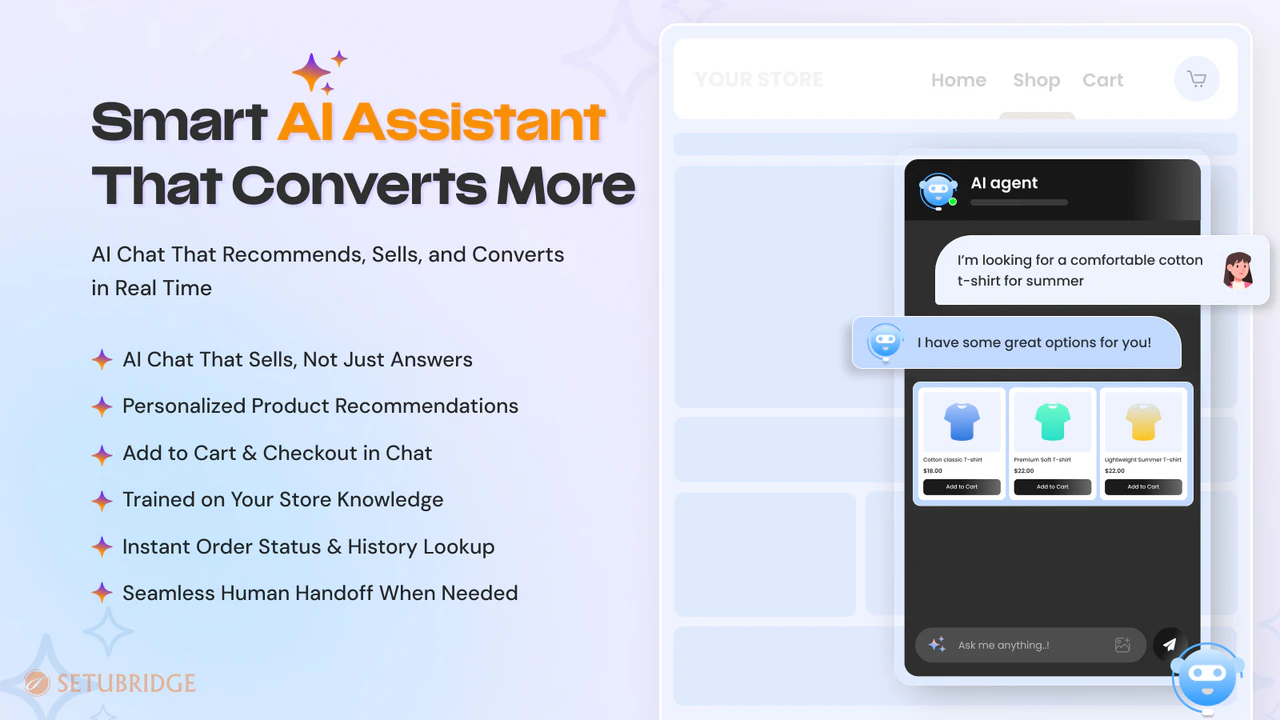
How can the AI Shopping Assistant – Chatbot be the highest-producing worker in your cyber store? It doesn’t take lunch breaks. It’s never sick. It hasn’t recently lost its ability to train new merchandise. And it applies the same level of attentive, revenue-generating service to your 2 pm and your 2 am visitors!
Here is what makes it different from generic chat tools:
It Learns Your Catalog Instantly
As soon as you install and activate the app, it instantly loads your entire Shopify catalog into the app. Descriptions, prices, variants, stock… all of it. A customer asks, “Do you have the blue version in a size 8?” and the app gives an immediate, real-time reply.
Smart Conversational Cross-Selling
Our cross-sell engine uses purchase pattern analysis and cart activity to determine which cross-sell recommendations to make and when. It doesn’t just push random items. It makes the right recommendation, at the right time, in the right voice. It slips the suggestion into the natural flow of the conversation so it doesn’t seem pushy or promotional.
Human Handoff When It Matters
Whether it’s a complex return, a wholesale inquiry, a frustrated customer, or an AI misfire, the app handoffs the conversation smoothly to your customer service team. The entire chat history is transferred, so your team doesn’t need to ask the customer to repeat themselves.
Built to Reduce Cart Abandonment
A real-time in-chat monitoring system watches the app for indicators of abandonment, long pauses on the checkout page, multiple back button clicks, a cart that hasn’t changed in a while, and engages proactively with the customer. But this time not with a pop-up. With a friendly, relevant message: “Still deciding? I can help you find the perfect fit or answer any questions.”
Deep Analytics Dashboard
Every conversation, every cross-sell, every chat that leads to a purchase, every abandoned cart reversal is logged and analyzed. Find out what cross-sell pairings drive the most revenue, what customers ask most frequently, and where on your site customers are most likely to get stuck. Actionable real data.
This is not a chatbot that sits on your website answering FAQs. This is a revenue engine that works every hour of every day to grow your store.
Conclusion: Start Chatting, Start Selling
The opportunity in front of any and every Shopify store owner right now is huge. Customers are already on your site. They already have questions. They are already close to buying. The only thing blocking the customer from completing the transaction and you from making more money is a conversation.
A truly intelligent shopping assistant for Shopify is not a luxury that only big brands can afford. It is an affordable, easily installable tool that any webshop owner can have set up in less than an hour. It can run in the absence of a customer, it improves weekly, and it can pay for itself within a single cross-sell.
It’s not the big ad budgets or the most product SKUs that will define winning e-commerce stores in 2026 and beyond. It will be stores that make every single shopper feel like they are seen, helped, and empowered to buy and to buy more.
Stop losing 7 visitors out of 10 to abandonment. chat. sell. continue.
Frequently Asked Questions (FAQs)
Everything you need to know about using an AI shopping assistant on Shopify is answered clearly and honestly.
Q1: What is an AI shopping assistant for Shopify?
A shopping assistant powered by AI is a smart chatbot that, for example, understands natural language, takes people around your store, recommends products, answers questions, and even proactively encourages cross-sells and upsells.
Q2: How is an AI shopping assistant different from a regular chatbot?
Older chatbots simply follow prescribed scripts. More intelligent AI shopping agents harness machine learning techniques to understand context, learn shopping behaviour, adjust the style of communications, and provide live product recommendations, turning them into revenue-generating tools and not support bots.
Q3: Can an AI shopping assistant really reduce cart abandonment?
Yes. During a moment of shopping cart abandonment, the AI detects it and can send a message to pull the customer back in with an offer like free shipping or a regular reminder of their cart contents that has been known to recover as much as 5-15 percent of lost sales.
Q4: How does conversational cross-selling increase my average order value?
The AI then makes a related product recommendation in a natural way within the current conversation. Consequently, the recommendation does not seem pushy or invasive, so the shopper is much more likely to add the product, and consequently increase the average order value of each transaction.
Q5: Do I need coding skills to install an AI shopping assistant on Shopify?
No. Contemporary AI shopping assistant applications reside on the Shopify App Store and are one-click installs. Using the setup wizard, you complete the customization and training steps without having to write a line of code.
Q6: How long does it take for the AI to learn my product catalog?
The majority of AI shopping assistants will autopopulate your Shopify product catalog within a few seconds of being installed at first. Uploading your FCAs and policies takes about 15–30 minutes, but your AI can begin providing relevant responses and recommendations immediately.
Q7: Is conversational commerce just a trend, or is it here to stay?
It’s forever. The world’s conversational commerce market is predicted to hit $34 billion in 2027. Customers are demanding immediate, customized service, and the merchants who meet this need will sell more and earn greater loyalty.
Q8: What metrics should I track to measure AI shopping assistant performance?
Keep track of: average order value, cart abandonment rate, cross-sell acceptance rate, chat-to-purchase conversion rate, and customer satisfaction score (CSAT). These KPIs will give you the complete revenue picture of your AI assistant.

Shopify Expert
Dipen Panchal, Shopify Tech Lead at Setubridge Technolabs, brings over a decade of expertise as a Shopify Expert. Passionate about e-commerce growth, he specializes in UI/UX design, crafting intuitive, engaging solutions tailored for merchants and B2B clients to enhance user experiences.