




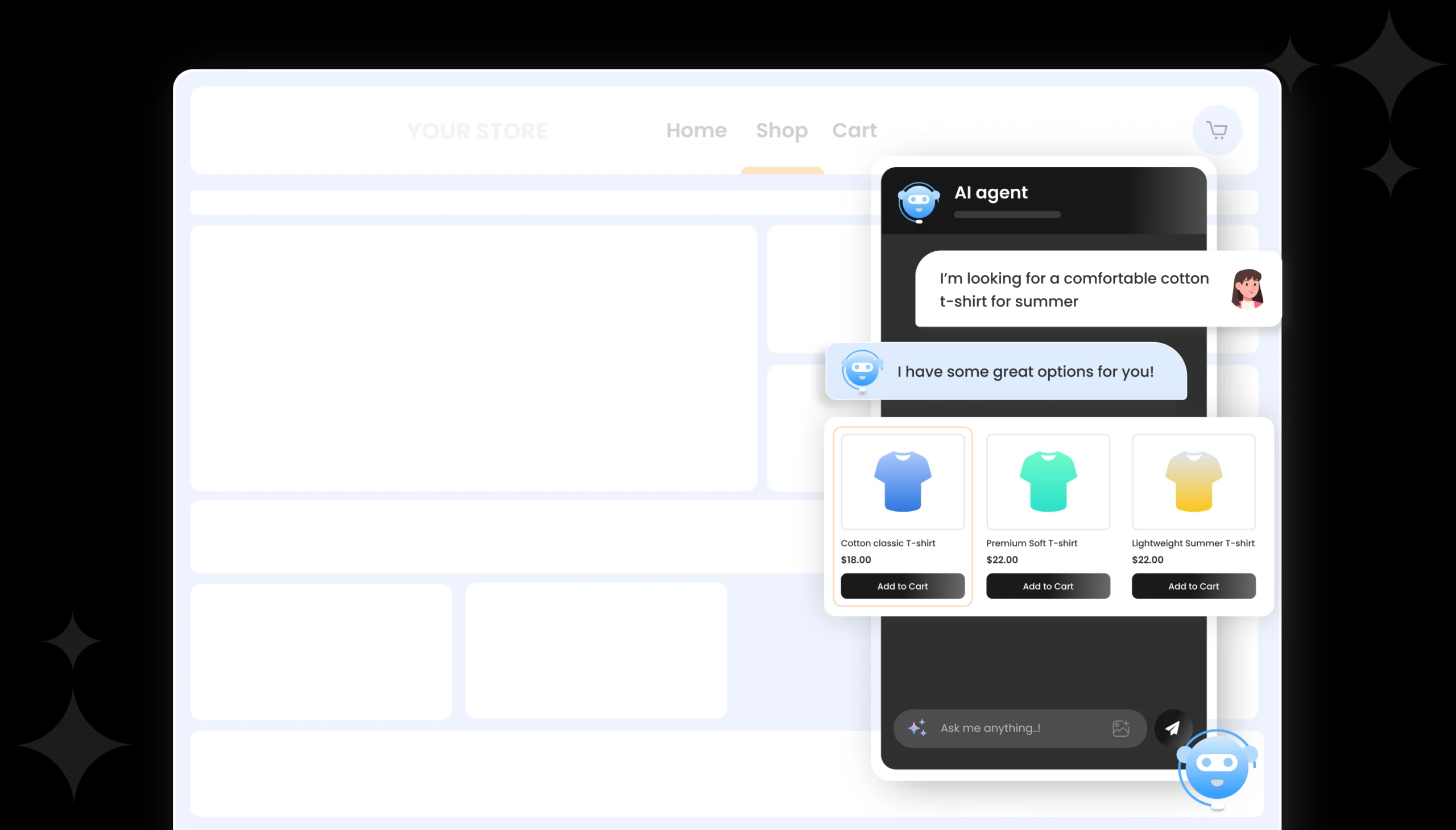
Now close your eyes and imagine you walk into a shop. From the second you walk in, the salesperson knows everything about you and therefore what will be popular with you next, from what your favorite purchase is, the type of clothing, price range, design, etc. No wandering around, no unimportant sales talks, a perfect sale to you.
It’s not a dream anymore. Because of AI solutions for recommendations, in the moment is an everyday reality for millions of consumers shopping on sites powered by Shopify.
Key Takeaways
- Real-time product recommendations update instantly based on live shopper behavior; static widgets cannot compete.
- 71% of consumers expect personalization; 76% get frustrated when brands fail to deliver it.
- AI recommendation engines analyze clicks, searches, cart activity, and time-on-page to predict shopper intent.
- Smart cart and conversational AI recommendations are among the highest-converting surfaces in any Shopify store.
- Product recommendations can account for 10–35% of total eCommerce revenue when implemented intelligently.
- Upselling and cross-selling with AI improve AOV without increasing advertising spend.
- Reducing choice to 3–6 highly relevant options consistently outperforms showing large, generic product grids.
- An AI shopping assistant chatbot provides 24/7 personalized guidance, the digital equivalent of a knowledgeable sales associate.
- Mobile commerce benefits disproportionately from AI recommendations, which reduce browsing friction on small screens.
- The future of Shopify is hyper-personalized, conversational, and predictive. Merchants who start now will lead tomorrow.
Unfortunately, the painful truth for most owners of online stores like yours is this: your existing recommendation methods are most likely costing you money. The majority of Shopify stores are still using fixed “related products” carousels, one-time-only upsells, or product matrices that display identical items to everyone. Sure, this approach might have been effective in 2012. In 2025, however, it will give your sales a serious hit.
Consumers are smarter, quicker, and much more impatient than ever before. According to McKinsey & Company, 71% of consumers expect companies to deliver personalized interactions, and 76% get frustrated when this doesn’t happen. Meanwhile, those brands that succeed with personalisation will gross 40% more from that activity.
And the best part? AI-powered, personalized recommendations in real time are now available to Shopify merchants of all sizes. Use them to increase conversion rates, lift AOVs, decrease bounce rates, and drive smarter, stickier shopping experiences.
In this guide, you will discover exactly how real-time product recommendations work, why the outdated techniques no longer cut it, and how to use AI-driven personalisation to turn your Shopify store into a real conversion machine.
What Are Real-Time Product Recommendations?
Real-time product recommendations are AI-powered ideas that are shown in response to a shopper’s true behavior in the current session and update immediately with every new action. They operate in real-time, contrary to static recommendation widgets that show similar results to all customers.
The AI engine tracks signals such as:
- Which products do a shopper click on
- How long they spend on each product page
- What search terms do they type
- Which items do they add to or remove from their cart
- Their scrolling patterns and engagement depth
- Past purchase history (for returning visitors)
Using this real-time flow of data, the AI predicts the product the shopper is most likely to want to browse at that moment and introduces it directly.
Traditional vs. Real-Time AI Recommendations
The table below summarizes the core differences between old-school static approaches and modern AI-powered recommendations:
| Feature | Static Recommendations | Real-Time AI Recommendations |
| Updates automatically | No | Yes |
| Based on shopper behavior | Limited | Real-Time |
| Personalized experience | Weak | Strong |
| Product relevance | Generic | Highly Targeted |
| Upsell opportunities | Basic | Intelligent |
| Conversion impact | Lower | Higher |
| Learns from customer actions | No | Yes |
| Works during live shopping | Limited | Excellent |
The shift from static to real-time is not just a technology upgrade; it is a fundamental change in how your store relates to each shopper.
Why Static Product Recommendations Fail
They Ignore Customer Intent
With the static recommendation widget, you end up getting the same recommendations whether you are a techie gamer or a girl who works from home. (They both browse on the same laptop page. But actually they want fairly different things.) That’s a lost opportunity.
How a customer intends to purchase depends a lot on the dynamics of the individual. The price may be crucial to one person, the demonstration of a performance habit in some specific product category may be vital to another, one purchaser will prefer a certain brand model, another will search for an alternative, and so on. Customers buy at the very start of the life of a product or service when it has very few competitors or at the very end when they can demand a high markup. Static systems can’t pick up any of this.
Shopper Interests Change Mid-Session
Here’s a scenario that static systems just cannot deal with: shoppers can be impulsive. Take a single five-minute session: one minute the shopper is viewing running shoes, then wandering off to sporting accessories, a second later sees a 20% off promotion banner, and suddenly they’re browsing for sales.
Real-time AI follows these micro-movements and constantly updates recommendations accordingly. Static, by definition, has no chance of reacting to anything that isn’t built into the page.
Static Widgets Miss Revenue at Every Turn
Every time a shopper encounters an inappropriate recommendation in your store, you are missing an up-sell, cross-sell, or bundle opportunity. Even worse, an ill-suited recommendation can in fact be a distraction that encourages a shopper to turn their attention away from the item already in their cart and toward something that isn’t ready to convert.
Barilliance’s research revealed that promotional product recommendation emails and on-site recommendation widgets that fail to be personalized experience click-through rates up to 3x worse than those that are personalized. In an age of eCommerce, being irrelevant can prove very costly.
How AI Understands Shopper Intent in Real Time
Reading Behavioral Signals
Contemporary AI recommendation engines are trained on millions of individual customer journeys. By analyzing those journeys, they learn to identify behaviors and sequences of actions that can predict with near certainty what a shopper is likely to do a few steps down the line. As a new user begins browsing, the AI begins crunching their pattern of behavior against all those known journeys and can begin making predictions right away.
The behavioral signals the AI monitors include:
- Products viewed and the order in which they were viewed
- Time-on-page as a proxy for interest level
- Search queries, including long-tail and conversational phrases
- Cart activity additions, removals, and quantity changes
- Wish list or save-for-later actions
- Device type, session time, and geographic location
Predicting What Shoppers Want Next
This is what starts to move AI from descriptive to predictive. Knowing that “shoppers who viewed X and then searched for Y almost always buy Z,” a recommendation engine can present product Z to a shopper before he or she even begins to search.
Let’s take a real-world example: A shopper throws a pair of running shoes into their shopping cart. A traditional widget could display other shoe options. An AI system detects that purchasers of those running shoes tend to buy sport socks, hydration bottles, and compression shorts during the same shopping session, and recommends those items. The result? Increased cart value and a satisfied, well-served customer.
Conversational AI Elevates Recommendations Further
With AI shopping assistants and chatbots, it’s not just one-way; they assist customers through a two-way conversation. Instead of silently strolling through pages filled with various products, customers narrate their requirements in plain language and instantly get curated suggestions.
Example conversation:
- Customer: “I need a birthday gift for my dad. He loves cooking. Budget is under $80.”
- AI Assistant: “Great choice! Here are three highly-rated gifts under $80 that home cooks love: [Product A], [Product B], [Product C]. Would you like me to add gift wrapping?”
But AI is making this kind of guided, conversational shopping possible with a machine, something that was only possible with a human sales assistant before. It makes it scalable, instant, and available 24/7.
Real-Time Personalization Examples That Increase Sales
Personalized Homepage Recommendations
It’s the most visited property on your website. Static stores drown it with tired, generic best sellers or new arrivals. AI-produced homepages present each visitor with a personalized feed reflecting their previous browsing.
Effective homepage recommendation modules include:
- “Recommended For You” products aligned with a visitor’s browsing history
- “Trending In Your Area” geo-localized popularity signals
- “Pick Up Where You Left Off” recently viewed items
- “Because You Bought [X]” post-purchase discovery
Consumers who arrive at a page that already shows them what they want remain for longer, click more often, and are four times more likely to convert. Salesforce finds that using AI for product discovery can boost the time-on-site by up to 15% and the revenue per visitor by 26%.
Smart Cart Recommendations
The cart page one of the most underappreciated conversion surfaces in Shopify. Most stores use it as a formality at checkout. AI makes it a last-mile upsell machine.
Smart cart recommendations utilize information about the cart and present relevant recommendations:
- Electronics in cart suggest compatible accessories or extended warranties
- Jeans in the cart suggest a matching belt or shirt
- The coffee maker in the cart suggests premium coffee beans or a descaling kit
Such small, localizable additions can play significantly into increasing AOV. Amazon reports it as having up to 35% of its total revenue derived from cross-sell and upsell recommendations, a number which would include many POMs at the cart and checkout
AI-Powered Search Recommendations
Search is the action with the highest intent that a shopper can take on your site. When someone hits your search bar, they are in buying mode. AI-powered search takes that ability further with an understanding of what someone is searching for instead of just keyword matching.
Just because a person types comfortable chair for back pain does not mean they are looking for any chair. They want an ergonomic chair, something likely to help with their back pain, perhaps with lumbar support. AI-powered search understands this intent and returns the best-fitting products, not just those with comfortable and chair in the title.
This sort of semantic understanding of natural language leads to a dramatic reduction in zero-results searches and a higher search-to-purchase conversion rate.
Dynamic Recommendations During AI Conversations
When your shop has an AI shopping assistant, the engine is embedded into the chat, and as the conversation occurs, the AI can improve the recommendations on the fly as the shopper discusses.
For example:
- Customer: “I need skincare for oily skin.”
- AI: “I found a great starter set for oily skin. It includes a salicylic acid cleanser, an oil-free moisturizer, and a clay mask. Would you like to see the full bundle?”
This lively, interactive recommendation engine transforms browsers into buyers much more effectively than any passive widget.
How Real-Time Recommendations Increase Shopify Conversions
Faster Product Discovery = More Conversions
Any additional step that a browser has to take to find what they are looking for adds to their chances of abandonment. Real-time recommendations short-circuit the discovery cycle of “searching” to “adding to carts”, eliminating friction at every stage.
It is proven that 4.5 times more visitors who look at the recommendation widget buy than non-clicking visitors. The fewer clicks you need to find a specific target amount of goods, the more conversions you’ll have.
Personalization Builds Trust and Confidence
A salesperson who seems to be with us builds confidence that much more. Merchandisers are more confident of a purchase decision if what they are buying is being confirmed rather than frustrated.
This isn’t a soft, invisible benefit here. A recent Epsilon study revealed that 8 out of 10 consumers are more likely to purchase from a brand who personalize the experience. Conversion is all about trust, and personalization will build trust.
Reducing Decision Fatigue
Cognitive overload is a conundrum that is real and deadly to the conversion business. A retailer with 500 SKUs (stock-keeping units) to choose from is a retailer who’ll shut their shop, log out, and go to bed.
AI recommendations address decision fatigue by “smart filtering.” Instead of bombarding consumers with choices, the technology reduces the field to the five or ten products that are most probable to correspond to what this customer is seeking at this moment. Smaller, higher-quality choices win every time.
A classic experiment in the realm of behavioral economics, known as the ‘Jam Experiment,’ conducted by Sheena Iyengar’s team showed how reducing the number of choices from 24 options to just 6 increased the probability of purchase by 600%. AI is applying this insight to scale in a dynamic manner.
Upsell and Cross-Sell Benefits of AI Product Recommendations
What Is Upselling?
Upsell: is the act of enticing a shopper onto a higher-priced/lower margin model of the product they are viewing. For example, selling a high-end system that offers superior bass and battery life to someone viewing a low-end wireless speaker. When successful, this benefits the merchant (higher AOV) and the customer (a better product).
What Is Cross-Selling?
Cross-selling is suggesting add-on items that could be used in conjunction with your main product. For instance, with a cell phone, cross-selling would be suggesting a case, screen protector, and a set of chargers. Each of these items increases the value of the cart for the shopper and the business.
Why AI Outperforms Manual Upselling
Manual upselling involves someone designing static triggers (“if customer views Product A, show Product B”) and maintaining them constantly. It is very time-consuming, prone to mistakes, and most important of all, directly limited in the extent to which it responds to an infinite number of potential customer journeys.
AI-powered upselling, by contrast:
- Responds to live shopper behavior in milliseconds
- Draws on real purchase data from thousands of customer journeys
- Learns and improves automatically over time
- Adjusts suggestions based on cart value, session context, and purchase history
- Scales instantly, no configuration needed for new products
High-Converting AI Upsell Examples
Here are some powerful real-world product pairings that AI consistently identifies:
| Main Product | AI Recommendation |
| Laptop | Mouse + Keyboard + Laptop Stand |
| Camera | Tripod + Memory Card + Camera Bag |
| Dress | Matching Handbag + Shoes |
| Protein Powder | Shaker Bottle + Vitamins |
| Gaming Console | Extra Controller + Headset + Game Titles |
| Smartphone | Case + Screen Protector + Charger |
Forrester projects that other product recommendations account for 10-30% of revenue on leading platforms, on average. For Shopify stores using intelligent upselling, that’s real revenue without any extra advertising spend.
The Real Conversion Statistics Behind Personalized Shopping
Let the numbers speak. Merchants who have invested in real-time AI personalization consistently report meaningful, measurable improvements across every key metric:
- Shoppers exposed to personalized recommendations have a 70% higher likelihood of returning to make a second purchase (Segment)
- AI-driven personalization can reduce cart abandonment rates by up to 20% by keeping shoppers engaged with relevant content (Baymard Institute)
- Stores using recommendation widgets see average order values increase by 15-20% per session (Nosto)
- Personalized post-purchase emails featuring AI recommendations achieve 6x higher transaction rates than generic follow-ups (Experian)
- 72% of shoppers say they only engage with marketing messages that are tailored to their interests (SmarterHQ)
These are not small wins. Even a conservative 15% AOV increase from AI recommendations for a traffic level of half a million in annual revenue using Shopify can translate into an additional $75,000.
AI recommendations for your store have never had a better investment case. The only thing to consider is how fast your store implements them.
How Real-Time Recommendations Improve Customer Experience
Shopping Becomes Easier and More Enjoyable
The ideal shopping experience is about shoppers buying just what they want, with minimal effort. Providing them with recommendations that are generated at the right moment and through the right context is akin to having an intelligent shopping buddy guiding you to the right product.
But this satisfaction is an added benefit that is built into the ease of finding. Your customer leaves your store having found exactly what was asked for (and some things that weren’t), and that feeling directly contributes to customer satisfaction with your store.
Customers Feel Understood, Not Sold To
The psychological difference here is that there is a huge difference between you being made to feel sold to and you being made to feel understood. The generic recommendation seems like spam. The personalized recommendation seems like friendly advice from your friend.
And this difference is just as powerful in creating not only a first-time but lifetime loyalty and conversion. Knowing consumers well and making them feel special will make them come back. They pass recommendations to friends, and the lifetime value of recommending a product is even higher than the one using it.
Better Experiences on Mobile
More than 70% of Shopify store visits are from a mobile device, though conversion rates from mobile are generally 30-40% below desktop conversion rates. Part of this discrepancy is often because products are hard to find on a small screen.
The real-time AI recommendations are especially impactful on mobile, since users have to browse less to find the right products. Features like intelligent search, conversational AI, and smart cart recommendations improve the speed and accuracy of mobile shopping and directly remedy the most frequent pain points for mobile shoppers:
Common Mistakes Shopify Stores Make With Product Recommendations
Mistake 1: Showing Random or Irrelevant Products
Exactly the worst thing for trust is a poorly targeted recommendation. Do not recommend $12 flip-flops when someone is shopping for high-end leather shoes. Irrelevant recommendations give the customer the impression you don’t know what you’re doing, and studies show that this drives down purchase intent.
Mistake 2: Ignoring Behavioral Intent Data
A lot of online stores will set recommendation rules by product category or manual curation and then leave them. It totally misses the most valuable data: what shoppers are doing right now. Behavioral intent data clicks, searches, and cart actions are infinitely more valuable than demographic assumptions or static categorization.
Mistake 3: Recommending Too Many Products at Once
More is not more in recommendation design. When we show a grid of 20 “related products”, we’re presenting viewers with enough choices that they will feel overwhelmed, and statistically, none will get clicked. Good AI recommendation modules surface 3-6 products that have significantly higher relevance for their users.
Mistake 4: Using Generic Apps Without Real Intelligence
However, not every recommendation app is equal. Many high-volume free, “frequently bought together” or “customers also viewed” type Shopify apps just compile data from those distasteful “uppy” and “downy” widgets that show Basic co-purchase data, not the actual Behavioral AI that is the best tech. They do not have built-in Apps for real-time intent tracking, dialogue, or the capacity to continuously learn. They just evolve very slightly over time because they were not built to learn.
As you’re comparing recommendation solutions for your Shopify store, be sure you’re looking at true AI product recommendations for Shopify or just rule-based recommendation tools/widgets.
Features to Look for in an AI Product Recommendation App for Shopify
Real-Time Personalization Engine
These programs should update live and in real time during a single browsing session, not just take into account the history of other purchases. Search for mentions that real-time tracking of behavior is one of the core features of the system.
Conversational AI and Chat Support
One of the most powerful recommendation surfaces is a conversational AI shopping assistant. This is the most successful surface because it is in the classic way humans ask for guidance. Conversing with the shopping assistant leads to 50-100% higher conversion rates than a usual browsing experience.
Intelligent Upselling and Cross-Selling
The app should produce AI upsell and cross-sell recommendations that are driven by real_behavior, not customized product pairings pushed by an admin. The best apps will discover which pairings do well and recommend them.
Analytics, Attribution, and Insights
You can’t improve it unless you can measure it. A quality recommendation engine application offers comprehensive analytics for recommendation click-throughs, dollar value of sales influenced by certain recommendation engines, impact on AOV, and data on the interaction of each shopper.
Seamless Shopify Integration
The app installs within minutes, without custom code, and leverages your existing theme, product catalog, and customer data to integrate with your store without sacrificing your store’s load speed.
How an AI Shopping Assistant Chatbot Helps Shopify Stores Increase Sales
In terms of conversions for Shopify, an AI shopping assistant chatbot is one of the most impactful use cases. Let’s see why:
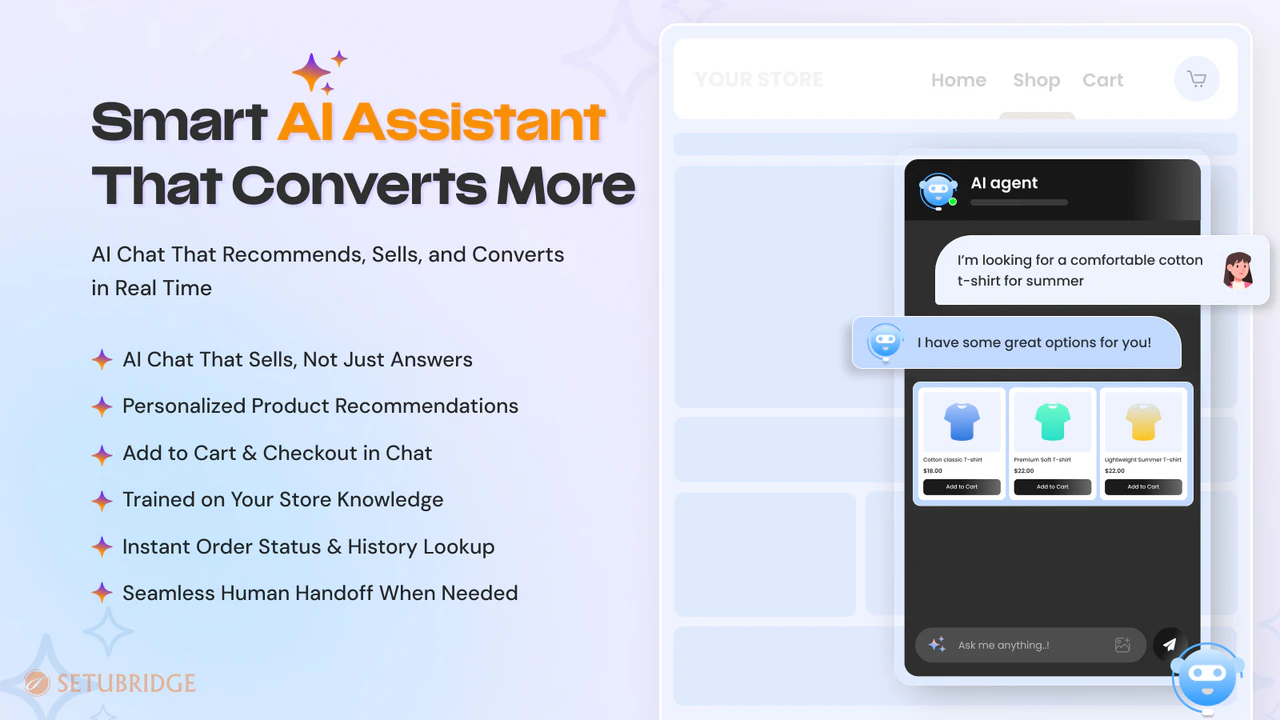
Real-Time Product Suggestions Within the Conversation
Unlike static recommendation widgets that sit passively on a page, an AI shopping assistant actively engages shoppers in dialogue. It responds to their questions, refines its understanding based on their answers, and delivers product suggestions that are contextually perfect, all in real time.
An AI shopping assistant for Shopify can handle hundreds of concurrent conversations without any degradation in response quality, giving every shopper the equivalent of a dedicated personal stylist or product advisor.
Guided, Conversational Shopping Experience
Befuddled or overwhelmed shoppers are sure-shot candidates for abandoned shopping carts. The AI chatbot can be the help they need without actually hiring someone to do it. Have a customer trying to decide which size of shirt works best for him? How about shopping for a gift? AI service is standing by 24/7.
AI-Powered Upselling During the Buying Journey
When is the optimal moment for upselling? The time immediately prior to and just after an acquisition decision is undeniably the most lucrative. An AI chatbot has the ability to identify such a moment and promote the appropriate upgraded features or additional services at the opportune moment without appearing overly aggressive or mechanical.
For instance, a buyer is interested in a camera. The AI chatbot will inform him: Excellent choice! Several photographers who buy this camera also buy a UV filter and a comfy carry bag. Should I add the bundle at a slight discount?” Same intelligent up-sell and cross-sell opportunity on Shopify.
Faster Support and Higher Engagement
An AI chatbot also lightens the burden on your customer support team by answering questions about shipping, returns, product fit, and availability, so your human agents can focus on fixing difficult problems while no shopper waits for the basics needed to make a purchase.
The Future of Shopify Product Recommendations
Hyper-Personalized Commerce
All of this is happening so fast, creating entirely personalized page layouts, shopping experiences, pricing, discounts, product ordering, and even the way stores look, that we are rapidly approaching a universe where everything about the shopping encounter is customized to the shopper, down to how the store appears to each shopper. The intelligent engines behind today’s real-time recommendations are the starting point for this hyper-personalized world.
According to Gartner in 2026, organizations that utilize AI will transfer 45% of their manual eCommerce processes to AI. This transformation will be led predominantly by personalization.
Voice and Conversational Commerce
Smart speakers and voice assistants will soon evolve into their own shopping channel: voice-activated product discovery (“Alexa, find me a good yoga mat under $40″) is entirely dependent on the intelligent recommendation infrastructure under development today. Its traders who adopt conversational AI now will be well set for the future.
Predictive Shopping: Recommendations Before the Search
The most sophisticated AI endeavors are already delivering shopping suggestions before the shopper walks through the door, the ultimate in predictive analytics. Predictive re-engagement email campaigns, push messages based on shopper cues, and pre-built shopping carts are all examples of technology already in the pipeline.
The destination the world where your store would hit the next customer need before they even know they had one. Nothing boosts your business’ loyalty rate like that. Not even a discount code or eye-popping flash sale.
Final Thoughts
Real-time product recommendations are no longer an exclusive feature for enterprise retailers. They are now an expected feature from today’s modern consumers and a validated revenue driver, no matter the size of the Shopify store.
The message couldn’t be clearer. Personalisation is effective. Artificial Intelligence learns. And shoppers, when confronted with a store that knows them, seldom wish to return to the generic.
Today’s most successful merchants in the hyper-competitive world of eCommerce are not just those with the best products or the lowest prices. They’re those with the most relevant, responsive, and human experiences. That’s how you’ll accomplish this at scale with AI-powered real-time recommendations.
If you haven’t moved past the static, identical recommendations for every visitor (which continues to cost you money daily), seeking out an AI-powered shopping assistant that melds ephemeral recommendations, intelligent upselling, and conversational help will probably be one of the highest ROI services you invest in your store:
The store of the future knows its customers. The time to build that store is now.
Frequently Asked Questions (FAQs)
Q1. What are real-time product recommendations in Shopify?
Real-time product recommendations are AI-generated suggestions that update instantly based on a shopper’s current browsing behavior, including clicks, searches, and cart activity, delivering highly personalized results in milliseconds.
Q2. How do AI product recommendations for Shopify increase sales?
AI recommendations increase sales by matching shoppers with the most relevant products at the right moment, reducing browsing friction, improving product discovery, and creating upsell opportunities that static systems cannot deliver.
Q3. What is the difference between upselling and cross-selling on Shopify?
Upselling encourages shoppers to buy a premium version of their chosen product. Cross-selling suggests complementary items. AI automates both strategies intelligently, using real behavioral data to time and personalize every suggestion.
Q4. Can small Shopify stores benefit from AI recommendations?
Absolutely. AI recommendation tools have become highly accessible and affordable for stores of all sizes. Even stores with modest traffic can see meaningful improvements in AOV, conversion rate, and customer retention from personalized recommendations.
Q5. How does an AI shopping assistant chatbot improve Shopify conversions?
An AI chatbot guides shoppers with personalized product suggestions through natural conversation, answers questions instantly, reduces abandonment, and enables intelligent upselling, all without human intervention and available around the clock.
Q6. How quickly can I implement AI product recommendations on Shopify?
Most quality AI recommendation apps integrate with Shopify in under 30 minutes, no coding required. The AI begins learning from your store’s data immediately and improves its recommendations as it collects more shopper behavioral signals.
Q7. What metrics should I track to measure AI recommendation performance?
Track click-through rate on recommendation widgets, revenue attributed to recommendations, average order value, cart abandonment rate, and conversion rate. Most AI apps provide built-in dashboards that report on all these metrics automatically.
Q8. Will AI recommendations work for niche or specialized Shopify stores?
Yes, in fact, niche stores often see the strongest results because AI can identify highly specific behavioral patterns within a focused product catalog, delivering recommendations that feel even more precise and personally relevant to shoppers.

Shopify Expert
Dipen Panchal, Shopify Tech Lead at Setubridge Technolabs, brings over a decade of expertise as a Shopify Expert. Passionate about e-commerce growth, he specializes in UI/UX design, crafting intuitive, engaging solutions tailored for merchants and B2B clients to enhance user experiences.