





Before shoppers buy, they want to know one thing: when will my order arrive? A message like “Ships in 3 to 5 business days” makes them do the math. Many guess, feel unsure, and leave before checkout. For Shopify store owners, that doubt turns into lost sales and more support emails.
A clear delivery date solves this before the shopper even reaches the cart. 73% of US shoppers say a visible delivery date shapes their purchase, and 40% won’t buy without one. That makes an estimated delivery date one of the simplest ways to build trust on a product page.
Key Takeaways
- A clear delivery date on the product page answers the shopper’s biggest question: “Will it arrive in time?”
- Both apps hold a 4.9-star rating, offer a free plan, and include a 7-day trial on paid plans.
- Estimated Delivery Date ‑ ETA supports more rule types, including tag, inventory, warehouse and shipping method rules.
- New stores can build product, collection, tag and vendor rules on its free plan, then move to unlimited views at $6.99/month.
- Corporate stores get warehouse ETAs, pickup ETAs, Shopify Plus checkout ETAs and a dedicated account manager on its $19.99 plan.
- S Estimated Delivery Date Plus carries the Built for Shopify badge and keeps pricing simple with one $6.99 plan.
- Accuracy beats speed, so set real processing times, cutoffs and holidays before you promise faster dates.
What Is a Shopify ETA App?
A Shopify ETA app calculates when an order should arrive and shows that date to shoppers. ETA means estimated time of arrival, and EDD means estimated delivery date. Shopify app listings use both terms for the same thing. The date can appear on product pages, the cart, checkout and order emails.
The app builds each date from a short chain of steps:
- Cutoff time: the latest time an order can be processed the same day.
- Processing time: the days you need to pick, pack or make the item.
- Transit time: the days your carrier needs to deliver.
- Blocked dates: weekends, holidays and days your team is closed.
- Delivery range: the final dates the shopper sees, such as “Arrives Tue to Thu.”
Here’s a simple example. A shopper orders at 3:10 p.m. on Wednesday, but your cutoff is 2 p.m. The app moves the order to Thursday, adds one processing day, then adds three to five transit days. It skips the weekend and shows a clear range on the product page.
One point matters before you choose an app. An ETA app shows a date your store calculates for the shopper. A delivery date picker lets shoppers choose a day or time slot instead. Pickers suit florists, bakeries and local grocers. Both apps in this guide are ETA apps.
The Real Cost of a Vague Delivery Message
“Ships in 3 to 5 business days” makes shoppers do math. Many guess, worry, and leave before checkout. 75.1% of shoppers say an EDD on the product page or cart makes them more likely to buy. A date removes that doubt at the exact moment of decision.
Shoppers who buy without a date often email you later. These “Where is my order?” messages are called WISMO tickets. They spike during Black Friday and December, right when your team is busiest. A date shown before purchase sets the expectation early and cuts those emails.
Late deliveries hurt even more than vague messages. 74% of consumers got a package later than its estimated date last year, and half are less likely to shop again. So your goal isn’t the fastest date on the page. Your goal is the most accurate date you can keep.
The US Rules Behind Delivery Promises
US stores have one more reason to get dates right. The FTC’s Mail, Internet, or Telephone Order Merchandise Rule covers shipping promises. You need a reasonable basis for any shipping time you state. If you can’t ship on time, you must tell the buyer and offer a refund option. Ask your advisor how the rule applies to your store.
Where Shopify’s Built-In Delivery Dates Stop
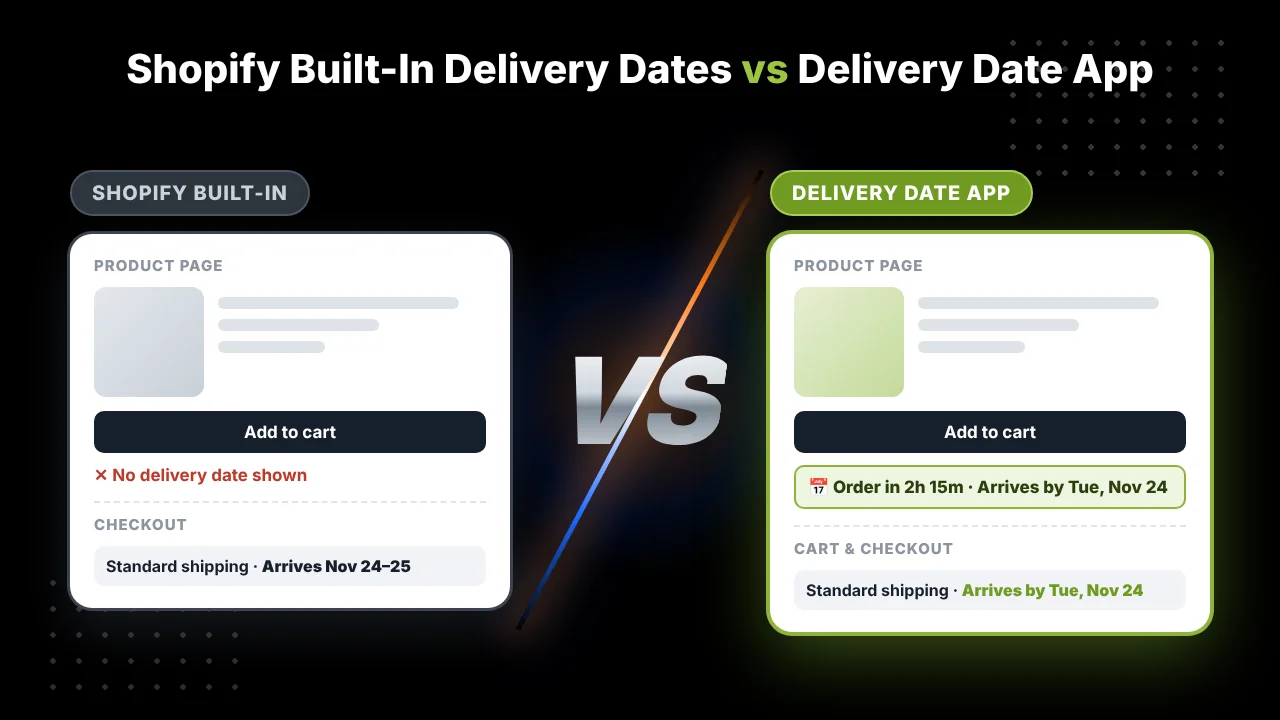
Shopify can show some delivery dates without an app. You can set processing time and delivery dates in your shipping settings, as Shopify’s delivery dates guide explains. These dates focus on checkout, and eligibility depends on your setup. Most stores still need product-page messages, product-level rules and a holiday calendar. That’s the gap an estimated delivery date app fills.
Meet the Two Shopify Estimated Delivery Date Apps
Estimated Delivery Date ‑ ETA
Estimated Delivery Date ‑ ETA by SetuBridge has been on the Shopify App Store since August 2020. It holds a 4.9-star rating from 520 reviews, and 472 of them are five stars. Its listing focuses on speed, large catalogs and heavy traffic. That matters for stores with thousands of products or big sale days.
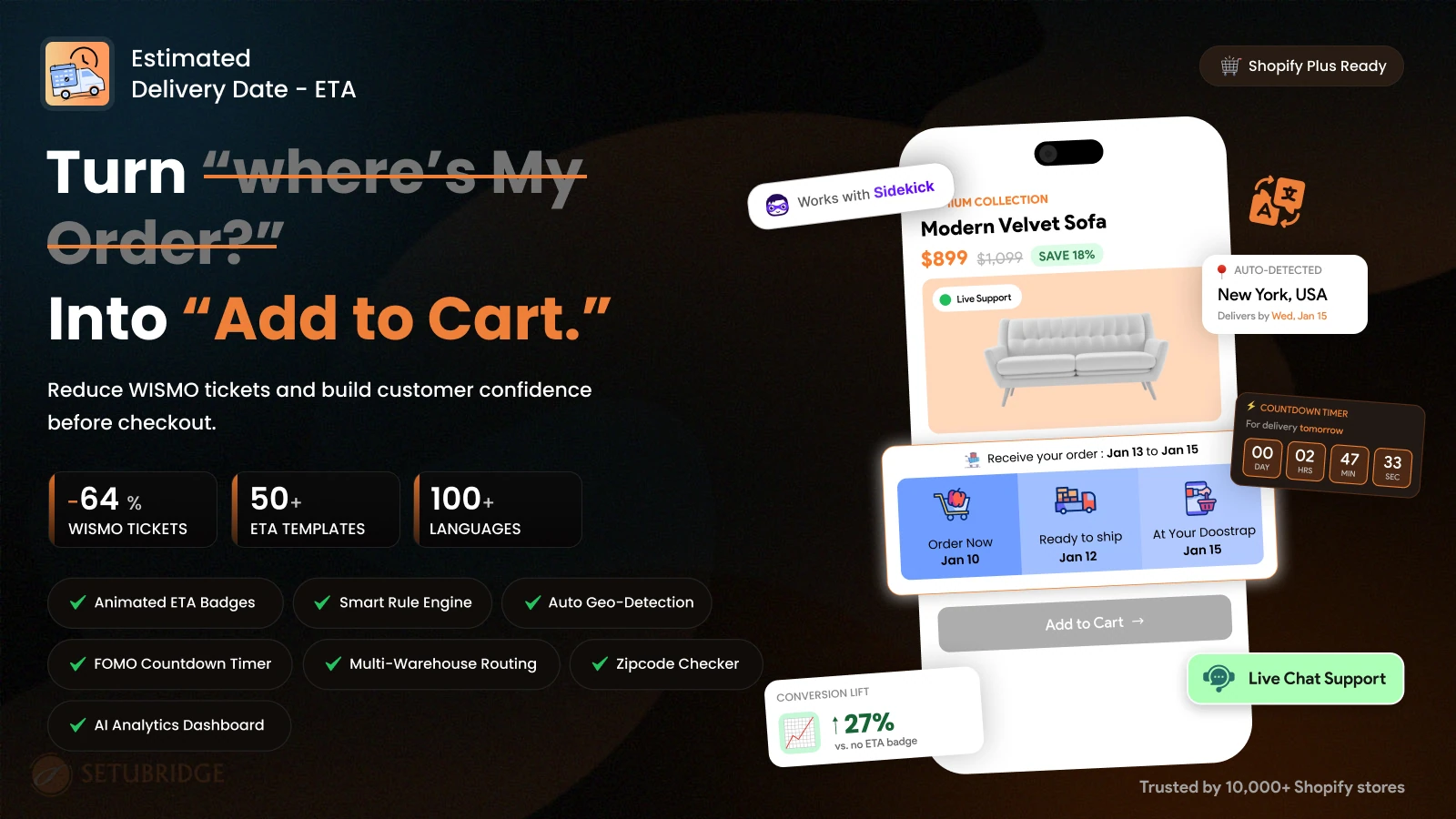
The app runs on a tiered rule engine. You can set rules by product, collection, tag, vendor, inventory, warehouse and shipping method. Plans grow from a free plan to 300 delivery rules, so the app grows with your catalog. It works with Judge.me, Loox, Trustoo and Sidekick AI, and its listing supports 11 languages.
S Estimated Delivery Date Plus
S Estimated Delivery Date Plus by Synctrack has been on the Shopify App Store since June 2018. It holds a 4.9-star rating from 461 reviews, with 96% at five stars. The app carries the Built for Shopify badge, which Shopify gives apps that meet its quality standards. Some merchants know it by its earlier Omega name.
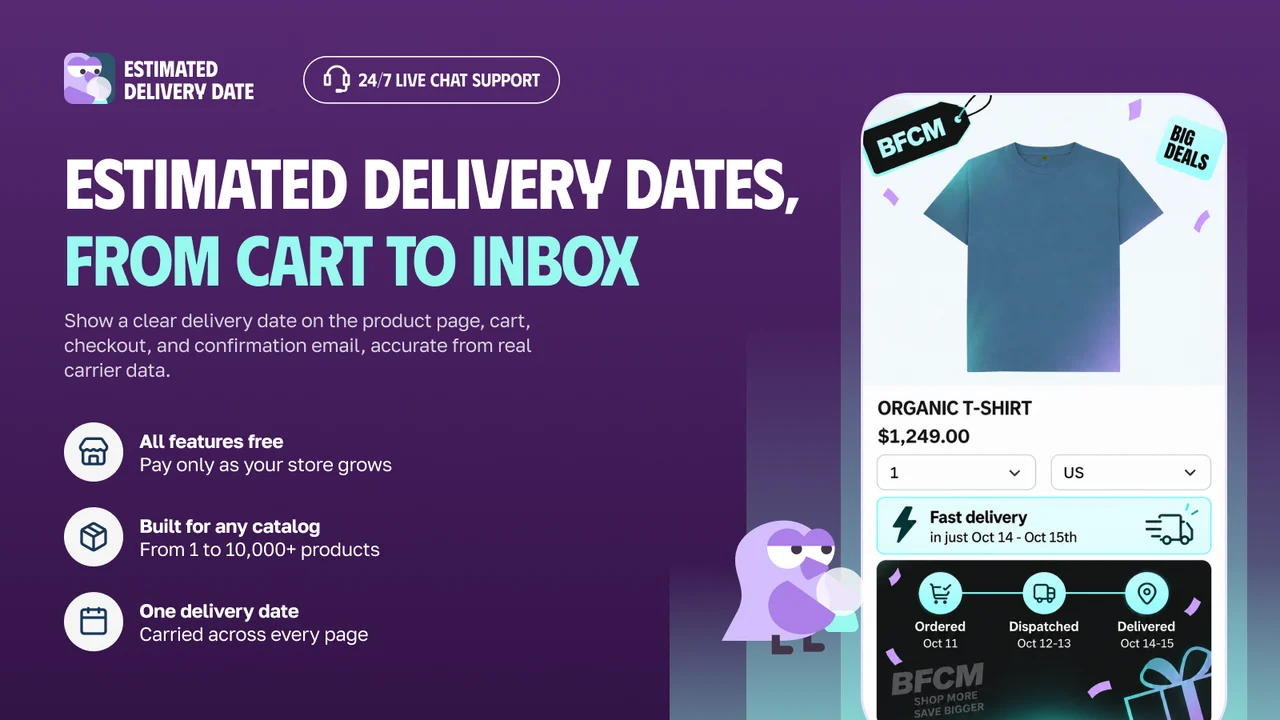
The app keeps pricing simple with a free plan and one paid plan. It supports rules by product, collection and vendor, plus estimates by shipping method, ZIP code and country. The paid plan adds carrier integration, location-based EDD and shipping protection. Its listing supports six languages and works with Shiprocket.
Quick Comparison: Estimated Delivery Date ‑ ETA vs S Estimated Delivery Date Plus
| Detail | Estimated Delivery Date ‑ ETA by SetuBridge | S Estimated Delivery Date Plus by Synctrack |
| On App Store since | August 2020 | June 2018 |
| Rating | 4.9 (520 reviews) | 4.9 (461 reviews) |
| Free plan | 100 ETA views, unlimited products, rules by product, collection, tag and vendor | Unlimited ETA views, 3 rules by product, collection or vendor |
| Paid plans | $6.99 per month | $6.99 per month |
| Lowest yearly price | $75.50 per year | $79.99 per year |
| Rule types | Product, collection, tag, vendor, inventory, warehouse, shipping method | Product, collection, vendor, shipping method, ZIP, country |
| Free templates | 30+ templates, 50+ animated on paid plans | Custom messages and renaming |
| Where dates appear | Home, collection, product, cart, checkout, order page, email | Home, collection, product, cart, checkout, order status, email |
| Shopify Plus checkout | Longest ETA and shipping ETA at checkout | ETA checkout extension |
| Listing languages | 11 | 6 |
| Extra support | Premium support, account manager, 1-on-1 onboarding | 24/7 live chat, priority support |
Prices are in USD as listed on November 23, 2026.
Pricing: What Each Shopify ETA App Costs as You Grow
Both apps start paid features at $6.99 per month. The difference is how features are grouped. Estimated Delivery Date ‑ ETA uses three paid plans, so you pay for the depth you need. S Estimated Delivery Date Plus puts its paid features into one plan.
| Monthly price | Estimated Delivery Date ‑ ETA | S Estimated Delivery Date Plus |
| Free | Lite: 100 ETA views, unlimited products, rules by product, collection, tag or vendor, 30+ templates, dates on cart, checkout, order page and email | Free: unlimited ETA views, 3 rules, dates on product, collection, home, cart, email and order status pages, 24/7 live chat |
| $6.99 | Startup: unlimited views, 15 rules, stock-status ETA, preparation time, holidays, multi-language, FOMO timer | All in One: unlimited rules, geolocation, translations, analytics, carrier integration, EDD by location |
| $14.99 | Growth: 50 rules, geo-detect by country, state or ZIP, ZIP checker, cart auto-update, analytics, premium support | — |
| $19.99 | Premium: 300 rules, warehouse ETA, Shopify Plus checkout ETA, in-store pickup ETA, account manager, onboarding | — |
Yearly billing lowers the cost on both apps. Estimated Delivery Date ‑ ETA Startup costs $75.50 per year, which saves 10%. Its Growth and Premium plans save 17% yearly. S Estimated Delivery Date Plus costs $79.99 per year and lists 25% off the first year for new users.
What a Typical Store Pays
The right plan depends on your store’s stage. This table shows the lowest listed plan that covers each common need.
| Store stage | Main need | Estimated Delivery Date ‑ ETA | S Estimated Delivery Date Plus |
| Testing a new store | One clear date on product pages | Free | Free |
| Steady sales, one warehouse | Holidays, cutoffs, stock-based dates | $6.99 Startup | $6.99 All in One |
| Selling coast to coast | Dates by state or ZIP code | $14.99 Growth | $6.99 All in One |
| Multi-warehouse or Shopify Plus brand | Warehouse, pickup and checkout ETAs with onboarding | $19.99 Premium | $6.99 All in One |
Shopify Plus stores should confirm the final price on the install screen. App pricing for Plus stores can differ from the standard listing.
Which App Fits a New Shopify Store?
New store owners juggle a lot at once. You’re adding products, testing ads and answering every email yourself. You need a delivery date that works now and grows later. You also need to avoid spending money before you have traffic.
Estimated Delivery Date ‑ ETA lets you build a full rule set on the free plan. You can set rules by product, collection, tag and vendor, and pick from 30+ templates. The live preview shows the result before shoppers see it. The free plan covers 100 ETA views, which suits setup and early launch weeks.
When traffic grows, the $6.99 Startup plan opens unlimited views. It also adds holidays, preparation time, stock-status dates and a countdown timer. Those are the settings that stop early WISMO tickets. Your rules carry over, so you don’t rebuild anything as you scale.
Which App Fits Corporate and High-Volume Stores?
Corporate stores face a different problem. You may have thousands of SKUs, several warehouses and a team that manages rules. A wrong date at scale means hundreds of support tickets. You need depth, control and someone to call.
Estimated Delivery Date ‑ ETA is designed for large catalogs and heavy traffic, according to its listing. The Premium plan includes 300 delivery rules, warehouse ETAs and in-store pickup ETAs. On Shopify Plus, it shows the longest ETA and shipping ETA at checkout. You also get a dedicated account manager and 1-on-1 onboarding for your team.
The Growth plan sits in the middle for brands that aren’t on Plus yet. It adds geo-detection by state or ZIP, a ZIP checker and an analytics report. Analytics help your team see which products and regions get the most date views. That data helps you tune rules before peak season.
When S Estimated Delivery Date Plus Is a Good Fit
S Estimated Delivery Date Plus suits stores that want one simple paid plan. Its $6.99 plan includes unlimited rules, geolocation, analytics and carrier integration. Its free plan has no limit on ETA views, which helps stores with steady traffic. It also includes shipping protection and 24/7 live chat support.
The Built for Shopify badge gives merchants extra confidence in the app’s quality. It has served Shopify stores since 2018. Stores with simple product groups and one fulfillment location can set it up quickly.
How to Add an Estimated Delivery Date to Your Shopify Store
Setup takes less time than most store owners expect. Use these steps with either app:
- Find your real numbers. Check your last 60 to 90 days of orders for processing days and carrier transit days.
- Install the app and turn on the app embed. Go to Online Store, then Themes, then Customize, then App embeds.
- Place the widget. Add the app block under the Add to cart button on your product template.
- Set your defaults. Enter your cutoff time, time zone, working days, processing time and holidays.
- Add rules for exceptions. Cover slow products, backorders, pre-orders, heavy items and distant states.
- Test before you go live. Preview on desktop and mobile, try a mixed cart, and test a distant ZIP code.
Check your dates against real deliveries for the first two weeks. Adjust processing or transit days where orders arrive early or late. Small changes here protect your reviews and repeat sales.
How to Know Your ETA Is Working
A delivery date should pay for itself in sales and saved time. Replacing a vague speed range with an accurate date lifted checkout conversion by about 13% to 25% in tested cases. Your results will vary, so track your own numbers. Compare four weeks before setup with four weeks after.
- Add-to-cart rate: shows whether shoppers feel confident on the product page.
- Checkout conversion rate: shows whether the date carries through to purchase.
- WISMO tickets: shows whether fewer shoppers ask about their order.
- On-time delivery rate: shows whether your promised dates match real arrivals.
Earlier dates can also lift sales when you can truly meet them. Moving the promised delivery date one day earlier improved conversion by 4%. Only shorten dates after your processing data proves you can keep them.
Conclution
Both apps help Shopify merchants show clear delivery dates and cut WISMO tickets. The better choice depends on your catalog, your locations and your growth plans.
For most new and corporate stores, SetuBridge’s Estimated Delivery Date ‑ ETA covers more of the workflow. New stores can build detailed rules and pick from 30+ templates on the free plan. Growing stores get stock-status dates, holidays and preparation time at $6.99. Corporate and Shopify Plus brands get warehouse ETAs, pickup ETAs, 300 rules and hands-on onboarding.
S Estimated Delivery Date Plus by Synctrack fits stores that want one simple plan with geolocation. It carries the Built for Shopify badge and offers unlimited ETA views on its free plan. Both apps offer a 7-day trial, so test your top need on a preview theme. Then set realistic dates before your next sale season.
FAQs
Which Shopify ETA app is better for a new store?
Estimated Delivery Date ‑ ETA suits most new stores that want detailed rules from day one. Its free plan includes product, collection, tag and vendor rules plus 30+ templates. You can move to unlimited views for $6.99 per month as traffic grows.
Which app works best for multi-warehouse or Shopify Plus stores?
Estimated Delivery Date ‑ ETA lists warehouse ETAs, pickup ETAs and checkout ETAs on its $19.99 Premium plan. That plan also includes 300 rules, a dedicated account manager and 1-on-1 onboarding.
Can I show different delivery dates by US state or ZIP code?
Yes, both apps support location-based dates. Estimated Delivery Date ‑ ETA lists geo-detection and a ZIP checker on its $14.99 Growth plan. S Estimated Delivery Date Plus includes geolocation in its $6.99 plan.
Does Shopify show estimated delivery dates without an app?
Shopify can show some delivery dates at checkout, based on your shipping settings and eligibility. Most stores add an app to show dates on product pages with product rules and holidays.
Can I show a different date for out-of-stock or pre-order items?
Yes. Estimated Delivery Date ‑ ETA lists stock-status ETAs on its $6.99 Startup plan. In-stock and out-of-stock variants can then show different dates on the same page.
Do both apps offer a free trial?
Yes, both apps offer a free plan and a 7-day free trial on paid plans. Test your main use case on a preview theme before you go live.
SetuBridge, the maker of Estimated Delivery Date ‑ ETA, published this comparison. App details come from public Shopify App Store listings, checked on November 23, 2026.

Shopify Expert
Dipen Panchal, Shopify Tech Lead at Setubridge Technolabs, brings over a decade of expertise as a Shopify Expert. Passionate about e-commerce growth, he specializes in UI/UX design, crafting intuitive, engaging solutions tailored for merchants and B2B clients to enhance user experiences.